
Most people picture the Schengen visa process as a pile of paperwork waiting for a consulate’s verdict. For many Lebanese travelers, the harder part comes earlier. It is getting a Schengen visa appointment in Beirut at all, with the right office, in the right window, before the trip you have already half-planned runs out of time.
This guide walks through the booking itself: who actually takes your application, when to book, how the process works step by step, and what to have ready on the day. If you want the full document requirements first, our Schengen visa guide for Lebanese travelers covers them. Here we stay focused on the appointment, because that is where good trips quietly go wrong.
Why the Schengen visa appointment in Beirut is the real bottleneck?
A complete file does nothing until someone accepts it. Your passport, photos, insurance and bank statements all wait on a calendar slot, and slots are not distributed evenly across the year. Demand tends to rise before the summer months and before year-end holidays, and the same applies when families try to book around school breaks.
The practical consequence is simple. Treat the appointment as the first milestone of your trip, not an afterthought once flights and hotels are chosen. Travelers who book flights first often discover that the earliest available slot, plus processing time, lands after their departure date. Nobody wants to explain that to an airline.
Consider a family of four planning ten days across Italy and Spain in July. The parents think of it as a “July trip.” In reality it is a set of dates working backwards: departure in mid-July, a decision needed several weeks before, an appointment needed before that, and documents prepared before that. Laid out like this, the real start date is spring, not June. That is an illustration rather than a client story, but it matches how the calendar behaves for almost everyone.
First, decide which country receives your application
You do not apply to “Schengen” as a whole. You apply to one country’s consulate, and that choice decides where you book. The general rule is that you apply to the country where you will spend the most nights. If your nights are split equally, you apply to the country of first entry.
This sounds trivial until a trip crosses several borders. A route through France, Switzerland and Italy might feel balanced, yet one of those countries will quietly have the most nights on your itinerary, and that is the one your Schengen visa application belongs to. Applying to the wrong country is a common reason files are returned or questioned. We unpack the logic, with examples, in our guide on which Schengen country to apply to from Lebanon.
Make this decision before you open any booking page. Everything that follows depends on it.
Who actually handles your Schengen visa appointment in Beirut
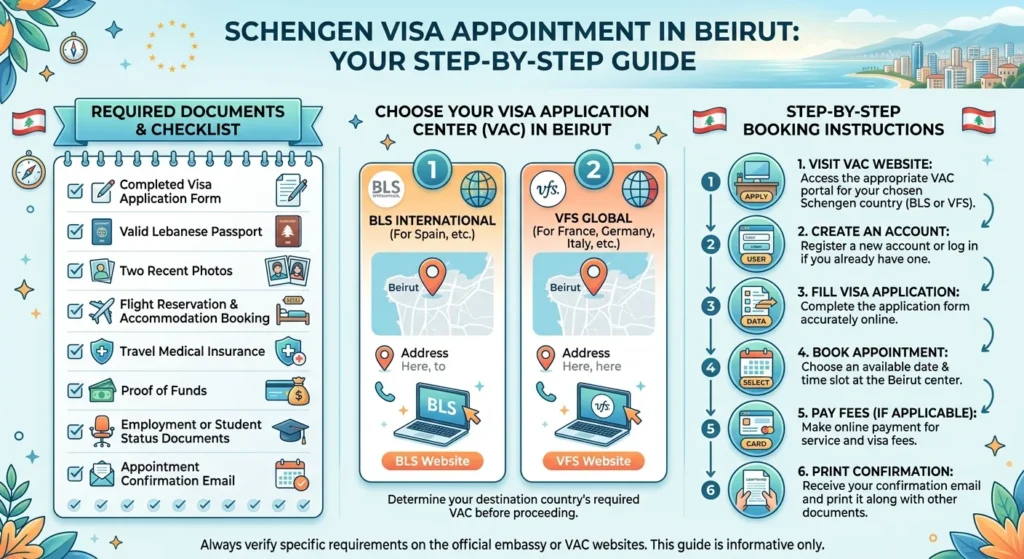
Here is where travelers get confused. Depending on the country, your Schengen visa appointment in Beirut may be taken by the embassy or consulate itself, or by an external visa application centre working on that country’s behalf. These centres collect documents and biometrics, but they do not decide your visa. The embassy does.
From the public pages we reviewed, Spain’s short-stay visa process in Lebanon runs through BLS, and Italy’s tourism document list is published through TLScontact for Beirut. Other countries use their own embassy channels or different providers, and arrangements can change. Treat any list you read online, including this one, as a starting point rather than a rule. The reliable move is to open your destination country’s embassy page for Lebanon and follow the link it gives you for appointments.
Three habits keep you safe here:
- Book only through the link published on the embassy or consulate’s own website.
- Ignore unofficial “fast slot” offers from third parties who are not the centre or your agent.
- Check that the fees you are shown match what the embassy page lists, including any service fee.
If a page looks like the right place to book but is not linked from the embassy site, pause and verify before entering passport details.
When to book your Schengen visa appointment
The Schengen rules allow you to apply up to six months before your planned trip. Visa centres commonly state that applications must be lodged at least 15 days before travel. Those two numbers define your window. The smart zone sits well inside it.
For most trips, aim to secure your Schengen visa appointment between roughly three and four months before departure when you can. That gives you room for a slot that is not the first one offered, a second attempt if a document is missing, and processing time that sometimes stretches. Our guide on Schengen visa processing time from Lebanon explains how long the decision itself can take, and why you should never plan to the last day.
A few timing details deserve attention:
Do not buy non-refundable tickets before approval. Most consulates ask for a flight reservation or itinerary, not a paid ticket. A refundable booking or a reservation that can be cancelled is the safer choice.
Check your travel dates against the application window. If your trip is more than six months away, you simply cannot book yet, however early you start looking. Set a reminder for the day your window opens.
Plan for peak seasons. Summer and the pre-holiday weeks fill first. If your trip sits in those periods, start looking for a slot as early as the rules allow.
Dates and rules differ slightly by country, so confirm the exact window on the relevant embassy or centre page.
How to book your Schengen visa appointment: step by step
Step 1: Confirm your destination country and trip dates
Write down your itinerary with nights per country, then identify the country of main stay. This is your application country. Keep the dates handy, because the booking form will ask for them.
Step 2: Find the official booking page
Go to the embassy or consulate website for that country in Lebanon and look for the visa section. It will either take appointments directly or direct you to a visa centre. Use that link, not a search result you cannot trace back.
Step 3: Create your account and check the document list
Most booking systems require an account before showing slots. While you are there, download the document checklist for your visa type. Tourism, business and family visits each have slightly different requirements, so make sure you choose the right category.
Step 4: Choose your slot and pay any fees due
Select a date that leaves room for mistakes. A slot two days before you need the decision is not a plan. Pay the fees through the official channel and save the confirmation. The Schengen visa fee for adults has been €90 since 2024, with lower rates for children, plus a separate service fee charged by many centres. Fees change, so check the current amount on the booking page.
Step 5: Print and organise your file
Bring originals and copies in the order the checklist gives. Put the appointment confirmation on top. A tidy file helps the officer and saves you from fumbling at the counter.
What to prepare before your appointment
The appointment is not the time to discover that your passport has expired. The documents below come up for almost every applicant, though each embassy has its own full list:
- A passport valid beyond your planned departure from the Schengen area, with enough blank pages and issued within the last ten years.
- Recent photos that meet the biometric photo standard.
- Travel medical insurance covering the whole stay, with at least €30,000 in coverage.
- Proof of accommodation and a realistic itinerary.
- Evidence of funds and of your ties to Lebanon, such as employment or business documents.
Financial proof causes more refusals and delays than almost anything else, so give it extra care. We cover what consulates look for in our upcoming guide to Schengen visa financial proof, and the broader reasons applications fail are explained in common visa rejection reasons. If you still need coverage, see travel insurance requirements for visa applications.
Remember that the checklist for your specific consulate always overrules a general summary.
What happens at your Schengen visa appointment?
Expect a short visit. Staff check that your documents match the list, take your fingerprints and a digital photograph the first time you apply, and take your fee. Biometric data is stored in the EU visa system, and for later applications you may not need to give fingerprints again within the validity period of the stored data. The embassy will tell you what applies to you.
After submission you receive a receipt or tracking reference. Keep it somewhere you can find it. Your passport stays with the processing office until a decision is made, so do not schedule any other trip needing that passport during the wait. When the decision arrives, you collect your passport or receive it as the centre’s process allows.
The officer at the counter usually does not decide your visa and often will not discuss your chances. Do not read anything into a quiet appointment.
Mistakes that cost Lebanese applicants time
Booking with the wrong country. Choosing the embassy that feels easiest rather than the one that matches your itinerary can lead to returned files.
Using the first slot without checking the date. A slot that arrives after your intended departure date helps nobody.
Arriving with incomplete financial evidence. A bank statement that doesn’t tell a clear story invites questions. Sponsors, salary letters and account history should line up.
Forgetting insurance details. The insurance must cover the entire stay and the whole Schengen area. A policy that starts a day late is a problem.
Booking through unofficial intermediaries. Pay only through the channel the embassy lists. A trusted agent can guide you, but they should never ask you to hand over account credentials or pay a mystery fee.
Booking for families, groups and business travelers
Each applicant needs their own appointment and file, children included, although families are often scheduled together. Our guide on Schengen visa documents for families lists what children and parents each need, and our guide on traveling with children from Lebanon covers consent letters and departure paperwork.
Business travelers face a different set of documents, including invitation letters and company papers, which we address in a dedicated guide on the Schengen business visa from Lebanon. If your trip combines leisure and business, tell the embassy plainly and apply under the category that fits the main purpose.
Frequently asked questions
Generally up to six months before your travel date. Some centres release slots only for dates inside that window, so if you cannot see an appointment for a trip further away, that is expected rather than a technical fault.
You can, using the official link on the embassy or centre website, or you can ask a travel agent to guide you through the process. Whichever route you pick, the appointment is in your name and you attend in person for biometrics.
Many centres allow rescheduling through your account, sometimes with limits or deadlines. Read the cancellation terms when you book and note whether fees are refundable, because policies differ by country and provider.
Check the booking page at different times, since cancellations release slots. Review whether your trip could realistically be assigned to another Schengen country only if your itinerary truly supports it. Never invent an itinerary just to get an earlier slot, because inconsistencies between your documents and your plan are a risk in themselves.
Yes, at least for the first application, because fingerprints and a photograph are collected in person. The embassy will confirm what applies to you for later applications.
Ready to book without the guesswork?
A well-timed Schengen visa appointment makes the rest of your trip easier. If you would like a second pair of eyes before you submit, Fayad Travel’s visa team can review your file, help you choose the right application country and flag gaps before your slot, so you spend the appointment submitting rather than scrambling. Ask Fayad Travel to review your file before your appointment, or read next about which Schengen country to apply to from Lebanon.
Visa rules, fees and booking providers change. Always confirm current requirements on the official embassy or visa-centre website before you apply.