
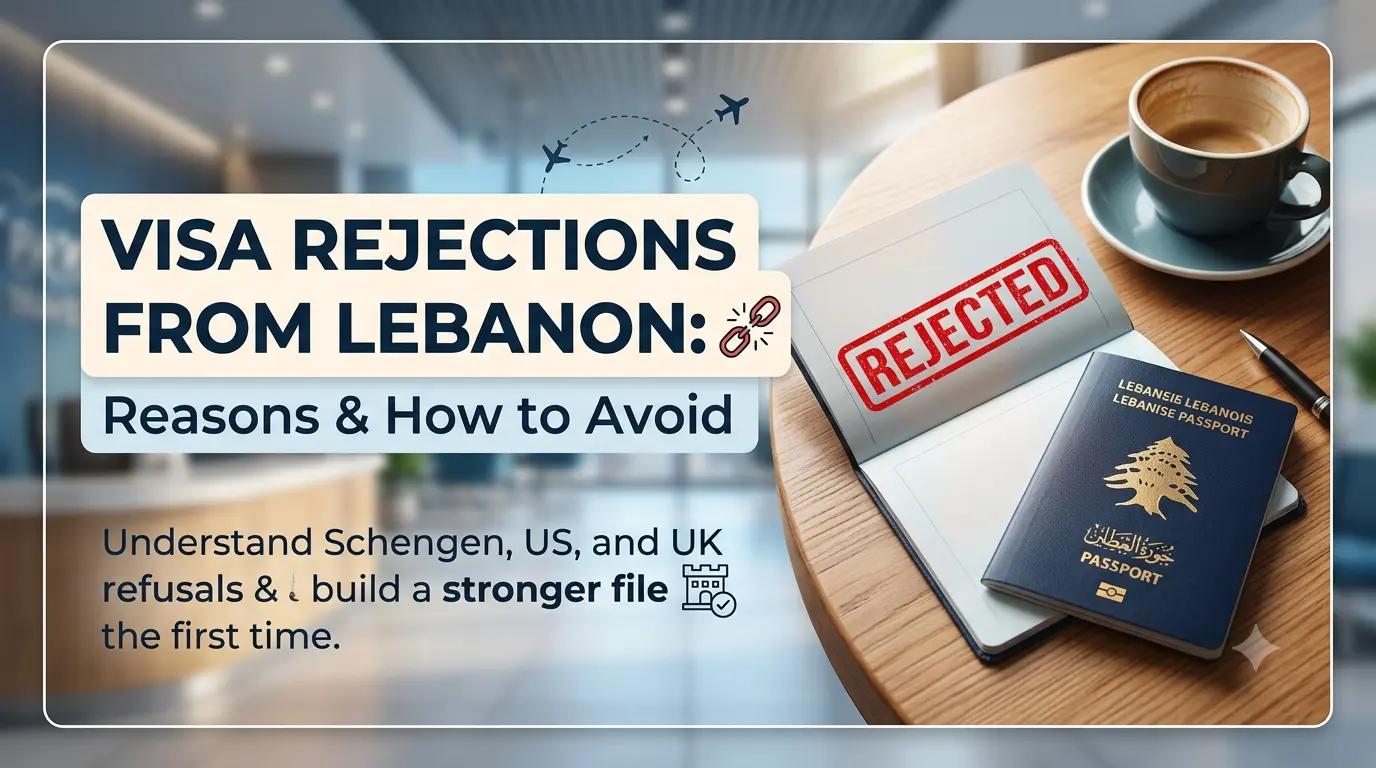
A visa rejection rarely comes down to one dramatic mistake. It’s almost always a handful of small, avoidable gaps — a bank statement that doesn’t quite match the stated purpose of the trip, an employment letter that reads as vague rather than specific, a travel insurance policy that misses one technical requirement by a small margin. Consular officers aren’t looking for reasons to say no; they’re looking for a complete, internally consistent picture, and it’s surprisingly common for genuinely legitimate travelers to submit a file that just doesn’t tell that story clearly enough.
For Lebanese applicants specifically, the numbers make the stakes concrete: Schengen states rejected 19,463 out of 115,890 visa applications from Lebanon in 2024 — a 16.79% rejection rate, moderately above the global Schengen average of around 14.8%. That means roughly one in six Lebanese applicants who apply for a Schengen visa is turned away, most often for reasons that were fixable before the application was ever submitted.
Why Rejection Rates Vary So Much by Destination and Consulate?
Rejection isn’t uniform even within a single visa category. Among Schengen states, Belgium’s non-issuance rate for Lebanese applicants ran as high as 55.48% in 2024, while Bulgaria approved the overwhelming majority of its (smaller volume of) applications. This spread isn’t random — it reflects each consulate’s own risk tolerance, the volume and type of applications it typically receives, and how strictly it interprets the same underlying requirements. The practical takeaway isn’t that some countries are “easier” in a way worth gaming — a mismatched application submitted to a lenient consulate can still fail — but that consistency and completeness matter more than which specific country you’re applying to.
The Most Common Reasons Applications Get Rejected
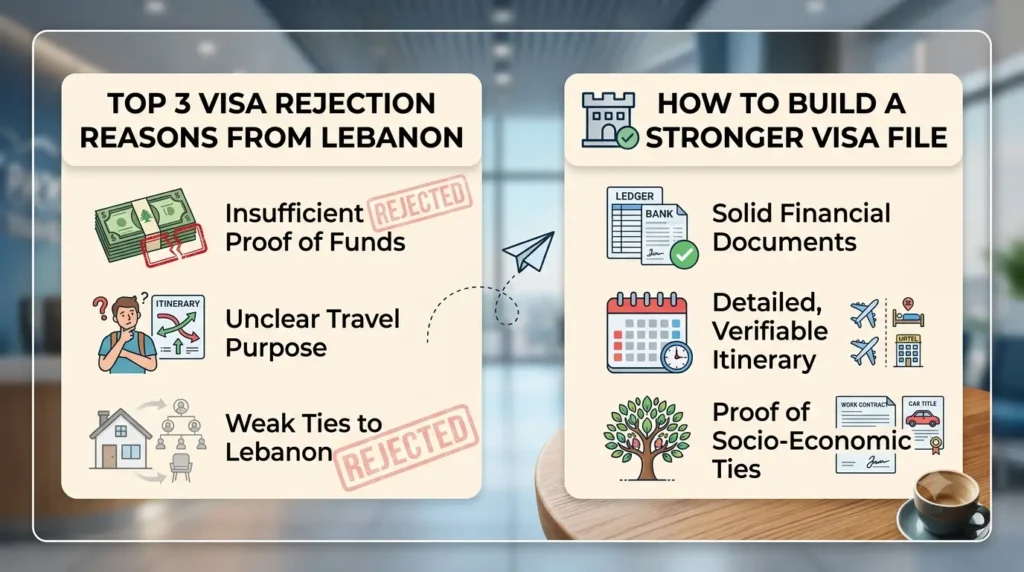
Weak or Unclear Ties to Lebanon
This is the single biggest driver of refusals across nearly every visa category, from Schengen to US B1/B2 to UK visitor visas. Consular officers are assessing “non-immigrant intent” — evidence that you have compelling reasons to return home rather than overstay. Stable employment, property ownership, family responsibilities, and an ongoing business are the strongest signals here. A vague employment letter, a recent job change with no clear explanation, or an applicant with no visible ties beyond a passport all read as risk factors, even when the person has every intention of returning.
Insufficient or Inconsistent Financial Documentation
Bank statements that don’t align with the applicant’s stated income, large unexplained deposits shortly before applying, or account balances that don’t plausibly cover the trip’s cost are consistent refusal triggers. It’s not about having a large balance — it’s about the numbers telling a coherent story that matches the rest of the application.
Incomplete or Incorrect Documentation
This sounds basic, but it’s genuinely common: a missing signature, an expired supporting document, a form filled out with a typo that doesn’t match the passport, or a required document simply left out. Consulates process high volumes of applications and don’t typically request missing items before deciding — an incomplete file is often just refused outright.
Travel Insurance That Falls Short of Requirements
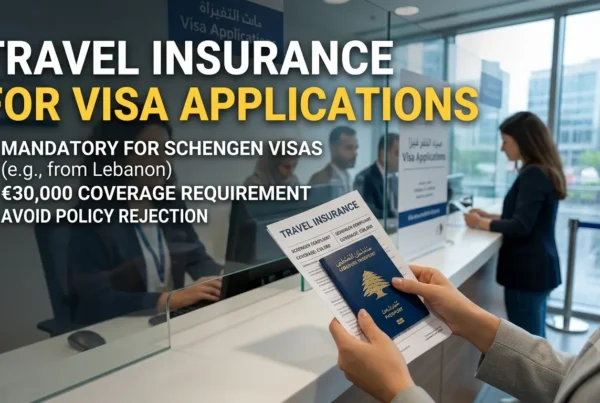
For Schengen applications specifically, this is a frequent and entirely avoidable rejection reason. A policy with a deductible, coverage below the €30,000 minimum, or restriction to a single country rather than the full Schengen area will be rejected regardless of how strong the rest of the application is. Since insurance is one of the more mechanical requirements — pass or fail, not a judgment call — it’s one of the easiest categories to get wrong through simple oversight and one of the easiest to get right with a quick check.
Inconsistencies Between the Application and Supporting Documents
Dates that don’t match between the application form and supporting letters, a stated purpose of travel that doesn’t align with the documents provided, or travel history that contradicts what’s declared — these inconsistencies invite deeper scrutiny and often result in refusal even when each individual document, viewed alone, looks fine.
Previous Immigration History
A prior overstay, a previous visa refusal from the same country, or a documented immigration violation elsewhere weighs heavily on a new application. This doesn’t make approval impossible, but it does mean the rest of the file needs to work harder to address what changed since the previous incident.
Applying at the Wrong Consulate or Missing Jurisdiction Rules
For Schengen applications, applying through the consulate of a country that isn’t your main destination is a straightforward, avoidable rejection — one that has nothing to do with the strength of your documentation and everything to do with a procedural rule.
How to Strengthen an Application Before You Submit It?
The single highest-leverage habit is treating the application as a coherent narrative rather than a checklist to complete. Every document should support the same story: who you are, why you’re traveling, what ties you to Lebanon, and why you’ll return. A few concrete practices help:
- Match your documents to your actual situation rather than a generic template — a self-employed applicant’s file should look different from a salaried employee’s, and trying to force one mold onto the other creates inconsistencies.
- Address anything unusual proactively. A recent job change, a large deposit, or a prior refusal doesn’t have to sink an application, but ignoring it and hoping it goes unnoticed usually backfires. A short, honest cover letter explaining context can preempt a consular officer’s question.
- Apply with margin, not against a deadline. Rushed applications are more likely to contain the small errors — missing signatures, mismatched dates — that account for a meaningful share of rejections.
- Verify the mechanical requirements exactly, especially travel insurance minimums and validity periods, since these are pass/fail checks rather than areas of judgment.
What Happens After a Rejection?
For Schengen refusals, the consulate is required to provide written grounds for the decision, and applicants generally have a formal right to appeal within a set window — commonly around one month, though this varies by country. For US B1/B2 refusals, there’s no formal appeal process, but there’s also no waiting period before reapplying.
In either case, the single most important factor in a stronger second attempt is demonstrating what’s actually changed since the refusal. Reapplying with an identical file rarely produces a different outcome — a consular officer isn’t reconsidering the same evidence, they’re looking for new evidence. New employment, a documented change in financial circumstances, a more specific and well-supported itinerary, or a direct response to whatever reason was cited in the original refusal all meaningfully improve a reapplication’s odds.
A Note on UK Visitor Visa Refusals
UK visitor visa refusals for Lebanese applicants follow a similar pattern to Schengen and US cases, with one added wrinkle: UK Visas and Immigration places particular weight on a detailed, credible account of the specific purpose and itinerary of the trip, not just proof of funds and ties to Lebanon. A generic “tourism” application with a thin itinerary is more likely to draw scrutiny than one that lays out specific plans, bookings, and a clear return date. Unlike Schengen refusals, UK decisions come with a formal right of administrative review in some visa categories, though visitor visa refusals typically don’t carry a right of appeal — reapplication with a stronger file is usually the more practical path forward.
A Quick Self-Check Before You Submit
Running through a short list of questions before submitting can catch the majority of avoidable rejection triggers:
- Does every date across the application form, employment letter, and bank statements match exactly?
- Does the stated purpose of travel match the supporting documents — an invitation letter for a business trip, a hotel booking for tourism, an enrollment letter for education?
- Does the travel insurance policy meet the specific technical minimums for the destination, not just “some” coverage?
- If anything about the application is unusual — a career gap, a large recent deposit, a previous refusal — has it been addressed directly rather than left for the officer to notice and question unprompted?
- Is the passport valid well beyond the minimum required period, with enough blank pages?
None of these questions require legal expertise to answer honestly, and running through them before submission catches a meaningful share of the errors that lead to an otherwise avoidable refusal.
Frequently Asked Questions
Weak or unclear evidence of ties to Lebanon — the consular officer’s assessment of whether an applicant is likely to return home — is consistently the leading cause across Schengen, US, and UK applications.
In 2024, Schengen states rejected 16.79% of applications from Lebanon (19,463 out of 115,890), somewhat above the global Schengen average of roughly 14.8% that year.
Yes. Consulates are required to provide written grounds for refusal, and applicants generally have a formal right to appeal within a set window — commonly around one month, though this varies by the specific consulate.
It’s a factor consular officers weigh, but it isn’t disqualifying on its own. A stronger follow-up application should directly address what changed since the refusal rather than resubmitting the same documentation.
No agency can influence a consular officer’s decision or guarantee approval, but a experienced advisor can review a document file for the specific gaps — insurance minimums, financial documentation, consistency issues — that most commonly cause refusals, before the application is ever submitted.
Have your documentation reviewed before you apply — request a tailored quote from Fayad Travel and get expert eyes on your visa file.