
Search “Lebanese passport visa-free countries” and you’ll find plenty of lists — most of them recycled from year to year, several of them already out of date. The Lebanese passport currently ranks 90th globally on the 2026 Henley Passport Index, with visa-free or visa-on-arrival access to 43 countries and territories. That’s the headline number. What actually matters for planning a trip is the detail underneath it — because “visa-free,” “visa on arrival,” and “eVisa” are three genuinely different experiences, and mixing them up is how travelers end up stuck at a check-in counter.
This guide breaks down all three categories with the current list for each, flags a recent policy change worth knowing about, and explains what to double-check before you book.
Where the Lebanese Passport Stands Globally?
Lebanon’s 90th-place ranking sits in a country that has moved around meaningfully over the past two decades — it held 79th place back in 2006, dropped as low as 102nd around 2015, and has hovered in the high-80s to low-90s range since. Regionally, it ranks among the more restricted GCC-adjacent passports; Qatar, Kuwait, and Saudi Arabia all currently offer their citizens broader visa-free access. That context matters mainly for expectations — a Lebanese passport won’t open every door the way a Gulf or European passport might, but the 43 accessible destinations span every inhabited continent and include some genuinely excellent travel.
Three Categories, Not One List
True Visa-Free Entry
This is the simplest category: no visa, no pre-approval, no online application. You show up with a valid passport (and sometimes a return ticket or proof of funds) and you’re in. Current true visa-free destinations for Lebanese passport holders include:
- Turkey — 90 days within any 180-day period
- Georgia — up to 1 year, though mandatory medical insurance for the stay applies
- Jordan — 3 months within 6 months
- Iraq — 30 days (Lebanese citizens can even enter using just a national ID card, no passport required)
- Syria — 180 days, free of charge
- Iran — 30 days within 180 days
- Malaysia — 90 days within 180 days
- Egypt — 90 days, though conditions apply depending on entry point
- Haiti — 3 months within 6 months
- Ecuador — 90 days within 180 days
- Suriname — 90 days, though a USD 50 entry fee is paid online prior to arrival
- Rwanda — 30 days
- Dominica — 21 days within 180 days
- Barbados — 90 days
- Micronesia — 30 days within 180 days
- Tajikistan — for travelers over 55 only, up to 60 days
Visa on Arrival
Here, you still need a visa — but you get it at the border or airport rather than applying in advance. This category splits further into free and paid arrivals, and a few require a pre-arrival “entry authorization” letter even though the stamp itself happens on arrival:
- Maldives — free visa on arrival, 30 days
- Palau — free visa on arrival, 30 days
- Mauritius — visa on arrival, 60 days (business) or up to 180 days (tourism)
- Timor-Leste — visa on arrival, 30 days, air arrivals only
- Comoros — visa on arrival, 45 days
- Guinea-Bissau — visa on arrival, 90 days
- Marshall Islands — visa on arrival, 90 days
- Tuvalu — visa on arrival, 1 month
- Samoa — entry permit on arrival, 90 days
eVisa Destinations
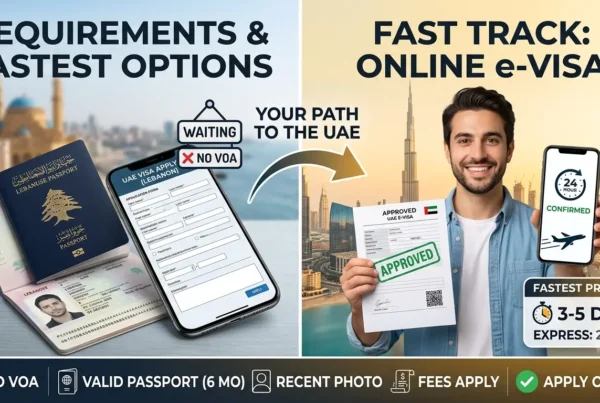
The largest and fastest-growing category. You apply online before departure, receive an approval, and typically must print it to present at check-in and on arrival — but you never set foot in an embassy or consulate. Popular eVisa destinations for Lebanese travelers include:
- Thailand — 60 days
- Vietnam — 90 days, multiple entry
- Indonesia — 60 days
- Kenya — Electronic Travel Authorisation, 90 days
- Uganda — 3 or 6 months depending on the fee tier
- Sri Lanka — ETA or visa on arrival, 30 days
- Armenia — eVisa or visa on arrival, 120 days
- Cambodia — eVisa or visa on arrival, 30 days
- Ethiopia — eVisa or visa on arrival, up to 90 days
- Nepal — online visa or visa on arrival, 90 days
- Sierra Leone — eVisa or visa on arrival
This is also where most of the “visa-free” confusion online comes from — an eVisa is genuinely quick and doesn’t require an in-person appointment, but it is still a visa, and it still requires action before you fly.
A Recent Change Worth Flagging: Qatar
Older “Lebanese passport visa-free” lists still circulating online list Qatar’s visa-on-arrival as available. As of April 1, 2026, Qatar temporarily suspended visa-on-arrival for Lebanese citizens. If a list you’re reading doesn’t mention this, it’s a good sign the content hasn’t been refreshed recently — and it’s exactly the kind of detail worth confirming directly with the destination country’s immigration authority before booking, since “temporary” suspensions can run for a while or reverse with little notice.
This is the general lesson worth taking from any visa-free list, including this one: policies shift with diplomatic relationships, security assessments, and reciprocal agreements. A country that was visa-free last year can add a requirement, and vice versa — Egypt, for instance, moved toward easier Lebanese access via specific entry points in recent years after previously requiring more paperwork. Treat any list, including this one, as a strong starting point rather than the final word — and confirm current requirements directly with the destination’s embassy or an official government portal before finalizing bookings.
What “No Visa Required” Doesn’t Mean?
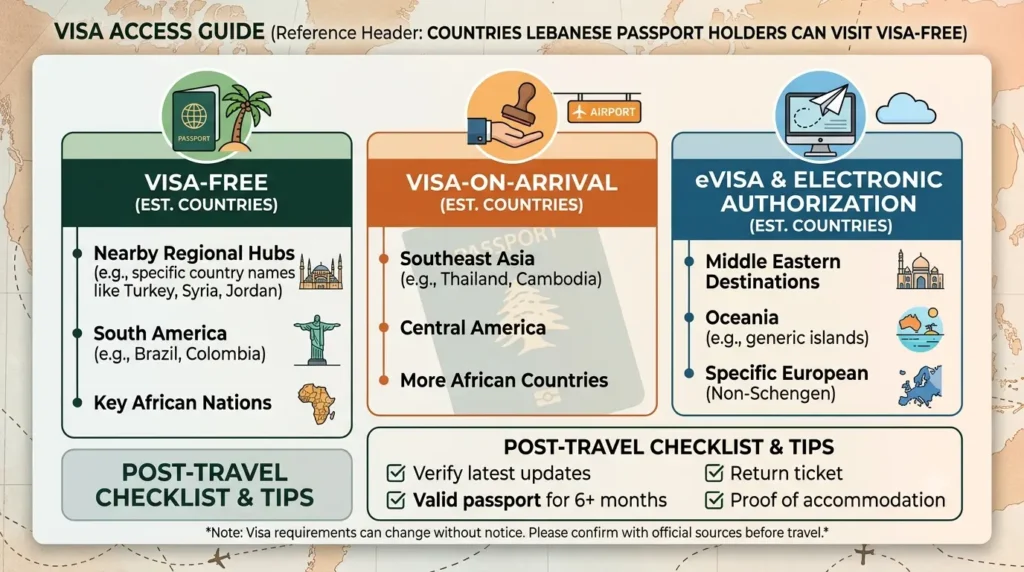
Visa-free or visa-on-arrival access isn’t the same as unconditional entry. Several of the destinations above carry conditions worth knowing before you pack:
Onward or return tickets and proof of funds. Many visa-free destinations still expect evidence you’re not planning to overstay — a return flight booking and visible financial means are commonly requested at the border even where no visa was required.
Passport validity windows. A large share of destinations worldwide — including several on this list — require your passport to remain valid for a minimum period beyond your departure date, commonly three to six months. This applies regardless of whether the destination itself required a visa.
Mandatory insurance. Georgia’s visa-free stay explicitly requires medical insurance covering the full duration. This is easy to overlook precisely because there’s no visa application process to prompt you to check.
Entry point restrictions. Egypt’s conditional visa-free access, for example, depends partly on where and how you arrive — a detail that a simple “visa-free: yes/no” table won’t capture.
Building a Trip Around Visa-Free Access
For Lebanese travelers who want to minimize documentation friction — a spontaneous long weekend, a trip planned on short notice, or simply a preference for less paperwork — sequencing an itinerary around this list rather than fighting a visa timeline can meaningfully change how a trip gets planned. Georgia’s year-long visa-free window, for instance, makes it a strong base for a longer regional trip through the Caucasus. Turkey’s 90-day allowance pairs naturally with a longer Mediterranean or Aegean itinerary. Malaysia’s visa-free access opens up a Southeast Asia route without the eVisa lead time that neighboring destinations require.
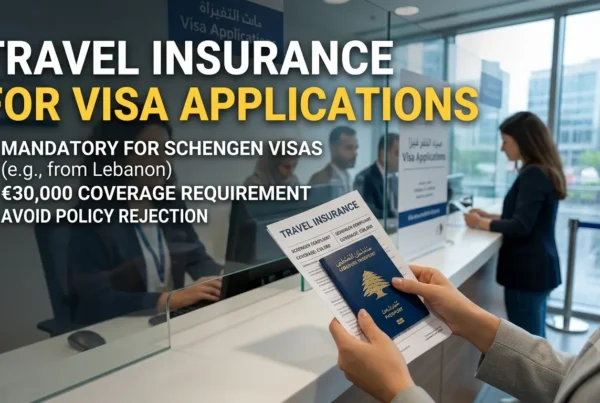
Where a destination isn’t on this list at all — much of Western Europe, the US, the UK, and most of the Gulf require a visa in advance — that’s where advance planning and, in the case of Schengen or US travel, the kind of documentation groundwork covered in our other guides in this cluster becomes the determining factor in whether a trip happens on schedule.
Planning a trip around visa-free or visa-on-arrival destinations?
Speak with a Fayad Travel destination expert to build an itinerary that matches your documentation timeline.
Frequently Asked Questions
As of the 2026 Henley Passport Index, Lebanese citizens have visa-free or visa-on-arrival access to 43 countries and territories, ranking the Lebanese passport 90th globally. The exact number shifts slightly as bilateral agreements change.
Visa-free means no visa process at all — just a valid passport. Visa on arrival means a visa is issued at the border or airport, without needing an application submitted in advance. An eVisa requires an online application and approval before departure, even though it doesn’t require an embassy visit.
Yes — Lebanese citizens can enter Iraq using only their national identity card, without needing a passport at all, a rare arrangement not extended to most other destinations.
Yes. As of April 1, 2026, Qatar temporarily suspended visa-on-arrival for Lebanese passport holders. Any list that doesn’t reflect this update should be treated as outdated.
No. Visa-free and visa-on-arrival status simply removes the advance application requirement — border officials can still request proof of onward travel, sufficient funds, or accommodation, and can deny entry regardless of visa status.