
If you’re planning a trip to Europe this year, the Schengen visa from Lebanon is very likely the first real obstacle standing between you and your itinerary — not the flights, not the hotels, but the paperwork. It’s also the part travelers put off the longest, usually because the process feels more confusing than it needs to be.
It isn’t complicated once you understand the logic behind it. Lebanese passport holders need a short-stay Schengen visa to enter any of the 29 countries in the Schengen area, whether the trip is a two-week honeymoon in Santorini or a long weekend in Paris. This guide walks through exactly who applies where, what documents actually get approved, how far in advance to start, and where Lebanese applicants most often lose time or get refused.
Do You Need a Schengen Visa from Lebanon?
Yes — Lebanese citizens are required to obtain a visa before entering Finland and the other Schengen member states, regardless of the purpose or length of the trip. The Schengen visa (also called a “C-visa”) permits a stay of up to 90 days within any 180-day period across the entire Schengen area, which currently spans Austria, Belgium, Bulgaria, Croatia, the Czech Republic, Denmark, Estonia, Finland, France, Germany, Greece, Hungary, Iceland, Italy, Latvia, Liechtenstein, Lithuania, Luxembourg, Malta, the Netherlands, Norway, Poland, Portugal, Romania, Slovakia, Slovenia, Spain, Sweden, and Switzerland.
One visa, one booklet, covers all of them — which is exactly why choosing the right embassy to apply through is the first decision that matters.
Which Country’s Embassy Should You Apply Through?
This trips up more applicants than any other step. The rule is straightforward: you apply at the embassy or consulate of your main destination — the Schengen country where you’ll spend the most nights. If your trip is evenly split between two or more countries, you apply through the consulate of whichever country you’ll enter first.
A traveler spending eight nights in Italy and two in France applies through the Italian consulate. A traveler splitting a trip evenly between Austria and Germany, entering through Germany first, applies through the German consulate. Getting this wrong doesn’t just slow things down — some consulates will refuse to process an application at all if it isn’t theirs to handle.
When to Apply: Timing Your Schengen Visa Application?
Applications can be submitted no earlier than six months before your planned travel date, and most consulates and visa centers recommend submitting no later than 45 days before departure. Processing officially takes a minimum of about three weeks, but can extend to a month or longer if your file needs additional review or is missing documentation.
For Lebanese applicants specifically, we’d push that further: apply as early in the six-month window as your itinerary allows. Appointment slots at Beirut’s visa application centers fill up quickly during peak European travel seasons — particularly the run-up to summer and the December holidays — and a rushed application is the single biggest driver of avoidable refusals.
Where Lebanese Applicants Submit Their Documents?
Most Schengen visa applications from Lebanon are processed through outsourced visa application centers in Beirut rather than the embassies themselves. VFS Global operates centers handling multiple Schengen countries’ applications, while a small number of countries — Spain, for instance — route through a different external provider (BLS) based in Verdun. A few embassies, like Austria’s, allow applicants to book directly through the embassy if no convenient VFS slot is available.
The practical implication: don’t assume every Schengen country uses the same office or booking portal. Confirm which visa center handles your specific destination country before you start collecting documents, since checklists and fee structures differ slightly between them.
Documents You’ll Need for a Schengen Visa from Lebanon
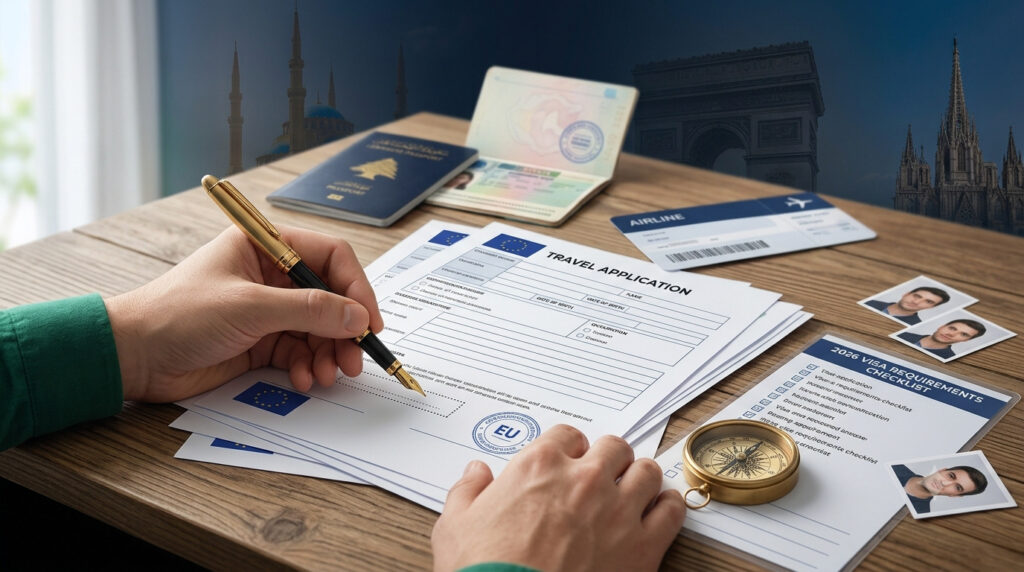
While each consulate publishes its own checklist, the core document set is consistent across Schengen countries:
- A completed and signed visa application form
- A valid passport — issued within the last 10 years, with at least two blank visa pages, and valid for at least three months beyond your planned departure from the Schengen area
- One recent, ICAO-compliant passport photo (3.5 x 4.5 cm)
- Proof of travel insurance meeting Schengen minimums (see below)
- Proof of accommodation — confirmed hotel bookings or an invitation letter if staying with family or friends
- Round-trip flight reservation
- Proof of sufficient financial means — recent bank statements are standard
- Employment documentation — an employment letter confirming position, salary, and approved leave dates, or equivalent proof of business ownership; students provide an enrollment letter
- Civil status documents where relevant — marriage or birth certificates for family-related travel
Applicants residing in Lebanon but holding residency elsewhere typically need to apply from their country of residence, not from Lebanon — worth confirming early if this applies to you.
Travel Insurance: The Requirement People Underestimate
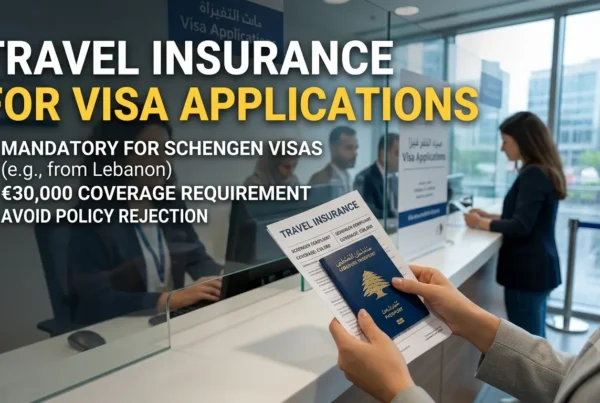
Travel medical insurance isn’t optional for a Schengen visa — it’s mandatory for every applicant and every accompanying child, with narrow exceptions for family members of EU/EEA nationals. The policy needs to cover the entire Schengen area (a policy that says “Finland, Schengen” without area restrictions, not one limited to a single country), carry no deductible, and provide coverage of at least €30,000 for medical emergencies, hospitalization, and medical repatriation, including repatriation in the event of death.
Handwritten policies aren’t accepted, and you’ll need to bring both the original and a copy to your appointment.
Step-by-Step: The Application Process
- Confirm your main destination and identify the correct consulate or visa center.
- Book your appointment directly through the official visa center portal — never through an unofficial intermediary, which adds cost without adding legitimacy.
- Assemble your documents against the specific checklist for that consulate, since minor requirements vary by country.
- Attend in person — every applicant, including minors, must appear at the appointment, and each traveler needs a separate appointment slot.
- Provide biometric data — fingerprints and a facial photo are captured at the center, unless you’re under 12 or have had compliant fingerprints taken within the last roughly five years.
- Track your application status online using the reference code provided at submission, and wait for the consulate’s decision.
What a Schengen Visa from Lebanon Costs?
Beyond the standard Schengen visa fee set by the destination country, expect an additional service fee charged by the visa application center itself — commonly in the $20-25 range, though this varies by country and center. Budget separately for your travel insurance policy, which is priced by trip length and coverage, and factor in that fees are generally non-refundable even if your application is refused.
Why Lebanese Applications Get Refused — and How to Avoid It?
The most common refusal reasons we see aren’t exotic — they’re avoidable gaps in an otherwise straightforward file:
Insufficient proof of intent to return. Consulates want to see that you have reasons to come back to Lebanon — stable employment, family ties, property, or ongoing enrollment. A thin or inconsistent employment letter is a red flag.
Incomplete financial documentation. Bank statements that don’t match your stated income, or that show large unexplained deposits shortly before applying, invite scrutiny.
Insurance that doesn’t meet the technical requirements. A policy capped below €30,000, one with a deductible, or one restricted to a single country will be rejected outright, even if genuinely purchased.
Applying at the wrong consulate. As covered above, this can result in the application being refused for jurisdiction reasons alone, regardless of how strong the rest of the file is.
Booking through unofficial agents who promise “guaranteed” appointments or approvals. No visa center or consulate offers guaranteed approval — anyone claiming otherwise is not affiliated with the actual process.
If a visa is refused, the consulate is required to notify you in writing with the specific grounds, and in most cases you have a formal right to appeal within a set window — typically around one month from notification, though this varies by country.
After Approval: What to Check Before You Fly
Once your visa is issued, verify the details on the visa sticker itself before leaving the visa center or picking up your passport — the passport number, name spelling, validity dates, and number of permitted entries. Errors do happen, and it’s far easier to correct them immediately than after you’ve already tried to board a flight. Remember, too, that holding a visa doesn’t automatically guarantee entry — border officials at your port of arrival can still request proof of sufficient funds, your return ticket, and your accommodation details.
A Note on ETIAS — and Why It Doesn’t Apply to You Yet
If you’ve seen headlines about “ETIAS” and Europe, it’s worth clearing up the confusion, since it causes real uncertainty for Lebanese travelers. ETIAS is a pre-travel authorization system built for travelers from visa-exempt countries — people who can already enter the Schengen area without applying for a visa, such as US or UK passport holders. Lebanese citizens are not visa-exempt, so ETIAS has no bearing on your process at all. You’ll continue to need a full Schengen visa regardless of when or whether ETIAS becomes fully operational. If you see a website offering to process an “ETIAS application” for a Lebanese passport, it’s not a legitimate option — treat it the same way you’d treat any offer of a guaranteed visa.
Traveling with Family or as a Group
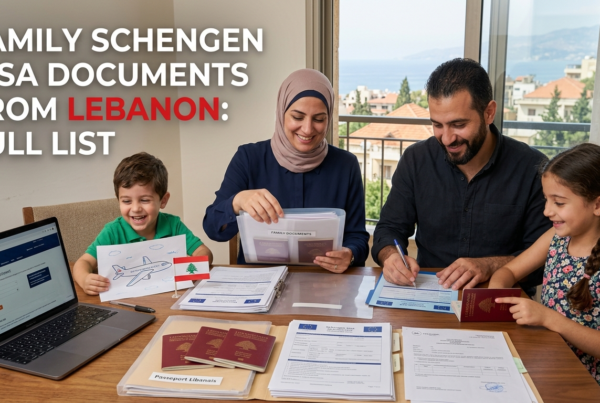
Group and family applications follow the same document logic, multiplied per traveler — each person, including children, needs their own application, their own insurance policy, and their own appointment slot. What changes is the supporting paperwork: children traveling with only one parent typically need notarized consent from the non-traveling parent, and family relationships (marriage certificates, birth certificates) need to be documented to explain why the group is traveling together and, in some cases, to justify a shared financial sponsor covering the trip.
This is also where sequencing matters most from a planning standpoint. A family of five applying at the wrong consulate, or with one child’s insurance policy structured differently from the rest, creates a single point of failure for the entire group’s trip — which is exactly the kind of detail worth checking well before the appointment, not during it.
Planning Beyond the Visa
The visa is a formality. What actually shapes the trip — which cities make sense together, how many nights each destination deserves, where the honeymoon suite or the family-friendly hotel actually is — is where the real planning happens, and it’s where a generic checklist stops being useful.
This is the part of a Europe itinerary Fayad Travel handles for Lebanese travelers every season: sequencing a multi-country Schengen trip around visa jurisdiction, matching accommodation to the trip’s occasion, and making sure the paperwork and the itinerary are built together rather than as two separate problems.
Plan your Europe itinerary and Schengen visa documentation together
speak with a Fayad Travel destination expert about your trip.
Frequently Asked Questions
A standard short-stay Schengen visa permits a stay of up to 90 days within any rolling 180-day period. The visa’s own validity window — how long you can enter within — is set individually and may be shorter or longer than the 90-day stay allowance itself.
Yes. Apply through the consulate of whichever country is your main destination — the one where you’ll spend the most nights, or your first point of entry if your stay is evenly split.
You can apply up to six months before travel, and most centers recommend applying at least 45 days ahead. In practice, booking as early as your itinerary allows is the safest approach, since appointment availability in Beirut tightens during peak travel seasons.
At least €30,000 (or the equivalent), covering the full Schengen area with no deductible, and including medical repatriation coverage.
A travel agency can’t submit the application on your behalf or influence the consulate’s decision, but it can help you build a compliant document file, sequence your itinerary around the correct consulate, and avoid the timing mistakes that most often cause delays or refusals.