

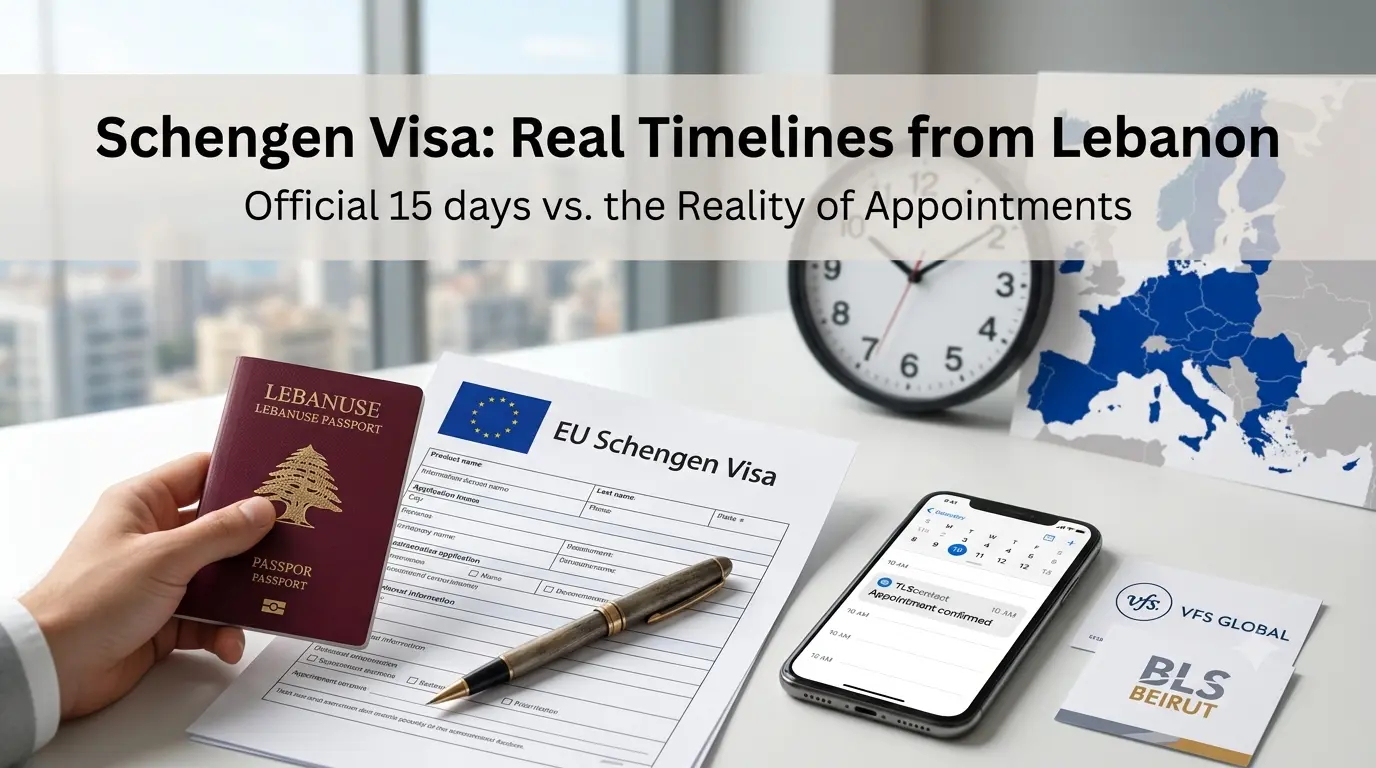
Every Schengen consulate website states the same official processing window, and it’s genuinely accurate — as far as it goes. What it doesn’t capture is the gap between submitting a complete application and actually getting an appointment slot to submit it in the first place, which is often the bigger variable for Lebanese applicants. This guide breaks down the real Schengen visa processing time Lebanon applicants should plan around, separating the official rule from what actually tends to happen at Beirut’s application centres — because planning a Europe trip around the wrong number is one of the more avoidable mistakes in the entire process.
The Official Schengen Processing Rule
The 15-Calendar-Day Standard
Schengen regulations set a standard decision window of 15 calendar days from the date a complete application is lodged with the consulate. This is the figure most official sources quote, and it holds true once an application has actually been submitted.
When It Can Extend to 30 or 60 Days?
That 15-day window can extend to 30 days in specific cases, or in rarer, more complex situations, up to 60 calendar days — typically when a consulate needs additional documentation, further verification, or referral to another authority. Applicants shouldn’t assume the extended timelines are unusual; they occur regularly enough to be worth building into a realistic planning buffer.
Where the Real Delay Actually Happens?
The Appointment Booking Gap
For most Lebanese applicants, the true bottleneck isn’t the 15-day decision window at all — it’s the wait to secure an appointment slot at the relevant application centre in the first place. During peak travel-planning periods, particularly ahead of the European summer season, appointment slots at Beirut’s centres can book out weeks in advance, meaning the total time from “starting the process” to “having a visa in hand” can run considerably longer than the official processing figure alone suggests.
Which Centre Handles Which Country?
Lebanese applicants don’t submit every Schengen application to the same place. TLScontact in Beirut handles French visa applications, since France remains the most commonly applied-for Schengen destination from Lebanon. VFS Global handles several other missions, including Germany, Italy, and the Netherlands. BLS International handles Spanish applications. The relevant rule for which consulate to apply through is generally based on the destination where the most nights of the trip will be spent — not simply the first country entered.
Is Expedited Processing Available?
Priority Services at Some Centres
A small number of consulates and application centres offer a priority or premium service for an additional fee, aiming to shorten either the appointment wait or the document-handling portion of the process. Availability varies significantly by consulate and by period, and it doesn’t bypass the underlying 15-day (or extended) decision window set by the destination country’s immigration authority — it simply speeds up the logistics around it.
What Priority Processing Doesn’t Fix?
It’s worth being clear-eyed about what a priority service does and doesn’t solve: it can sometimes secure an earlier appointment slot or faster document courier turnaround, but it cannot override a consulate’s own internal review timeline if a file gets flagged for additional scrutiny. Applicants sometimes assume paying for priority service guarantees a fast decision regardless of document quality, which isn’t accurate — a well-prepared standard application often outperforms a rushed priority one.

A Sample Realistic Timeline
Applying Four Months Before Travel
A Lebanese applicant starting the process four months ahead of a planned trip has comfortable room to absorb both a slow appointment-booking period and a possible extension into the 30-day review window, without the travel date itself being at risk.
Applying Six to Eight Weeks Before Travel
Starting six to eight weeks out is workable in calmer periods but leaves little buffer if the application centre is experiencing an appointment backlog or if the file needs additional review — precisely the scenario where the gap between the official 15-day figure and the real Schengen visa processing time Lebanon applicants actually experience becomes a genuine risk to the travel date.
Tracking a Schengen Application in Progress
Status Updates from the Application Centre
Most application centres in Beirut offer some form of online status tracking once biometrics have been submitted, giving applicants visibility into whether the file is still under standard review or has moved into extended processing. Checking this periodically is more useful than repeatedly contacting the centre directly, which rarely accelerates a decision already in progress.
When to Follow Up?
If a decision hasn’t arrived by the upper end of the relevant processing window — 15 days for standard cases, longer if the applicant was notified of an extension — it’s reasonable to follow up directly with the application centre, though this should be treated as confirming status rather than expecting to influence the timeline itself.
Why Schengen Timelines Differ from Other Destinations?
Compared to Visa-on-Arrival or E-Visa Countries
Lebanese travelers accustomed to visa-free or e-visa destinations like Turkey or the UAE sometimes carry those expectations into Schengen planning, assuming a similarly quick turnaround. The Schengen visa processing time Lebanon applicants face is structurally different — it requires an in-person biometric appointment at a physical application centre, a document-based review by a consular officer, and, in some cases, referral between authorities, none of which apply to a visa-free or purely online e-visa process.
Compared to the UK’s Visitor Visa Process
The UK’s Standard Visitor visa process, also handled through an in-person appointment in Beirut, runs on a broadly similar principle — a standard multi-week window that can extend if additional review is needed — though the two systems are entirely separate, and a UK visa doesn’t substitute for a Schengen visa or vice versa, even for a combined itinerary.
Realistic Timeline Planning for a Schengen Visa from Lebanon
A More Honest Total Estimate
Combining the appointment wait with the official processing window, a more realistic total timeline for a Schengen visa processing time from Lebanon often runs four to eight weeks from the day an applicant starts trying to book an appointment to the day a decision is issued — sometimes longer during the busiest pre-summer months. This is meaningfully longer than the 15-day figure alone implies, which is exactly why treating that number as the full picture leads to rushed, last-minute planning.
How Far in Advance to Apply?
Schengen rules allow applications to be submitted up to six months before the intended travel date, and consulates generally recommend applying as early as that window allows rather than waiting until closer to departure. For Lebanese applicants specifically, applying early isn’t just a general best practice — it’s the main lever available for absorbing the appointment-booking delay that the standard processing figures don’t account for.
What Slows Down a Schengen Application from Lebanon?
Peak Season Demand
Appointment availability tightens considerably in the months leading into the European summer, as well as around major holiday periods, since demand from Lebanese travelers spikes at the same time as demand across the wider region. Applying in the off-peak months, where the trip allows that flexibility, can meaningfully shorten the appointment-booking portion of the timeline.
Incomplete Financial and Supporting Documents
Beyond appointment availability, incomplete or inconsistent financial documentation is one of the more common reasons a Schengen application from Lebanon gets pushed into the extended 30- or 60-day review window rather than resolved within the standard 15 days — another factor that stretches the real Schengen visa processing time Lebanon applicants experience well past the headline figure. Given Lebanon’s mixed banking environment, presenting clear USD account statements alongside any LBP documentation is worth extra care before submission.
Planning a Trip Around a Realistic Schengen Timeline
Because the appointment wait is the single biggest wildcard in the entire process, the most reliable approach is to start the Schengen visa process as the very first step in planning a Europe trip from Lebanon — well before locking in non-refundable flights or hotel bookings. A travel advisor familiar with the current appointment situation across TLScontact, VFS Global, and BLS International in Beirut can help sequence the application against a realistic travel date, rather than working backward from a departure date that assumes only the official 15-day window applies.
Frequently Asked Questions
While the official decision window is 15 calendar days, the true total timeline — including the wait to secure an appointment at TLScontact, VFS Global, or BLS International in Beirut — often runs four to eight weeks, especially during peak season.
Applications can be submitted up to six months before travel, and applying as early as possible within that window is the best way to absorb potential appointment-booking delays.
TLScontact handles French applications, VFS Global handles several missions including Germany, Italy, and the Netherlands, and BLS International handles Spanish applications — applicants generally apply through the consulate of the country where they’ll spend the most nights.
Processing can extend to 30 or, in more complex cases, 60 calendar days when additional documentation or verification is needed, separate from any appointment-booking delay beforehand.
It doesn’t shorten the official decision window, but it does give more room to absorb appointment-booking delays, which are typically the larger factor behind the real Schengen visa processing time Lebanon applicants encounter compared to the headline 15-day figure.
Want help timing a Schengen visa application around your travel dates? Request a tailored quote from Fayad Travel and we’ll help you plan the process realistically.