

Ask ten travelers what their insurance policy actually covers, and most will admit they never read past the first page. This travel insurance guide exists because Lebanese travelers face a specific set of gaps that generic international advice doesn’t address — from which destinations require proof of coverage at the border, to what a policy purchased through a foreign website will and won’t honor if something goes wrong on Lebanese soil during a connecting leg home.
Travel insurance isn’t one product. It’s a bundle of separate protections — medical coverage abroad, trip cancellation, baggage loss, and a handful of smaller add-ons — and the right combination depends entirely on where you’re going and how you’re getting there. This guide breaks each piece down so you can identify what type of travel insurance you actually need, rather than buying whatever a search engine ranks first.
Why Generic Travel Insurance Advice Falls Short for Lebanese Travelers?
Most travel insurance content is written for travelers based in North America or Western Europe, where domestic healthcare coverage sometimes extends internationally and insurers assume a certain baseline of protection already exists. That assumption doesn’t hold the same way for travelers departing from Lebanon, where destination-specific visa rules, currency considerations, and airline routing can all affect which policy terms actually apply.
4 core protections bundled into most standard travel insurance policies
26+ Schengen countries requiring proof of minimum medical coverage for visa applications
Days not hours — how long an uninsured medical evacuation claim can take to resolve without coverage
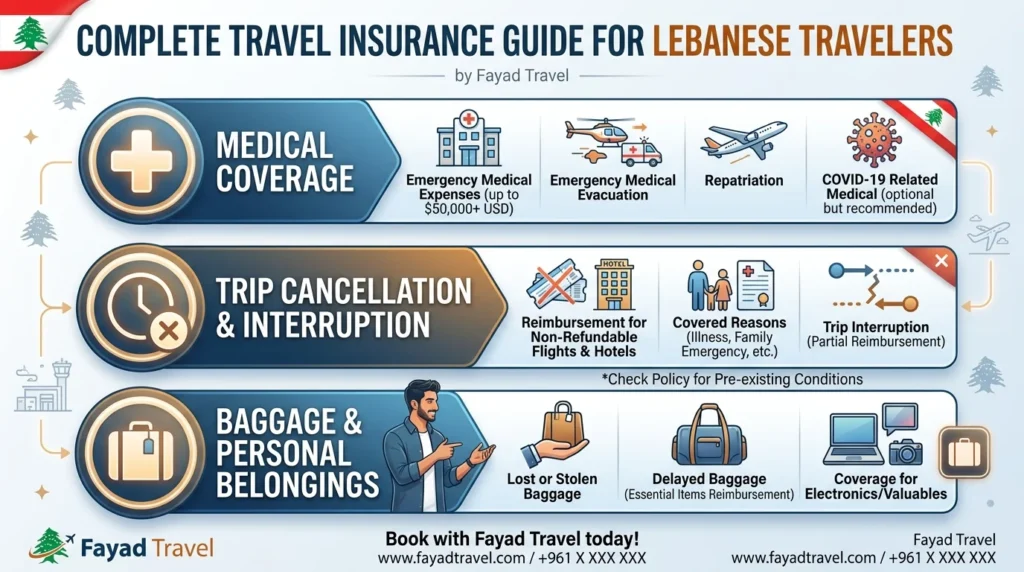
The Four Protections Every Policy Should Cover
1. Medical Coverage Abroad
This is the protection that matters most and gets understood least. A policy needs to cover emergency treatment, hospitalization, and — critically — medical evacuation, which is the cost of transporting you to a country with adequate care if the destination’s facilities can’t treat a serious condition. Evacuation costs are often the single largest expense in an uninsured medical emergency abroad, far exceeding the treatment itself.
2. Trip Cancellation and Interruption
This covers non-refundable costs — flights, hotels, tour deposits — if a trip is cancelled or cut short for a covered reason: illness, a family emergency, or in some policies, unexpected travel restrictions. For travelers booking well in advance for peak-season trips, this is often the most financially relevant piece of the whole policy, since deposits and non-refundable fares represent real money at stake long before departure.
3. Baggage Loss and Delay
Airlines carry their own liability for lost or delayed baggage, but the payout is often capped well below the actual value of what’s inside a suitcase — particularly relevant for travelers carrying gifts, business equipment, or event clothing. Travel insurance fills that gap and, in most policies, also covers essential purchases needed during a delay.
4. Travel Delay and Missed Connection Coverage
Less discussed but genuinely useful: coverage for expenses incurred when a delay or missed connection forces an unplanned overnight stay, meal, or rebooking fee. On multi-leg itineraries routed through connecting hubs, this is one of the more frequently used parts of a policy.
What Type of Travel Insurance Do You Actually Need?
The honest answer depends on the trip. A short regional business trip has very different risk exposure than a two-week family holiday to a destination requiring visa-linked medical coverage. The table below breaks down how coverage priorities shift by trip type.
| Trip Type | Priority Coverage | Why It Matters |
|---|---|---|
| Schengen / Europe travel | Minimum medical coverage (often a visa requirement) | Many Schengen visa applications require proof of coverage to a set minimum |
| Family holiday with children | Medical + trip interruption | Higher likelihood of illness disrupting plans mid-trip |
| Business travel | Missed connection + baggage | Time-sensitive itineraries are more exposed to delay costs |
| Multi-country / long-haul trips | Full bundle, higher medical limits | More transit points and more exposure across the itinerary |
“The claims that cause the most regret aren’t the ones that get rejected — they’re the ones travelers never think to file because they didn’t know their policy covered it.”
Questions to Ask Before Buying Any Policy
- Does the medical coverage limit meet the minimum required for my destination’s visa, if applicable?
- Is medical evacuation included, and to what coverage limit?
- Are pre-existing conditions excluded, and does that apply to me?
- Does trip cancellation cover the specific reasons most likely to affect my trip?
- What’s the baggage loss cap, and does it realistically cover what I’m carrying?
- Is there a 24-hour emergency assistance line, and in what languages?
Where a Travel Insurance Guide Alone Isn’t Enough?
Reading about coverage categories is a useful starting point, but matching a policy to a specific itinerary — especially one involving visa requirements, multiple destinations, or connecting flights through countries with their own entry rules — benefits from guidance that understands both the insurance side and the travel logistics side together. This is where planning coverage alongside the rest of a trip, rather than as an afterthought booked the night before departure, tends to produce better outcomes.
Frequently Asked Questions
It depends on the destination and trip length, but most Lebanese travelers benefit from a bundle covering medical treatment abroad, evacuation, trip cancellation, and baggage protection — with medical coverage prioritized for any destination with visa-linked minimums.
Yes, in most cases. Schengen visa applications typically require proof of medical coverage to a set minimum, valid for the full duration of the trip.
This varies significantly by policy and insurer. Some plans exclude pre-existing conditions entirely, while others offer coverage for an additional premium — it’s worth confirming this explicitly rather than assuming either way.
Medical evacuation limits. Many travelers assume basic medical coverage is enough, without realizing evacuation costs from a destination with limited medical facilities can far exceed standard treatment costs.
Yes — our team can walk you through coverage options as part of planning your itinerary, so your insurance actually matches your destination and visa requirements rather than being a generic add-on.
Not sure which coverage actually fits your trip?
Fayad Travel helps you match travel insurance to your destination, visa requirements, and itinerary — request a tailored quote today.Request a Tailored Quote