
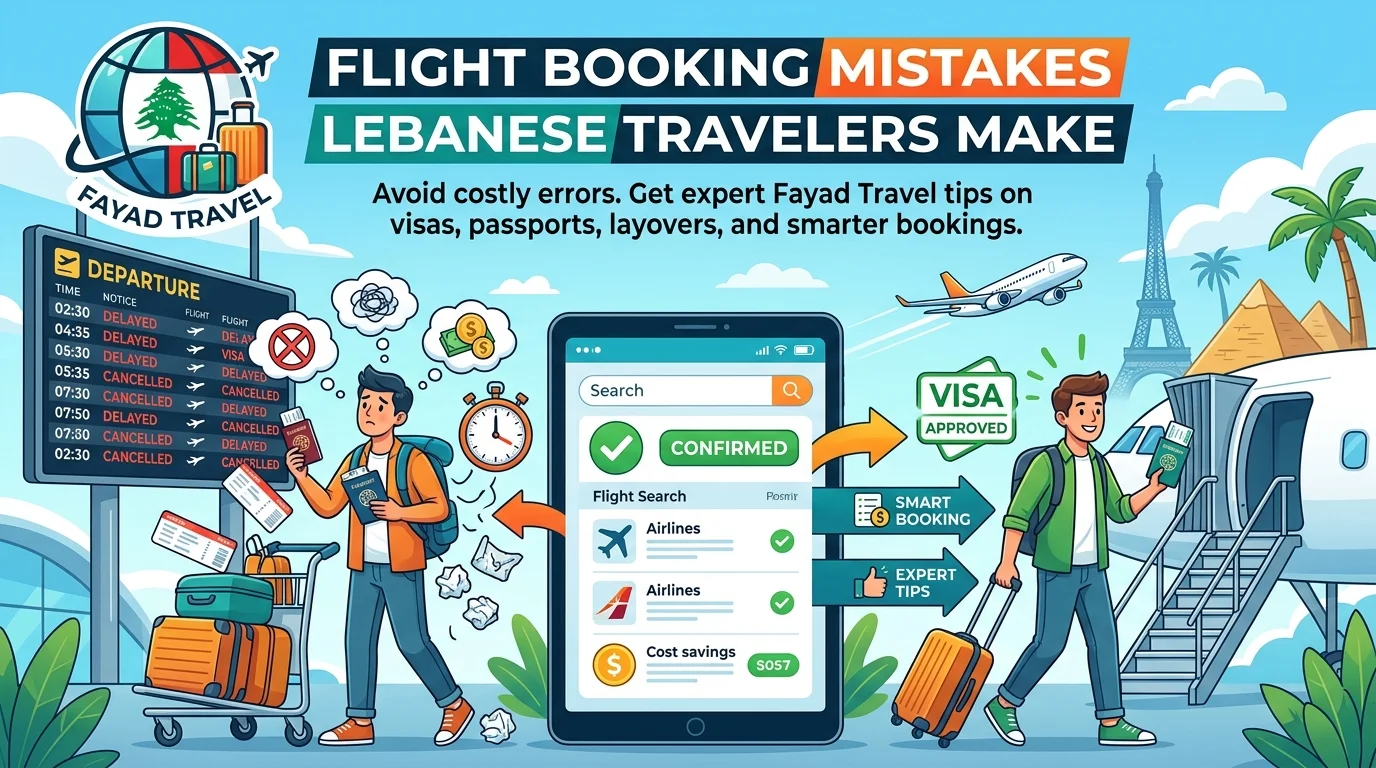
Booking a flight out of Beirut sounds simple until the fine print catches up with you. A traveler grabs the cheapest fare on a comparison site, only to discover a two-day visa gap in a layover country, a baggage allowance that doesn’t cover a wedding suitcase, or a departure date that lands squarely on a religious holiday when the airport is at its busiest. These flight booking mistakes are some of the most common — and most avoidable — problems Lebanese travelers run into, and they rarely show up until it’s too late to fix them cheaply.
Lebanon’s position as a regional travel hub, combined with the specific visa, passport, and airline realities that apply to Lebanese passport holders, means that booking a flight here isn’t quite the same as booking one from Paris or Toronto. What works for a general “how to book flights” article often misses the details that actually matter to someone flying out of Rafic Hariri International Airport. This guide walks through the mistakes we see most often at Fayad Travel, and what to do instead.
Why Flight Mistakes Cost Lebanese Travelers More Than Just Money?
A flight booking error rarely stays contained to the flight itself. Book the wrong dates and you might also lose a hotel deposit. Misjudge a layover visa requirement and you could miss the connecting flight entirely, triggering rebooking fees on top of the original ticket. For business travelers, a missed connection can mean a missed meeting; for families, it can mean a ruined first day of a long-planned holiday.
60–90 days minimum passport validity often required beyond travel dates
2–3x fare increase typical when booking within 14 days of religious holidays
24–48 h average delay caused by an unplanned layover visa issue
The Most Common Flight Booking Mistakes We See
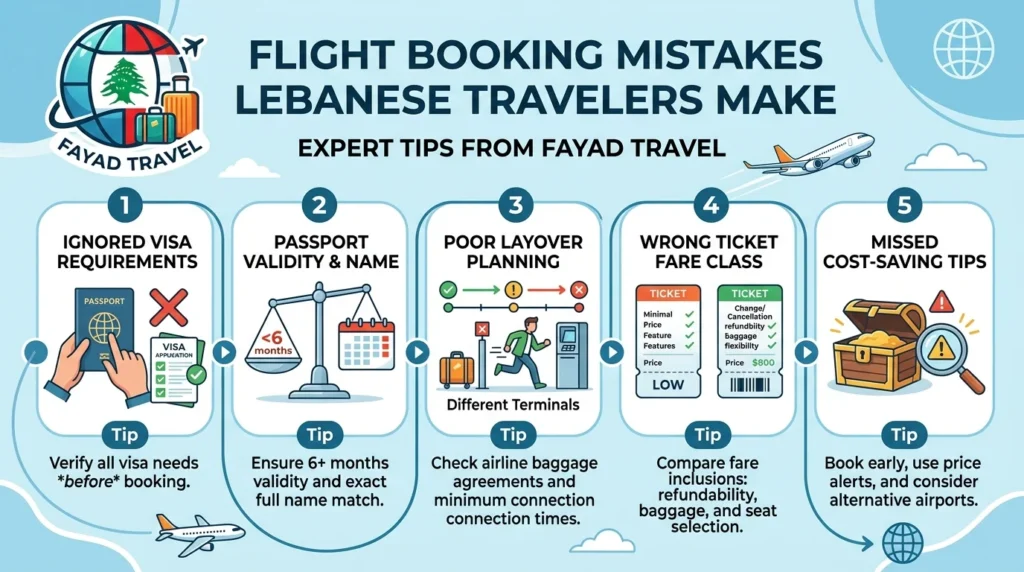
1. Choosing a Layover Based on Price Alone
The cheapest itinerary often routes through a country that requires a transit visa for Lebanese passport holders, even for a short layover. Airlines’ own booking engines rarely flag this. Before locking in a fare that connects through Gulf, European, or Asian hubs, it’s worth confirming whether that specific layover airport requires a transit visa for Lebanese citizens — the rules differ by airport, not just by country.
2. Overlooking Passport Validity Windows
Many destinations popular with Lebanese travelers — across the GCC, the Schengen area, and much of Southeast Asia — require a passport to remain valid for **six months beyond the return date**, not just beyond the departure date. A passport that looks perfectly valid on the calendar can still get a traveler denied boarding at check-in.
3. Booking Too Close to Peak Religious and Holiday Periods
Flights around Eid, Easter, Christmas, and the summer diaspora season fill up fast, and fares climb well before the dates themselves. Lebanese expats flying home for these periods often assume prices will settle closer to the date — in practice, they almost always rise. Booking 8–10 weeks ahead of these windows is the more reliable strategy.
4. Ignoring Baggage Allowance Differences Between Airlines
Baggage rules vary significantly between full-service carriers and the budget or hybrid airlines increasingly used on Beirut routes. A fare that looks like a bargain can end up costing more once checked-bag fees, extra weight charges, or gate-check penalties are added — a common surprise for families traveling with wedding gifts, sports equipment, or holiday shopping.
5. Not Calculating the True Total Cost
The advertised fare rarely reflects what actually lands on the card statement. Airport transfer fees, visa costs at the destination, seat selection charges, and currency conversion fees on foreign-issued tickets all add up. Comparing two itineraries by base fare alone, without factoring these in, frequently leads to the “cheaper” option costing more overall.
6. Skipping Travel Insurance to Save a Few Dollars
Given regional volatility and the possibility of flight schedule changes, skipping travel insurance is one of the more short-sighted savings a traveler can make. A missed connection, a canceled leg, or a medical issue abroad without coverage can turn a modest booking mistake into a five-figure problem.
7. Booking Entirely Alone, Without Local Support
Online travel sites are built for volume, not for edge cases. They won’t tell a Lebanese traveler that a specific layover needs a visa, that a specific airline enforces stricter baggage rules on Beirut routes, or that a specific date sits inside a fare-spike window. A local travel agency that books flights daily for Lebanese passport holders catches these issues before they become expensive.
DIY Booking vs. Working With a Local Travel Agency
| Factor | Booking Alone Online | Booking Through Fayad Travel |
|---|---|---|
| Layover visa checks | Traveler’s own responsibility | Checked before booking |
| Passport validity rules | Easy to miss | Verified against destination rules |
| Fare-spike timing | Often booked too late | Flagged in advance |
| Schedule change support | Airline call centers, long waits | Direct agent follow-up |
| Total cost transparency | Fees appear at checkout or later | Full cost outlined upfront |
“Most of the flight problems we resolve for clients didn’t start at the airport — they started three weeks earlier, at the moment of booking.”
A Quick Pre-Booking Checklist
- Confirm passport validity extends at least six months past the return date
- Check transit visa requirements for every layover airport, not just the final destination
- Compare baggage allowances across airlines, not just base fares
- Avoid booking travel within two weeks of major religious or holiday periods without checking fare trends
- Add up transfer fees, visa costs, and seat charges before comparing “cheap” itineraries
- Consider travel insurance, especially for connecting or multi-leg trips
Frequently Asked Questions
It depends entirely on the layover airport and airline — some require a transit visa even for connections under 24 hours, particularly in parts of Europe and Asia. This is one of the most overlooked flight booking mistakes and should always be checked before ticketing.
For Eid, Christmas, and summer diaspora travel, booking 8–10 weeks ahead generally secures better fares and seat availability than waiting closer to the date.
Base fares are often similar, but a travel agency can flag hidden costs — visa fees, baggage charges, transfer costs — that make the real total cost clearer upfront, which often ends up being the deciding factor.
As a general rule, keep at least six months of validity remaining beyond your planned return date, since many countries popular with Lebanese travelers enforce this strictly at check-in.
Yes — one of the practical advantages of booking through a local agency like Fayad Travel is having a direct point of contact to manage schedule changes, rather than relying solely on an airline call center.
Avoid the booking mistakes that cost travelers time and money.
Fayad Travel checks visa requirements, passport rules, and total costs before you book — so your flight is right the first time.Request a Flight Quote