
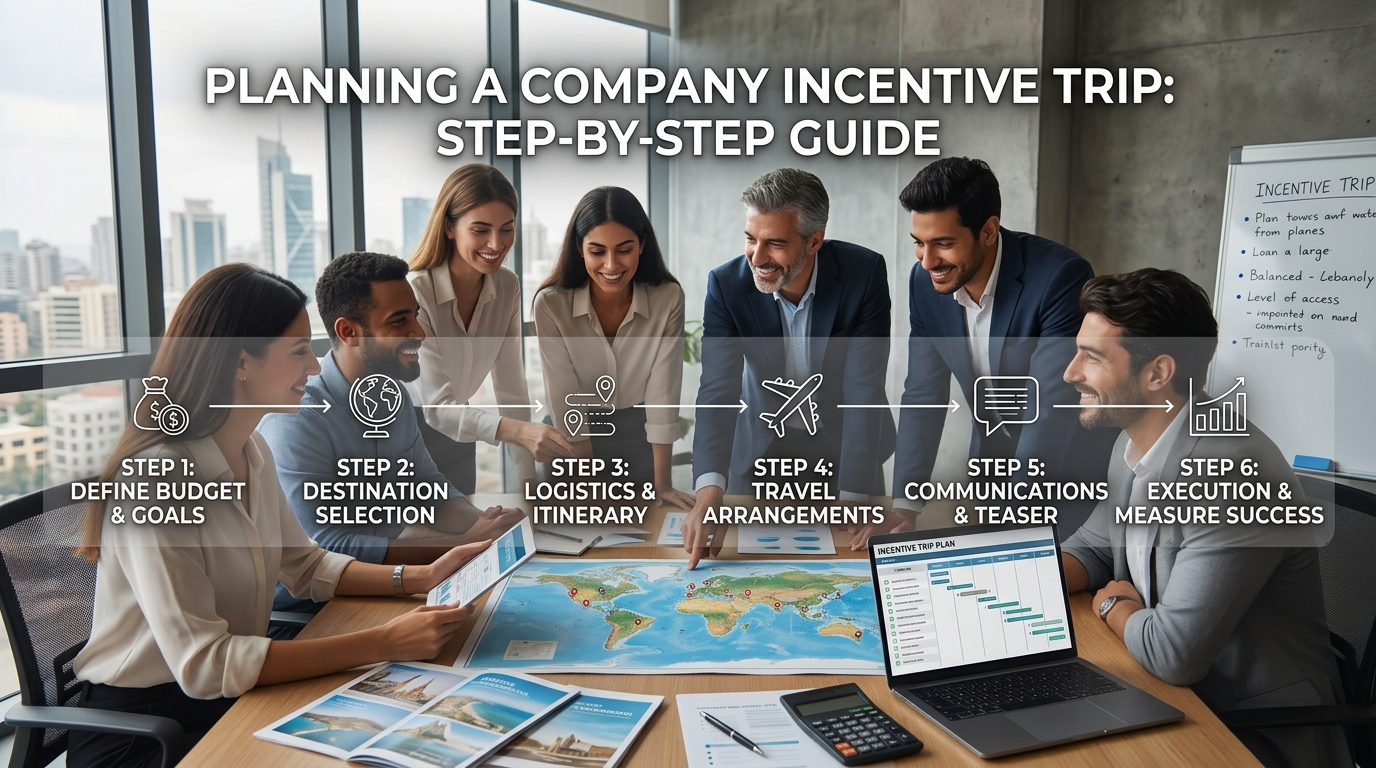
An incentive trip only works as a genuine motivational tool if it’s planned with the same rigor as any other business investment — a vague “we’ll take the top performers somewhere nice” plan tends to produce a mediocre trip and a disappointed team, while a structured process produces something employees actually talk about for years. This guide walks through corporate incentive trip planning step by step, from defining the program’s goals through measuring whether it actually worked — the full process rather than just the fun parts most companies focus on first.
A Sample Per-Employee Budget Breakdown
Mid-Range Incentive Trip Example
A mid-range incentive trip to a European or regional destination might break down roughly as follows per employee: $600 to $1,200 for flights depending on origin and destination, $150 to $300 per night for accommodation across a three-to-five-night trip, $50 to $100 per day for meals and activities, and a 10 to 15 percent buffer for incidentals and the recognition event itself.
Adjusting the Budget for Different Group Sizes
Larger groups can sometimes access better per-person rates on flights and hotel blocks, while smaller, more exclusive trips might intentionally spend more per person to create a more premium experience — neither approach is inherently better, but the budget should reflect a deliberate choice rather than an afterthought.
Common Mistakes That Undermine Incentive Trips
Unclear or Shifting Qualification Criteria
Changing the rules partway through a qualifying period, even with good intentions, damages trust in the program more than almost any other planning mistake, since employees who adjusted their effort based on the original criteria feel the goalposts moved unfairly.
Underbudgeting for the Full Experience
Companies that budget tightly for flights and hotel alone often find themselves cutting corners on activities or dining once the real costs become clear, which can make the trip feel noticeably less generous than intended even when the headline budget looked reasonable on paper.
Treating the Trip as Purely Administrative
An incentive trip planned purely as a logistics exercise, without genuine thought given to the recognition moment and the emotional experience of being rewarded, tends to underdeliver on the program’s actual motivational purpose, regardless of how smoothly the logistics themselves run.
Why Companies Work with a Travel Agency for Incentive Trips?
This is often the step that separates smooth corporate incentive trip planning from a stressful, last-minute scramble.
Coordinating Complexity at Scale
Corporate incentive trip planning for a group of any meaningful size involves considerably more moving parts than an individual leisure trip — visas, group flight bookings, hotel blocks, and activity coordination all need to align for a single fixed set of dates, which is where a dedicated agency’s coordination capacity becomes genuinely valuable.
Access to Group Rates and Venue Relationships
An agency with existing relationships across hotels and activity providers can often secure better group rates and more flexible booking terms than a company negotiating independently for a one-off event, offsetting some of the agency’s own fee through the savings achieved.

Step 1: Define the Program’s Goals Before Anything Else
Every genuinely effective round of corporate incentive trip planning starts here, not with a destination shortlist.
What Is This Trip Actually Meant to Achieve?
Before any destination or budget conversation, it’s worth being explicit about what the incentive trip is meant to accomplish — driving a specific sales target, rewarding a broader team’s performance over the year, or strengthening cross-departmental relationships all point toward genuinely different trip structures and qualification criteria.
Setting Clear Qualification Criteria
Whatever the goal, employees need to understand exactly how the trip is earned well before the qualifying period begins — vague or shifting criteria undermine the trip’s motivational value far more than a modest budget does, since employees can’t work toward a target they don’t clearly understand.
Step 2: Set a Realistic Per-Employee Budget
Budgeting is where a lot of corporate incentive trip planning goes wrong, usually by underestimating the full cost picture.
What a Per-Employee Budget Typically Needs to Cover?
A complete per-employee budget should account for flights, accommodation, meals, activities, and a reasonable buffer for incidentals — companies that budget only for the headline hotel and flight costs often find the final bill considerably higher once group activities and dining are added.
Balancing Budget Against Destination Ambition
A modest budget doesn’t rule out an impressive trip, but it does need to shape destination choice realistically — a shorter, closer destination executed well generally lands better with employees than an ambitious long-haul trip stretched too thin across a limited budget.
Regional vs. Long-Haul Incentive Destinations
The Case for a Regional Destination
A regional destination — within the Gulf, Turkey, or nearby Europe — reduces flight cost and travel fatigue, letting more of the budget go toward the on-ground experience rather than long-haul airfare, and works particularly well for shorter trips of three to four nights.
When a Long-Haul Destination Is Worth It?
For milestone years or particularly strong performance periods, a longer-haul destination can create a more memorable, clearly “once in a career” feeling that a regional trip may not carry in the same way, provided the budget and trip length genuinely support the extra travel time involved.
Step 3: Choose a Destination That Matches the Group
Matching Destination to Group Size and Composition
A destination that works beautifully for twenty people can become logistically strained for two hundred — hotel block availability, group activity capacity, and transfer logistics all need to scale with the actual delegation size rather than being chosen based on a smaller reference trip.
Considering the Group’s Demographics and Interests
A younger, more adventure-oriented team may respond well to an activity-heavy destination, while a more senior leadership group might prioritize a more refined, relaxed setting — matching the destination’s character to who’s actually attending matters more than defaulting to a generically popular location.
Step 4: Handle Visa and Travel Document Logistics Early
Coordinating Visas Across the Group
For destinations requiring a Schengen visa, UK visa, or similar advance application, starting this process well ahead of the trip is essential, particularly for larger groups where even a small percentage of delayed applications can affect the whole group’s travel dates.
Assigning a Single Point of Coordination
Rather than leaving each employee to manage their own visa application independently, assigning a single coordinator — whether internal HR staff or an external travel agency — to track document status across the group considerably reduces the risk of a last-minute scramble.
Step 5: Book Logistics as a Coordinated Group
Flights and Group Booking Rates
Booking flights as a coordinated group, rather than individually, often unlocks better rates and ensures the whole team arrives and departs together, simplifying the on-ground logistics considerably compared to staggered individual arrivals.
Hotel Block Booking and Room Allocation
Securing a hotel block well in advance, with a clear room allocation plan, avoids the scramble of last-minute individual bookings that can scatter the group across multiple properties and undermine the shared-experience goal of the trip.
Step 6: Plan the Activity and Program Schedule
Balancing Structured Activities with Free Time
A well-designed incentive trip schedule balances organized group activities — team dinners, excursions, a recognition event — with enough free time for employees to explore independently, since an overly packed schedule can feel more like a work obligation than a reward.
Building in a Recognition Moment
Most successful incentive trips include a dedicated recognition event or dinner where top performers are formally acknowledged, giving the trip a clear emotional centerpiece beyond simply being a nice vacation.
Step 7: Measure Whether the Trip Achieved Its Goals
Connecting Back to the Original Objectives
After the trip, it’s worth revisiting the goals set in Step 1 — did the qualifying period see the expected performance lift, and did post-trip employee feedback suggest the experience genuinely felt like a meaningful reward rather than a routine team outing?
Using Feedback to Improve the Next Program
Structured post-trip feedback, even a brief survey, helps refine qualification criteria, destination choice, and program structure for the next cycle, turning each incentive trip into a data point for improving the next one rather than a one-off event.
Frequently Asked Questions
Good corporate incentive trip planning starts by defining clear program goals and qualification criteria, sets a realistic per-employee budget, chooses a destination matching the group’s size and interests, handles visa logistics early, books flights and hotels as a coordinated group, and measures results against the original objectives afterward.
Flights, accommodation, meals, activities, and a reasonable buffer for incidentals — budgeting only for flights and hotel often leads to a higher-than-expected final cost once group activities and dining are added.
As early as possible, particularly for destinations requiring a Schengen or UK visa, since even a small percentage of delayed applications within a larger group can affect everyone’s travel dates.
No — the strongest incentive trips balance structured group activities with enough free time for employees to explore independently, since an overly packed schedule can feel more like work than reward.
By revisiting the original program goals after the trip, checking whether the qualifying period achieved the expected results, and gathering employee feedback to refine the next program.
Planning an incentive trip for your team and want the logistics handled professionally? Request a tailored quote from Fayad Travel and we’ll coordinate every step from budget to booking.