
Most travelers only think seriously about emergency medical coverage after something has already gone wrong, at which point the options are far more limited and expensive than they would have been with a plan in place beforehand. This guide covers emergency medical travel support in plain terms — what a medical evacuation actually costs, what travel insurance genuinely covers, and how embassy assistance and a travel concierge each play a different role if something happens abroad. This is general informational content, not medical or insurance advice; anyone with specific health concerns or policy questions should consult their physician or insurance provider directly.
What Medical Evacuation Actually Costs?
Understanding real costs is the foundation of taking emergency medical travel support seriously rather than treating it as an abstract insurance line item.
A Wide Range Depending on Distance and Severity
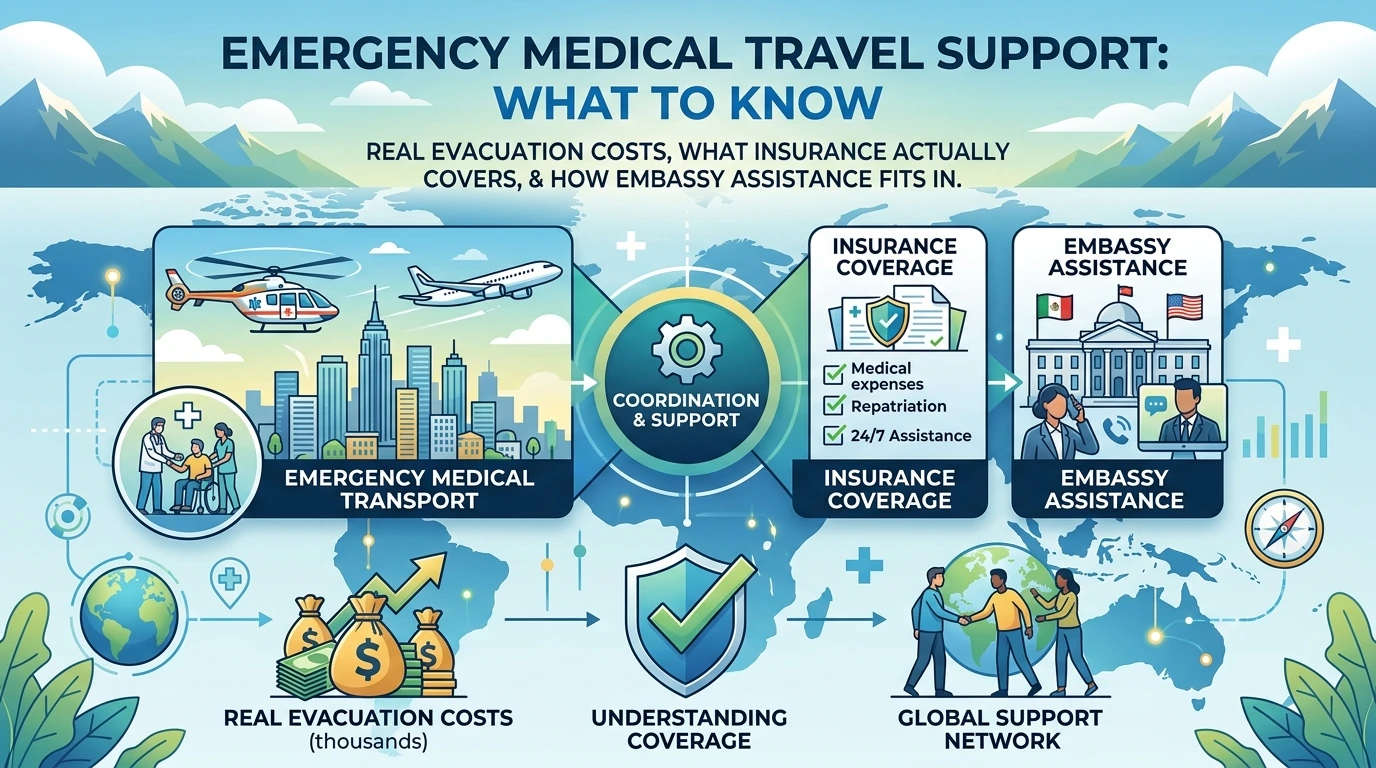
International medical evacuations, particularly those requiring an air ambulance from a remote or poorly served location back to a major medical center, commonly range from around $25,000 on the lower end to well over $250,000 in the most severe or logistically complex cases.
Why the Range Is So Wide?
Distance to the nearest appropriate facility, the severity of the medical condition, and whether a full air ambulance with medical staff is required versus a commercial flight with an escort all drive the enormous variation in cost between a straightforward case and a genuinely complex one.
What Travel Insurance Typically Covers?
This is the core of any genuine emergency medical travel support setup, since insurance is what actually pays for treatment and evacuation when something goes wrong.
Medical Evacuation and Repatriation Coverage
Most comprehensive travel insurance policies include a specific medical evacuation and repatriation benefit, commonly ranging from $50,000 up to $1 million depending on the policy tier, intended to cover exactly the kind of high-cost emergency transport described above.
Emergency Medical Treatment Abroad
Separate from evacuation coverage, most policies also include a medical treatment benefit covering hospital stays, emergency procedures, and related costs incurred at the destination, typically with its own coverage limit distinct from the evacuation benefit.
What’s Often Excluded or Limited?
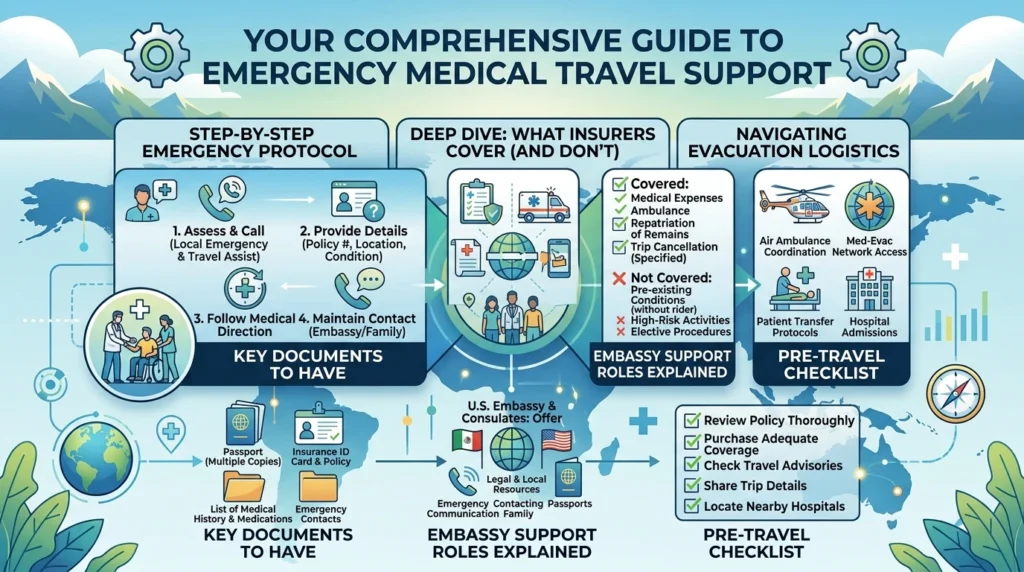
Pre-existing conditions are frequently excluded or covered only under specific conditions (such as a recent, stable diagnosis with no changes to treatment), and it’s worth reviewing a policy’s exact terms on this rather than assuming standard coverage applies to every medical situation.
Emergency Medical Considerations for Family Travel
Coverage for Children and Elderly Family Members
Family travel insurance policies should be reviewed to confirm coverage extends adequately to both children and any elderly family members traveling together, since age-related terms sometimes differ meaningfully within the same family policy.
Evacuation Logistics for a Family Emergency
If a medical evacuation becomes necessary for one family member, it’s worth understanding in advance how a policy handles accompanying family — some policies cover a companion’s transport alongside the patient, while others require this to be arranged and paid for separately.
Emergency Medical Support for Business Travelers
Why Business Travelers Shouldn’t Assume Coverage?
Business travelers sometimes assume a company health plan extends coverage abroad, when in practice most domestic health insurance plans, including employer-sponsored ones, provide little to no coverage for medical treatment or evacuation outside the home country.
Confirming Company Travel Insurance Policies
Companies with a formal corporate travel policy should confirm exactly what medical and evacuation coverage is provided for employees traveling internationally, since gaps here can leave both the employee and the company exposed during a genuine emergency.
Choosing the Right Coverage Level
Matching Coverage to the Destination
Destinations with limited local healthcare infrastructure, remote regions, or significant distance from major medical centers generally warrant higher evacuation coverage limits than a trip to a destination with excellent, easily accessible healthcare.
Matching Coverage to the Traveler
Older travelers or those with existing health conditions should pay particular attention to how a policy handles pre-existing conditions, since standard policies often apply meaningful restrictions in this area that a younger, healthier traveler wouldn’t need to consider as closely.
The Role of Embassy Assistance
Embassy support is one of the more misunderstood pieces of emergency medical travel support, since many travelers overestimate what an embassy can actually do.
What an Embassy Can and Cannot Do?
A Lebanese embassy or consulate abroad can provide certain forms of support during a medical emergency — helping contact family, providing a list of local medical providers, or assisting with communication if a language barrier is an issue — but embassies generally cannot pay medical bills or arrange evacuation directly, which is precisely why insurance coverage matters independently of embassy support.
When to Involve the Embassy?
Registering travel plans with the embassy before departure, where this service is available, and knowing how to reach the nearest embassy or consulate at the destination are both worth doing proactively rather than trying to locate this information during an actual emergency.
How a Travel Concierge Fits Into a Medical Emergency
Coordinating Logistics While Insurance Covers Costs
A 24/7 travel concierge, where available, can coordinate the practical logistics of a medical emergency — communicating with local hospitals, keeping family informed, and helping navigate the insurance claims process — while the insurance policy itself covers the actual financial costs involved.
Why the Two Work Together?
Neither a concierge nor an embassy substitutes for actual insurance coverage, and neither insurance alone eliminates the value of having someone coordinate communication and logistics during a stressful, unfamiliar situation — the strongest setup combines proper coverage with accessible, knowledgeable support.
Preparing Before You Travel
Good emergency medical travel support isn’t something arranged after the fact — it needs to be in place before departure to be of any use.
Confirming Coverage Before Departure
Reviewing a policy’s evacuation and medical coverage limits, and confirming they’re appropriate for the specific destination and trip length, is worth doing as a deliberate step in trip planning rather than assuming any travel insurance purchased automatically provides adequate coverage.
Carrying Key Information Accessibly
Keeping insurance policy numbers, emergency contact information, and any relevant medical information in an easily accessible format — both digital and a printed backup — means this information is available immediately if needed, rather than requiring a search under pressure.
Documenting an Emergency for Insurance Claims
Keeping Records From the Start
Retaining copies of medical reports, receipts, and any communication with local providers from the moment treatment begins makes the insurance claims process considerably smoother once back home, compared to trying to reconstruct documentation after the fact.
Notifying the Insurer Promptly
Most policies require notifying the insurance provider within a specific window after an incident — commonly 24 to 48 hours — to remain eligible for coverage, making prompt contact a genuinely important step rather than something to defer until after treatment concludes.
Frequently Asked Questions
Good emergency medical travel support generally involves seeking local medical treatment, contacting the travel insurance provider as soon as possible, and, for severe cases, coordinating a medical evacuation covered under the policy’s evacuation benefit.
Costs commonly range from around $25,000 to well over $250,000 depending on distance, destination, and the complexity of the case, which is why comprehensive evacuation coverage is worth prioritizing when choosing a travel insurance policy.
Generally no — embassies can offer certain forms of practical support, like helping contact family or providing a list of local providers, but they typically cannot cover medical costs directly, which is why insurance coverage remains essential.
It depends on the specific policy; many exclude or limit coverage for pre-existing conditions unless specific criteria are met, making this an important detail to review before purchasing coverage.
No — a concierge can coordinate logistics and communication during a medical emergency, but it doesn’t cover the actual financial costs involved, which remains the role of a proper insurance policy.
Want help confirming your coverage is appropriate for your next trip? Speak with a Fayad Travel destination expert about building the right support into your itinerary.