
Packing for a multi climate trip is one of the trickiest parts of planning a European itinerary that crosses several regions in one journey. A route that starts in the Alps, drops into the Mediterranean coast, and finishes in a northern European city can swing from snow to sunshine to steady rain within the same ten days. Pack for only one of those climates and the rest of the trip becomes a series of compromises — an overpacked suitcase, an underdressed evening, or an expensive last-minute shopping stop abroad.
The good news is that multi-climate packing isn’t about bringing more. It’s about bringing the right system. A well-planned Europe packing list built around layering, versatile fabrics, and a realistic luggage limit can cover a two-week, four-country trip in one mid-size suitcase and a carry-on. This guide breaks down exactly how to build that system, region by region.
Why Multi-Climate European Trips Catch Travelers Off Guard?
Europe’s geography compresses more climate variety into a short itinerary than most travelers expect. A direct flight or short train ride can move you from alpine cold to Mediterranean heat in under three hours. Travelers coming from Lebanon, where the climate shifts are more gradual and seasonal rather than regional, often underestimate how sharply the weather can change simply by crossing a border or changing altitude.
15–20°C typical temperature swing between alpine and coastal stops on the same itinerary
3–4 micro-climates commonly crossed on a two-week, multi-country European route
1 suitcase that can realistically cover it all, with the right layering system
Build a Layering System, Not a Separate Wardrobe for Each Stop
The single most useful shift in mindset is to stop packing “outfits” and start packing a **layering system**. Instead of a full warm-weather wardrobe and a full cold-weather wardrobe, pack a smaller set of pieces designed to be combined, added, and removed depending on where you are that day.
The Three-Layer Foundation
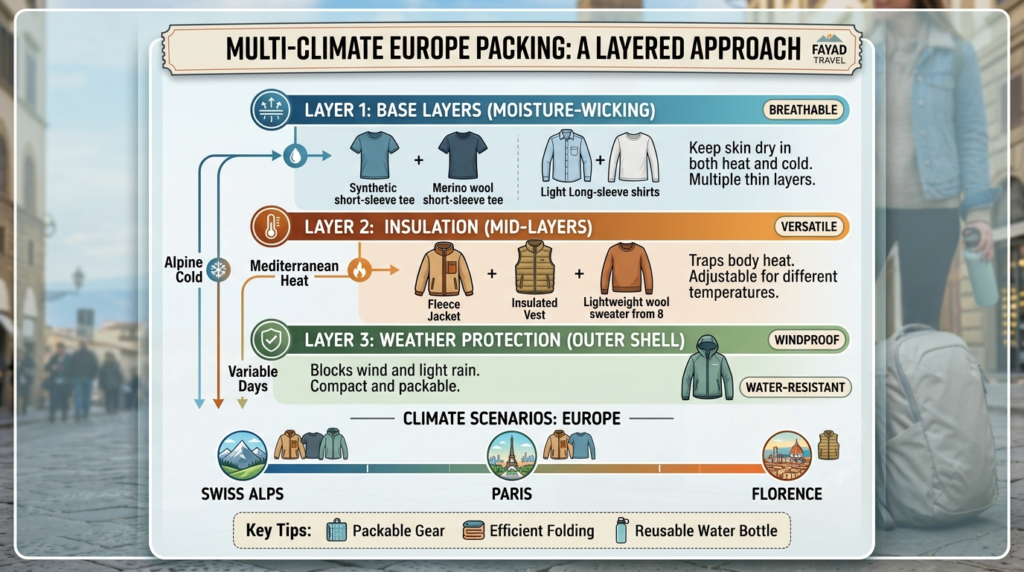
A reliable system rests on three layers: a lightweight base layer worn against the skin, a mid-layer for insulation, and an outer shell for wind and rain. On a cold, alpine morning, all three layers come together. On a warm coastal afternoon, only the base layer is needed — and it doubles as a standalone piece rather than sitting unused at the bottom of the suitcase.
Choosing Versatile Fabrics
Fabric choice does more work than most travelers realize. Merino wool and technical blends regulate temperature far better than cotton, resist odor over multiple wears, and pack down small — a real advantage when luggage space is shared across four or five destinations. Cotton, by contrast, is comfortable but bulky, slow to dry, and offers little insulation once damp.
Packing by Region: What Actually Changes
| Region Type | Typical Conditions | What to Prioritize |
|---|---|---|
| Alpine / Mountain | Cold mornings, sharp temperature drops at altitude | Insulating mid-layer, windproof shell, sturdy footwear |
| Mediterranean Coast | Warm days, breezy evenings | Breathable base layers, one light layer for evening wind |
| Northern European Cities | Cool, frequently overcast, occasional rain | Water-resistant shell, layerable knitwear |
| Central European Cities | Mild but changeable, indoor heating in cooler months | Adaptable mid-layer that works indoors and out |
“The travelers who pack lightest for multi-country European trips are rarely the ones who bring the least — they’re the ones who bring pieces that do more than one job.”
Respecting Luggage Limits Without Sacrificing Preparedness
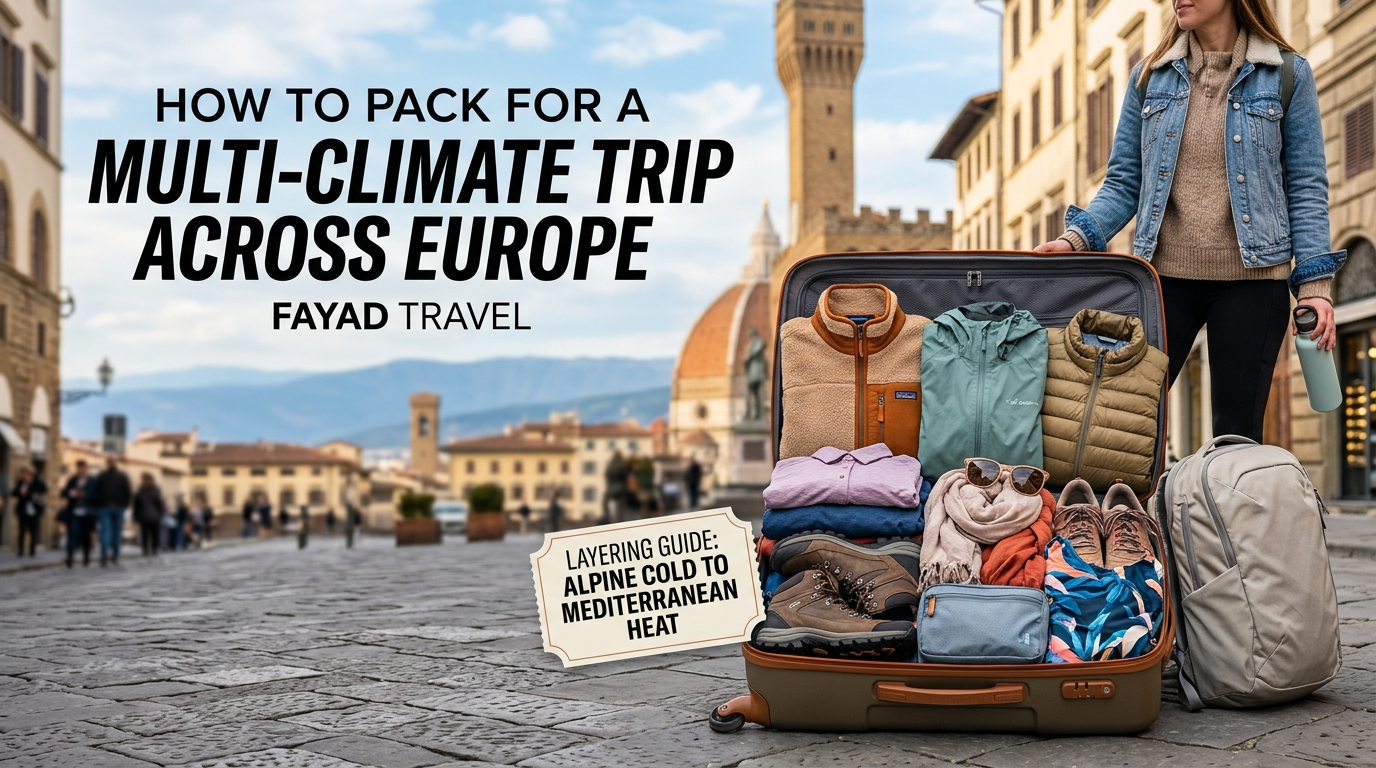
Multi-city European itineraries often involve regional flights or trains with stricter carry-on and checked baggage limits than long-haul routes out of Beirut. This makes luggage discipline as important as the clothing choices themselves. A capsule approach — roughly six to eight interchangeable tops, two to three bottoms, one insulating layer, and one weatherproof shell — covers most two-week itineraries without exceeding standard weight allowances.
Packing cubes help enforce this discipline by making the limits visible before departure rather than at the airport counter. Rolling rather than folding saves additional space and reduces creasing, which matters more on a trip with limited access to ironing between stops.
- One breathable base-layer set for warm coastal days
- One insulating mid-layer (fleece or lightweight knit) for cooler stops
- One packable, windproof-and-water-resistant outer shell
- Comfortable walking shoes plus one pair suited to dressier evenings
- A compact travel umbrella or packable rain layer
- A scarf or light wrap — useful for warmth, sun, and modesty at religious or cultural sites
Planning Beyond the Suitcase
Packing well is only half of a smooth multi-climate itinerary. The other half is sequencing — arranging the route so that climate transitions are gradual rather than abrupt, and building in a buffer day when moving between very different regions. This is where a locally planned itinerary makes a measurable difference: a route built with weather patterns in mind reduces the need to overpack for worst-case scenarios at every stop.
Frequently Asked Questions
Focus on a layering system rather than separate outfits for each destination. A base layer, one insulating mid-layer, and one weatherproof shell can adapt to most conditions across a multi-country route, cutting overall volume significantly.
Merino wool and technical performance fabrics generally outperform cotton — they regulate temperature better, resist odor, and pack down smaller, which matters when the same suitcase needs to work in four or five different regions.
It depends on the number of connections and whether regional or budget carriers are involved, since baggage allowances vary. A capsule wardrobe built around layering usually fits within carry-on limits even for two-week itineraries.
Most travelers overestimate this. Six to eight interchangeable tops, two to three bottoms, and one or two layering pieces typically cover a two-week trip when the pieces are chosen for versatility rather than variety.
Yes — our team builds itineraries that sequence climate transitions logically, so travelers aren’t packing for extremes at every single stop along a multi-country European route.
Planning a multi-country trip across Europe?
Fayad Travel designs Europe itineraries that make packing and climate transitions easier, from the Alps to the Mediterranean coast.Explore Europe Travel Packages