

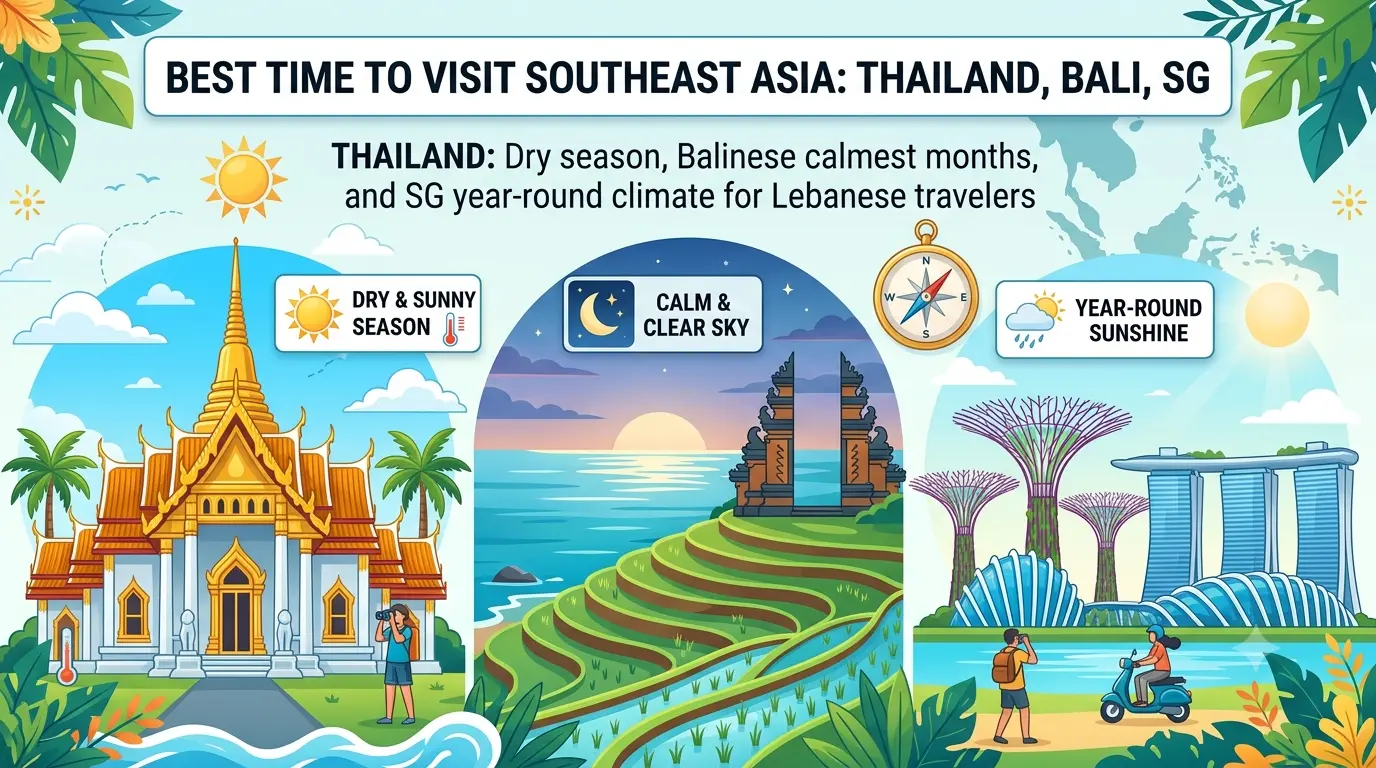
Southeast Asia’s tropical climate creates a common misconception among first-time visitors: that any month works equally well anywhere in the region. In reality, Thailand, Bali, and Singapore each run on a slightly different seasonal rhythm, and a multi-country itinerary timed around one destination’s ideal window can land squarely in another’s rainiest stretch. This guide breaks down the best time to visit Southeast Asia across all three destinations individually, so a combined itinerary gets timed sensibly rather than by guesswork — and so no leg of the trip gets stuck with the wrong end of a monsoon season.
Thailand: Cool Season, Hot Season, and Rainy Season
The Cool Season (November to February)
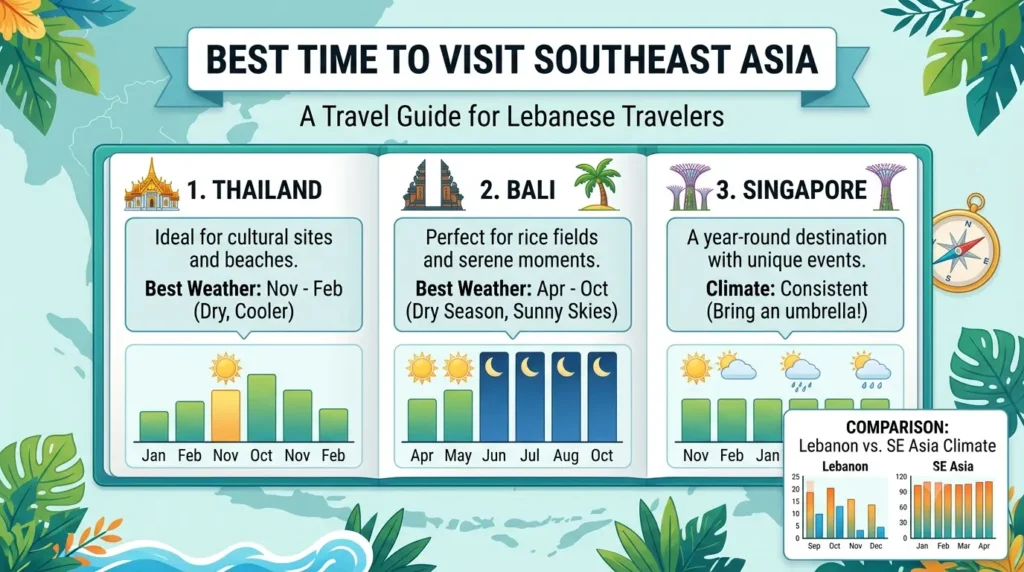
Thailand’s cool season is the most popular window for good reason — comfortable temperatures and lower humidity across most of the country, making it ideal for both Bangkok sightseeing and island time in the south. This is also the peak tourist season, meaning higher prices and busier attractions, particularly around the December-January holiday period.
The Hot Season (March to May)
March through May brings the country’s highest temperatures, often intense in Bangkok and the central plains, though this period also includes Songkran, Thailand’s water festival held April 13-15, which turns much of the country into a nationwide celebration and is genuinely worth experiencing for travelers who don’t mind the heat and the crowds it draws.
The Rainy Season (June to October)
June through October brings the southwest monsoon, with short, intense afternoon downpours rather than sustained all-day rain in most regions. This period offers meaningfully lower hotel rates and thinner crowds, along with lush, green scenery, making it a reasonable choice for travelers prioritizing value over guaranteed sunshine.
Bali: A Simpler Dry-and-Wet Pattern
Dry Season (April to October)
Bali’s dry season runs roughly April through October, delivering the most reliable weather for beach time, rice terrace hikes, and outdoor day trips. July and August sit at the peak of this window and draw the heaviest crowds and highest villa rates, while the surrounding shoulder months offer nearly identical weather at noticeably better value.
Wet Season (November to March)
November through March brings Bali’s wet season, characterized by humid conditions and a higher chance of rain, though typically in shorter bursts rather than continuous downpours. This period sees lower villa and resort rates, making it appealing for travelers building their itinerary primarily around villa time, spa days, and cultural experiences less dependent on constant sunshine.
Singapore: Consistently Warm, With Two Monsoon Patterns
Year-Round Tropical Climate
Singapore sits almost directly on the equator, meaning temperatures stay consistently warm and humid throughout the year with far less seasonal variation than either Thailand or Bali. This makes Singapore one of the more forgiving stops on a Southeast Asia itinerary when it comes to timing, since there’s no dramatically “wrong” season to visit.
Northeast and Southwest Monsoon Windows
Singapore does experience two monsoon patterns — the northeast monsoon (December to early March) tends to bring the wettest, most consistent rainfall, while the southwest monsoon (June to September) brings shorter, more localized afternoon showers. Neither pattern typically disrupts a city-based itinerary significantly, given how much of Singapore’s attraction lineup — Gardens by the Bay, Marina Bay Sands, its extensive indoor and covered attractions — is well suited to being enjoyed regardless of rain.
Common Mistakes When Timing a Southeast Asia Trip
Assuming One Regional Season Applies Everywhere
The most frequent planning mistake is treating “Southeast Asia” as a single climate zone and booking a trip based on one destination’s calendar without checking the others. A traveler planning around Thailand’s cool season, for instance, might not realize that same window sits closer to the tail end of Bali’s dry season rather than its peak, which is a meaningfully different, though still workable, set of conditions.
Underestimating Regional Temperature and Humidity Differences
Even within Thailand alone, conditions vary meaningfully between Bangkok, the northern hills around Chiang Mai, and the southern islands, with humidity and rainfall patterns shifting enough that a single “Thailand” seasonal guideline doesn’t apply with equal precision to every region on a multi-stop itinerary.
Booking Around Peak Season Without Checking Value Alternatives
Because peak-season pricing across all three destinations can run meaningfully higher than shoulder-season rates for very similar weather, it’s worth checking whether the true best time to visit Southeast Asia for a specific trip’s priorities is the widely marketed peak window or a slightly less obvious shoulder period offering nearly the same experience at better value.
Building a Multi-Country Itinerary Around the Right Season
Where the Seasons Actually Overlap?
For travelers combining Thailand and Bali in one trip, the cool season crossover point — roughly November through February — offers the best overlap between Thailand’s most comfortable months and Bali’s tail end of dry season, making it the strongest single window for a combined itinerary covering both destinations.
Why Singapore Simplifies Multi-Country Planning?
Because Singapore’s climate varies less dramatically across the year, it functions well as a flexible anchor point in a combined itinerary — a stopover or short stay that doesn’t need to be carefully timed the way the Thailand and Bali legs do, which takes some pressure off the overall itinerary planning.
Matching Trip Length to Seasonal Flexibility
Shorter Trips Benefit from Tighter Seasonal Targeting
For a shorter, single-country trip — say, ten days focused entirely on Thailand or Bali — it’s worth targeting that destination’s genuinely best window fairly precisely, since there’s less time built in to simply wait out a rainy stretch if the timing lands poorly.
Longer Multi-Country Trips Have More Built-In Flexibility
A longer itinerary spanning three or four weeks across Thailand, Bali, and Singapore naturally builds in more resilience against any single day of poor weather, since the itinerary isn’t riding on one narrow window the way a shorter, single-destination trip is. This is part of why longer Southeast Asia itineraries can afford to prioritize other factors — flight availability, festival timing, budget — slightly above chasing the single best time to visit Southeast Asia down to the exact week.
Festival Timing Worth Building an Itinerary Around
Thailand’s Songkran
Songkran, held nationwide April 13-15, is one of the more compelling reasons to visit Thailand during its hot season despite the temperatures, given the scale and genuine cultural significance of the celebration beyond its now-famous water fights.
Other Regional Festival Considerations
Bali’s Nyepi (Day of Silence), typically falling in March, involves a full-day island-wide shutdown with no flights in or out and residents required to stay indoors — a detail worth checking against travel dates specifically, since it affects arrival and departure logistics in a way most festivals don’t.
Frequently Asked Questions
For the best time to visit Southeast Asia across a combined Thailand and Bali itinerary, roughly November through February offers the strongest overlap between Thailand’s cool, comfortable season and the tail end of Bali’s dry season.
Thailand’s most comfortable, driest conditions run November through February, while Bali’s dry season runs somewhat longer, from April through October.
Singapore sees two monsoon patterns — northeast (December–March) and southwest (June–September) — but given the city’s largely indoor and covered attraction lineup, rain rarely disrupts a well-planned itinerary significantly.
For many travelers, yes — Songkran (April 13-15) is a genuinely significant cultural celebration, though it does coincide with the hottest part of the year and draws considerable crowds.
Nyepi, typically in March, involves a full-day island-wide shutdown with no flights operating in or out of Bali, which needs to be factored directly into arrival and departure planning if travel dates fall near it.
Planning a multi-country Southeast Asia trip and want the timing right across every stop? Speak with a Fayad Travel destination expert to build an itinerary around the best season for each destination.