


All three of these Indian Ocean islands market themselves as year-round destinations, and in a sense they are — none of them shuts down for a season the way a ski resort or a European Christmas market destination might. But “open year-round” isn’t the same as “equally good year-round,” and the difference between a trip timed well and one timed poorly shows up directly in sea conditions, rainfall, and — for honeymooners specifically — whether a hot air balloon or boat excursion actually goes ahead as planned. This guide breaks down the best time to visit Maldives, Seychelles, and Mauritius individually, since despite sitting in the same ocean, their seasonal calendars don’t actually line up — a detail that matters more than most travelers expect when booking a honeymoon around one of them.
Maldives: Dry Season vs. Monsoon Timing
The Dry Season (December to April)
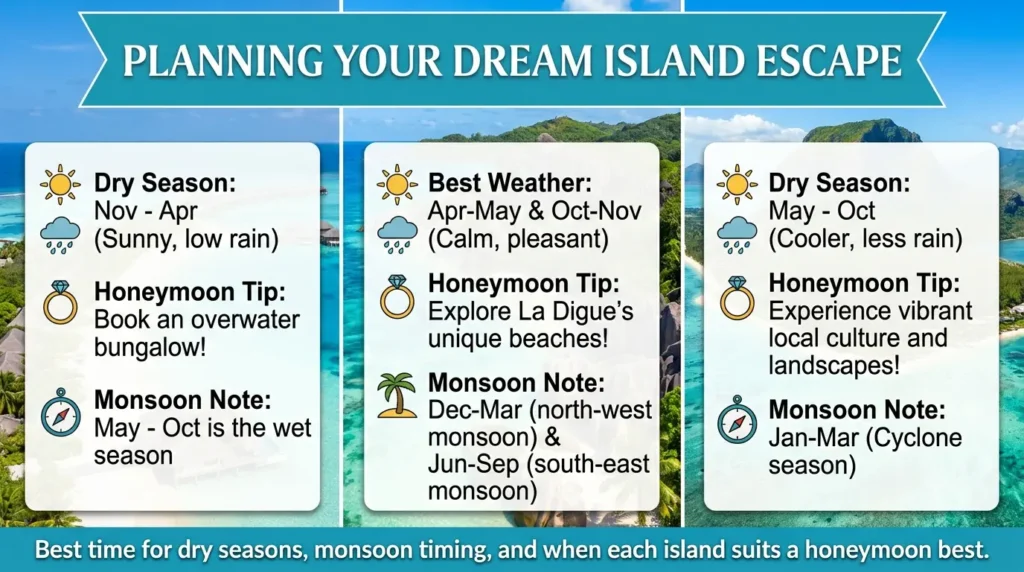
The Maldives’ dry season, roughly December through April, delivers the calmest seas, the most consistent sunshine, and the most reliable conditions for the daylight-dependent seaplane transfers that connect most resorts to the airport. This is also the busiest and most expensive window, particularly around the December-to-January peak, when demand from Northern Hemisphere winter travelers is at its highest.
The Wet Season (May to November)
The wet season brings the southwest monsoon, with a higher chance of short, intense rain showers rather than sustained day-long rain, along with noticeably lower resort rates and thinner crowds. Many honeymoon-focused experiences — private dinners, spa treatments, in-villa time — are largely unaffected by an afternoon shower, making the wet season a genuinely reasonable choice for couples prioritizing value over guaranteed sunshine.
When to Avoid Monsoon Season in the Maldives
Travelers most sensitive to rough seas or overcast conditions should be most cautious around the peak of the southwest monsoon, typically June through August, when wind and wave conditions are least predictable. Couples planning water-based excursions — diving, snorkeling trips, or sunset cruises — get more consistent conditions by leaning toward the shoulder months of April-May or October-November, which often combine reasonable rates with settled weather.
Seychelles: A Gentler Seasonal Swing
Calmest Months: April-May and October-November
Seychelles sits close enough to the equator that its seasonal variation is milder than either Maldives or Mauritius, but the calendar still matters. April-May and October-November are the calmest shoulder windows, with lighter winds and settled seas that suit island-hopping between Mahé, Praslin, and La Digue particularly well.
The Southeast Trade Wind Season (June to September)
From June through September, the southeast trade winds bring choppier conditions to the eastern coasts of the main islands, which is worth factoring in for couples planning boat excursions, diving, or a beach-heavy stretch on the more exposed side of an island.
Mauritius: A Clearer Dry-and-Wet Divide
Dry Season (May to November)
Mauritius runs on a more clearly defined cycle than either of the other two islands: May through November is dry, mild, and comfortable, making it the most popular window for honeymooners and the season most reliably suited to activity-heavy days — golf, catamaran sailing, hiking Le Morne.
Wet Season and Cyclone Risk (December to April)
December through April brings warmer, more humid conditions, a higher chance of short tropical downpours, and the tail end of cyclone season running through roughly March. This doesn’t rule the season out entirely — many honeymooners still visit successfully during these months — but it’s worth building some itinerary flexibility around potential weather disruption during this window.
Booking Windows and Price Timing Across the Three Islands
When Rates Peak Across All Three Destinations
All three islands see their highest demand and pricing around the Northern Hemisphere’s December-January holiday period, and again around European summer school breaks, meaning couples chasing the best time to visit Maldives, Seychelles, or Mauritius purely for value should generally look toward each destination’s respective shoulder season rather than these peak windows. This value-focused version of the best time to visit Maldives question comes up almost as often as the weather-focused one, particularly among couples working within a defined honeymoon budget.
Booking Ahead for Peak-Season Travel
Because overwater and beachfront villa inventory is genuinely limited at the smaller, more exclusive properties common across all three destinations, couples set on traveling during peak season should expect to book six to nine months ahead to secure their preferred resort and villa category, particularly for a fixed honeymoon date tied to a wedding.
Sample Trip Timing by Priority
Prioritizing Guaranteed Sunshine
For honeymooners who want the highest odds of consistent sun and calm seas regardless of cost, the Maldives’ December-to-April dry season and Mauritius‘ May-to-November dry season both deliver strong, predictable conditions, while Seychelles’ milder climate makes exact timing somewhat less critical to the overall experience.
Prioritizing Value Over Guaranteed Weather
Couples more focused on value than weather certainty often do well choosing the Maldives’ wet season or Mauritius’ December-to-April window, accepting a higher chance of short showers in exchange for meaningfully lower resort rates and thinner crowds — a trade that suits honeymooners planning most of their time around in-resort experiences rather than weather-dependent excursions.
Comparing All Three at a Glance
- Maldives: Best overall conditions December–April; wet season (May–November) offers value with occasional showers; avoid peak monsoon (June–August) for water-dependent activities.
- Seychelles: Calmest April–May and October–November; June–September brings choppier trade-wind conditions, particularly on exposed coasts.
- Mauritius: Dry and reliable May–November; December–April is warmer and wetter, with cyclone risk through March.
Combining Two Islands in One Trip
Matching Seasons Across a Combined Itinerary
Couples considering a Seychelles-and-Mauritius combination, or pairing either with a Maldives stopover, need to weigh each leg’s calendar independently rather than assuming one season suits both. Because Seychelles’ calmest months (April-May, October-November) don’t perfectly overlap with Mauritius’ dry season (May-November), a combined itinerary timed for late April through May or October through November tends to capture reasonably good conditions across both islands simultaneously.
Why This Matters More for Multi-Island Trips
A single-destination honeymoon only needs to work around one calendar, but a combined itinerary compounds the seasonal planning question — getting the timing right matters more, not less, when two islands’ weather windows both need to align with the travel dates.
Which Island’s Season Matters Most for a Honeymoon?
Weather-Dependent Experiences
For honeymooners specifically, the activities most worth planning around season are the ones that depend directly on calm water and clear skies — Maldives seaplane transfers and balloon-style excursions, Seychelles boat-based island-hopping, and Mauritius catamaran cruises all perform noticeably better within each destination’s respective calm window.
Flexibility for In-Resort Experiences
Experiences that happen entirely within the resort — spa treatments, private dinners, villa time — are largely season-proof across all three destinations, which is why a wet-season Maldives honeymoon or a December Mauritius trip can still deliver a genuinely excellent experience, provided expectations around outdoor excursions are set accordingly.
Planning Around the Right Season
Because all three islands are reached from Lebanon via a similar one-stop routing through the Gulf, the flight logistics don’t meaningfully favor one destination’s calendar over another — the real planning question is which season’s trade-offs (rain risk, wind, or peak-season pricing) matter least for the specific trip being planned. A travel advisor familiar with all three destinations’ calendars can help match the chosen island to the travel dates that actually work, rather than the other way around.
Frequently Asked Questions
Each has its own calmest window: the best time to visit Maldives is its dry season, December–April, while Seychelles is calmest April–May and October–November, and Mauritius is driest May–November.
The peak of the southwest monsoon, roughly June through August, brings the least predictable wind and wave conditions, making it worth avoiding for water-dependent excursions specifically.
Cyclone risk runs roughly December through March, and while many trips proceed without disruption, building some itinerary flexibility into that window is a sensible precaution.
Not necessarily — in-resort experiences like spa treatments and private dinners are largely unaffected by rain, though outdoor and water-based excursions are more weather-dependent during wetter months.
Seychelles, given its proximity to the equator, sees a gentler difference between its calmest and windiest months compared to the more clearly defined dry-and-wet cycles of the Maldives and Mauritius.
Deciding between these three islands for a honeymoon? Speak with a Fayad Travel destination expert and we’ll help you match the season to the trip.