


Unlike most seasonal-timing questions, a safari’s calendar isn’t just about comfortable weather — it’s about where a million-plus wildebeest happen to be standing on any given week, and that changes the entire character of a trip. A Tanzania safari booked for the calving season looks and feels almost nothing like the same trip booked for the Mara River crossings four months later, even though both fall within what’s broadly called “safari season.” This guide breaks down the best time for African safari travel across the region’s major destinations, so a trip gets timed around what a traveler actually wants to see — the migration itself, general game viewing, or simply the best value.
Understanding the Great Migration’s Yearly Circuit
A Continuous, Year-Round Movement
The Great Migration isn’t a single event with a start and end date — it’s the year-round, roughly clockwise movement of over a million wildebeest, along with hundreds of thousands of zebra and gazelle, across the Serengeti-Mara ecosystem spanning Tanzania and Kenya. Because the migration is driven by rainfall and grazing rather than a fixed calendar, timing shifts by a few weeks most years, which is worth treating as a strong guideline rather than a guaranteed schedule.
Calving Season (Late December to March)
The southern Serengeti’s Ndutu plains host the migration’s calving season roughly from late December through March, when thousands of wildebeest calves are born within a short, concentrated window. This period draws intense predator activity, since newborn calves represent an easy target, making it one of the most dramatic and reliably rewarding stretches of the entire migration calendar.
River Crossings (June to October)
As the dry season progresses, the herds move north through the western corridor, crossing the Grumeti River around May-June before reaching the more famous Mara River crossings, which typically peak from late July through September, with crossing activity continuing into October in some years. This is the migration’s most photographed and highest-demand period, and camps in the northern Serengeti and Masai Mara book out furthest in advance for these months.
Where the Herds Are the Rest of the Year
Outside calving and crossing season, the migration moves through the central and western Serengeti (roughly April through July) before beginning its journey back south through the eastern Serengeti toward the calving grounds in November and December, completing the yearly circuit.
Tanzania vs. Kenya for Migration Timing
Tanzania Offers More Flexibility
Because the herds spend the majority of the year within Tanzania’s Serengeti ecosystem — the southern plains for calving, the central and western Serengeti through the middle of the year, and the northern Serengeti from July onward — Tanzania offers considerably more flexibility on timing than Kenya alone, which is part of why Tanzania so often comes up first in any discussion of the best time for African safari travel.
Kenya’s Narrower Window
Kenya’s Masai Mara holds the migrating herds for a comparatively shorter stretch, broadly July through October, coinciding with the Mara River crossings on the Kenyan side of the border. Travelers building an itinerary specifically around Kenya rather than Tanzania need to work within this narrower window to reliably catch the migration there.
Dry Season vs. Green Season Across East Africa
The Dry Season (June to October)
East Africa’s dry season delivers the most reliable game viewing conditions overall, independent of the migration specifically — sparse vegetation makes wildlife easier to spot, and animals concentrate around remaining water sources. This overlaps directly with the Mara River crossing period, which is part of why June through October represents peak safari season and peak pricing across the region.
The Green Season (November to May)
The green season brings lush scenery, dramatically lower rates, and thinner crowds, along with the calving season’s predator drama in its early months. Rain tends to fall in shorter, more predictable bursts rather than continuous downpours, and this period also offers exceptional birdwatching as migratory species arrive.
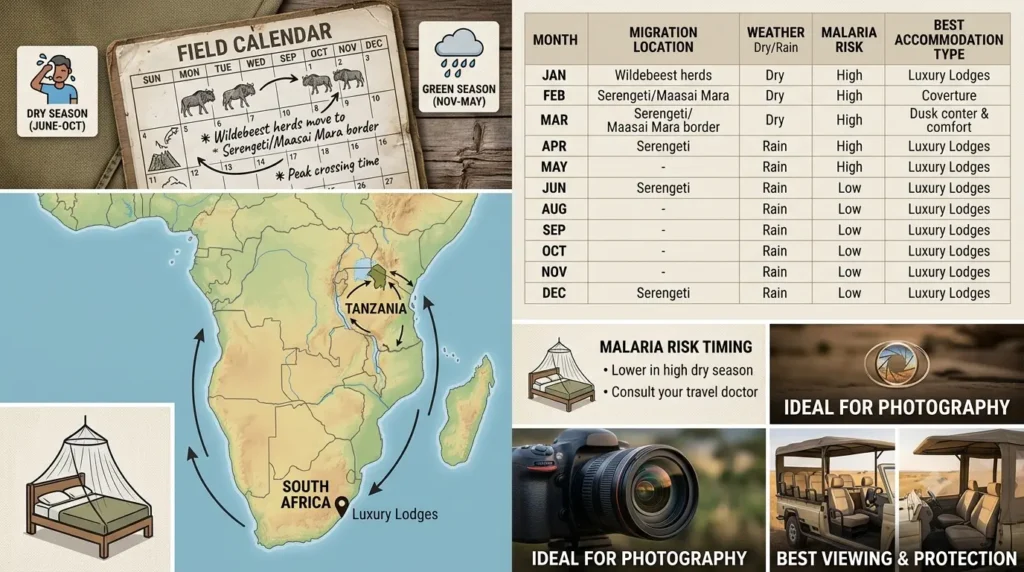
South Africa: A Different Seasonal Calendar Entirely
Dry Season (May to September)
South Africa’s safari regions, including Kruger National Park and its neighboring private reserves, run on their own seasonal cycle, largely independent of East Africa’s migration calendar — which is exactly why the best time for African safari travel can’t be answered with one universal rule across the whole continent. The dry winter months, May through September, offer the best game viewing conditions, with sparse vegetation and animals concentrated around waterholes, similar in principle to East Africa’s dry season logic but on an entirely different calendar.
Malaria Risk Considerations
Malaria risk in South Africa’s safari regions is generally higher during the warmer, wetter summer months (roughly November through April) and lower during the dry winter season, which is one reason many travelers — particularly families with young children — lean toward South Africa’s dry-season window or choose one of the region’s several malaria-free private reserves regardless of season.
Combining Tanzania and South Africa in One Trip
Handling Two Different Calendars in One Itinerary
Travelers combining an East Africa migration safari with a South Africa extension need to plan around two genuinely separate seasonal systems rather than assuming one calendar applies to both legs. Because Tanzania’s dry season (June–October) and South Africa’s dry season (May–September) largely overlap, a combined itinerary timed for July through September tends to capture good conditions across both regions simultaneously.
Why This Combination Works Well for Timing
This overlap is one of the more convenient coincidences in safari planning — it means travelers don’t have to choose between optimal timing for one leg of the trip at the expense of the other, unlike some multi-destination itineraries where the best windows for each stop pull in opposite directions.
Booking Windows for Peak Safari Season
How Far Ahead to Book Crossing-Season Camps
Camps positioned along the active stretch of the Mara River during peak crossing season routinely book out close to a year in advance, particularly the smaller, more exclusive properties with direct river access. Travelers set on witnessing the crossings specifically should treat this as a genuine planning deadline rather than a soft recommendation.
More Flexibility Outside Peak Windows
Calving season and the green-season months generally allow for a shorter booking lead time, though popular calving-season camps around Ndutu still fill up meaningfully faster than off-peak options elsewhere in the Serengeti ecosystem.
Common Mistakes When Timing a Safari
Assuming the Migration Follows a Fixed Calendar
Because migration timing is driven by rainfall rather than a fixed date, travelers who book rigidly around a specific week sometimes arrive to find the herds have moved earlier or later than the typical pattern suggests. Building in a few extra days, or choosing a camp with strong access to multiple areas of the migration route, meaningfully improves the odds of catching the action regardless of exact timing.
Overlooking South Africa’s Separate Calendar
Because East Africa’s migration calendar dominates most general safari content, travelers sometimes mistakenly apply Tanzania and Kenya’s dry-season logic to South Africa without realizing the two regions run on entirely separate seasonal cycles tied to different hemispherical weather patterns.
Not Weighing Malaria Risk Against Travel Dates
Especially for families or travelers with health considerations, overlooking the seasonal shift in malaria risk — higher in the wetter months across most safari regions — can be an avoidable planning gap, particularly when malaria-free reserve alternatives exist in several regions regardless of season.
Matching the Season to What You Want to See
Travelers Prioritizing the Migration Specifically
For travelers whose primary goal is witnessing the Great Migration itself — either the crossings or the calving season — timing needs to be precise and booked well in advance, since camps positioned along the active migration route fill up as much as a year ahead for the peak crossing months. For this group, the best time for African safari travel is dictated almost entirely by the migration’s own calendar rather than general weather preferences.
Travelers Prioritizing General Game Viewing and Value
For travelers less fixed on the migration specifically and more focused on general wildlife viewing, comfortable weather, and better value, the green season or the shoulder months around the main migration windows can deliver an excellent safari experience at meaningfully lower cost.
Frequently Asked Questions
For the best time for African safari travel focused specifically on the river crossings, late July through September is the strongest window, with activity sometimes continuing into October, though exact timing shifts year to year based on rainfall.
Calving season runs roughly late December through March in the southern Serengeti’s Ndutu plains, drawing intense predator activity around the newborn calves.
Tanzania offers more flexibility since the herds spend most of the year within its borders, while Kenya’s Masai Mara holds the migration for a narrower window, broadly July through October.
May through September, South Africa’s dry winter season, offers the best game viewing conditions in Kruger and neighboring private reserves, along with generally lower malaria risk than the wetter summer months.
Yes, particularly for travelers prioritizing value, thinner crowds, and lush scenery over guaranteed migration crossings — the green season also offers strong predator activity during calving season and excellent birdwatching.
Planning a safari and want the timing built around what you most want to see? Speak with a Fayad Travel destination expert to time your trip around the migration or the season that suits you best.