
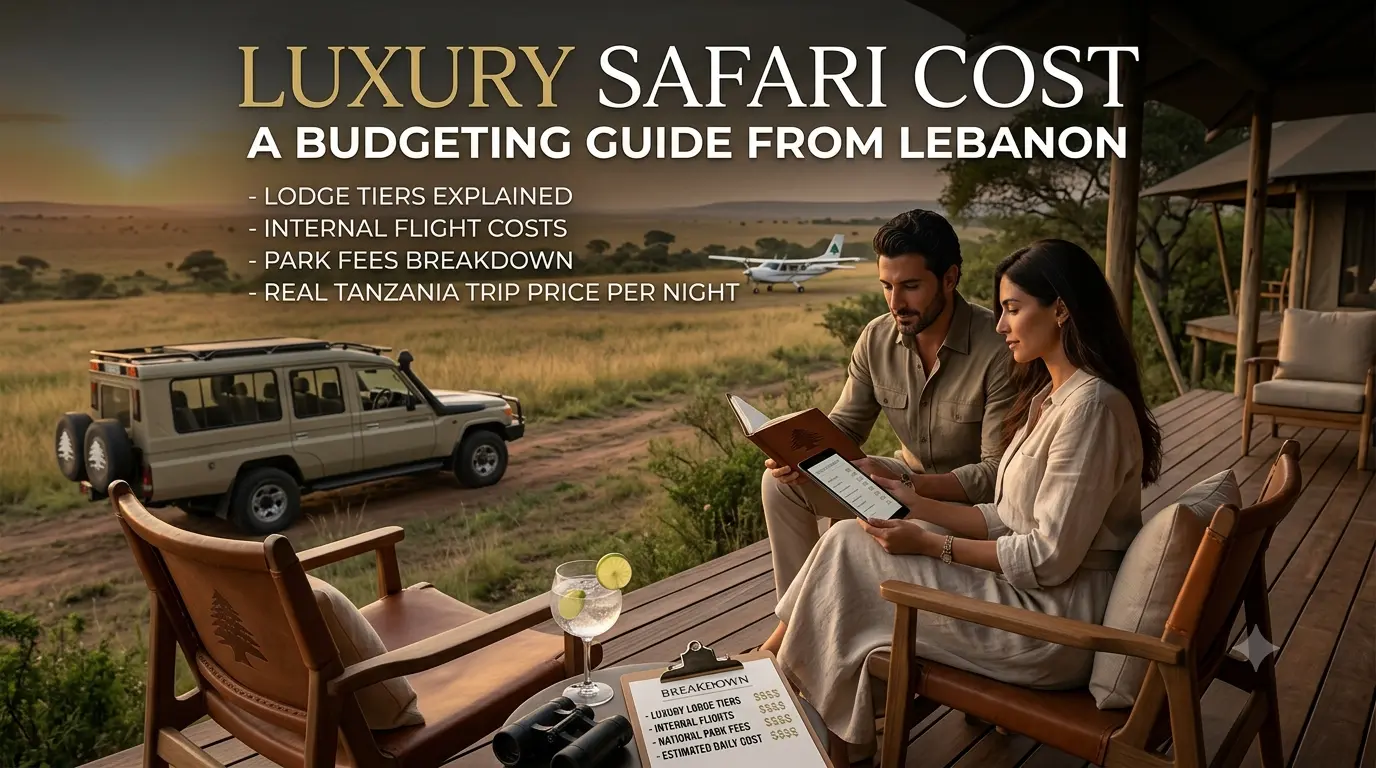
A safari is one of the few trips where the price range genuinely spans an entire order of magnitude — a comfortable week in Tanzania can run anywhere from $2,500 to well over $18,000 per person, and both figures buy a completely legitimate, well-run experience. The difference comes down almost entirely to accommodation tier, transport method, and how remote the reserve is, which makes safari budgeting more nuanced than most other luxury trips. This guide breaks down the real luxury safari cost Lebanese travelers should expect, piece by piece, so a quote makes sense rather than arriving as a mystery number — and so two safaris that look similar on paper can actually be compared fairly.
What Actually Drives Safari Pricing?
Accommodation Is the Single Biggest Variable
Unlike a beach holiday where hotel category is one factor among several, on safari the lodge or camp choice dominates the total luxury safari cost more than almost anything else. A public campsite might run $30–$50 per person per night, a comfortable mid-range tented camp with private bathrooms sits in the $150–$500 range, and top-tier luxury lodges with plunge pools, gourmet dining, and dedicated guides run $700 to $1,500 or more per person per night, with the most exclusive fly-in camps exceeding $2,000 in peak season.
Location and Exclusivity
A lodge inside a heavily visited public park competes on price with dozens of similar properties nearby, while a camp inside a private conservancy or concession — often bordering the Serengeti or the Masai Mara — charges a premium for exclusive traversing rights, off-road game viewing, and a meaningfully lower guest-to-guide ratio. This exclusivity premium is one of the clearest drivers separating a $300-a-night lodge from a $1,500-a-night one, even when both sit in the same general region.
Season
Safari pricing swings considerably between peak and low season — often by a factor of two. Peak season (roughly June through October, coinciding with the Great Migration in East Africa, plus February for calving season) commands premium rates, while the shoulder and green seasons (March through May) can offer the same lodges at meaningfully lower rates, with fewer crowds as a bonus.
Typical Luxury Safari Cost by Tier
Mid-Range Safari
A mid-range safari — comfortable permanent tented camps, private bathrooms, full board, and shared or semi-private game drives — typically runs $350 to $800 per person per day all-inclusive, making a 7-day Tanzania trip for two roughly $5,000 to $9,000 total including park fees, meals, and transfers, though usually excluding international flights.
Luxury Safari
Stepping up to genuine luxury — top-tier lodges with private plunge pools, dedicated guides, and all-inclusive dining and drinks — typically runs $700 to $1,500 per person per night, putting a 7-night luxury safari for two in the $10,000 to $20,000 range overall, again before international flights.
Ultra-Luxury and Fly-In Safaris
At the very top of the market, remote fly-in camps accessible only by light aircraft, often set within private concessions with exclusive traversing rights, can exceed $1,500 to $2,500 per person per night, pushing a week-long trip for two well past $20,000. This tier trades driving days for light-aircraft hops between properties, buying more time actually at wildlife sightings rather than in transit.
What’s Usually Included in an All-Inclusive Safari Rate?
Standard Inclusions
Most safari lodges price on a fully inclusive basis — accommodation, all meals, house drinks, laundry, and shared or private game drives with a professional guide are typically bundled into the quoted nightly rate, which is part of why safari pricing looks steep at first glance compared to a standard hotel rate.
What’s Usually Extra?
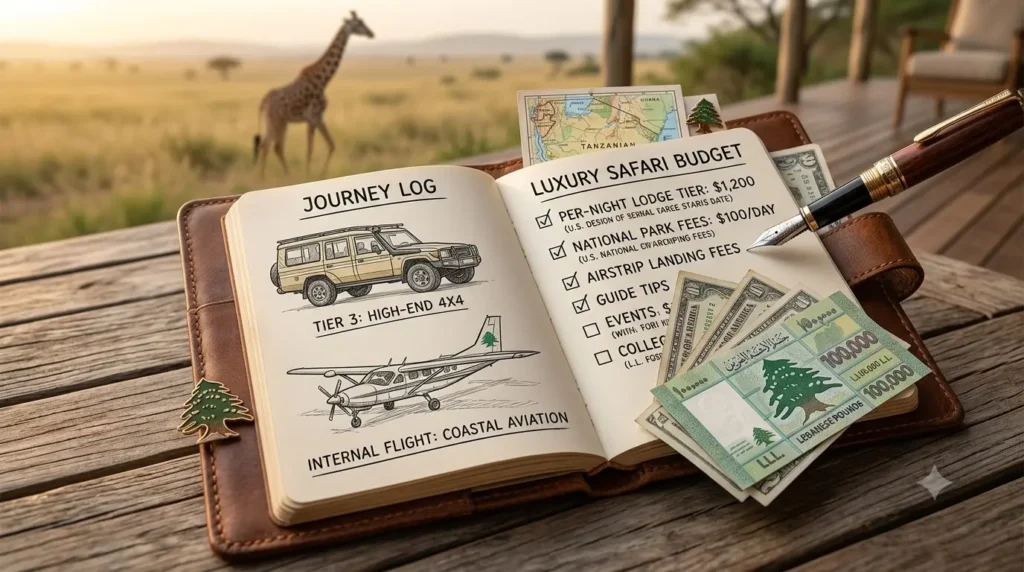
Despite the “all-inclusive” framing, a few costs typically sit outside the headline rate: park and conservation fees (charged per person per day by the relevant park authority), premium drinks or specialty wines beyond the house selection, guide and camp staff gratuities, and any add-on experiences like a hot air balloon safari over the Serengeti, which typically runs several hundred dollars per person as a standalone activity.
Internal Flights and Transport Costs
Getting from Beirut to East or Southern Africa
There’s no direct flight from Beirut to Tanzania or South Africa, so international travel typically routes through a regional hub — Ethiopian Airlines via Addis Ababa is one of the more direct options to Kilimanjaro, with total journey times often in the 7–14 hour range depending on connection, while other routings via Doha, Dubai, or Istanbul are also common depending on the specific safari destination and time of year.
Driving Between Parks vs. Flying
Within the safari itself, a road-based safari (driving between parks in a private or shared 4×4) is the more cost-effective transport method, while a fly-in safari — using small aircraft to hop between remote airstrips — adds meaningfully to the total cost but saves significant time, which matters most for shorter trips covering multiple parks or conservancies.
Sample Safari Budget Breakdown
A Realistic 7-Night Luxury Itinerary
Putting the pieces together, a realistic 7-night luxury safari for a couple might break down roughly as follows: $10,000–$16,000 for lodge accommodation at the luxury tier, $1,000–$2,500 for park and conservation fees across the trip, several hundred dollars for guide and staff gratuities, and an optional $1,200 for a two-person Serengeti balloon safari — before factoring in international flights from Beirut, which typically add several hundred to over a thousand dollars per person depending on route and season.
Where Costs Can Be Trimmed Without Losing the Experience?
Choosing a slightly less remote lodge, traveling in the shoulder season rather than peak months, or opting for a road-based safari over a fly-in itinerary can meaningfully lower the total luxury safari cost without giving up the core experience — private game drives, quality guiding, and comfortable, well-located accommodation.
Budgeting a Safari for Families or Larger Groups
Per-Person Costs vs. Group Discounts
Safari pricing is almost always quoted per person sharing a room or tent, and larger groups can sometimes unlock modest per-person discounts on vehicle-based game drives, since the cost of a private vehicle and guide gets spread across more people. Families should also check each lodge’s policy on children — some properties offer discounted rates for younger guests, while others set a minimum age (often 6 or 8 years old) for participating in game drives at all.
Private Vehicle vs. Shared Game Drives
Families or small groups wanting more flexibility often opt for a private vehicle and guide rather than joining shared game drives with other lodge guests, which adds to the overall luxury safari cost but allows the itinerary to be tailored around nap schedules, photography interests, or simply a slower pace than a shared vehicle would allow.
Choosing Between East Africa and Southern Africa
Tanzania and Kenya: The Classic Migration Safari
East Africa’s Serengeti and Masai Mara are built around the Great Migration and tend to command the highest luxury safari cost per night among mainstream safari destinations, largely due to the sheer density of wildlife and the premium placed on private conservancy access during peak migration months.
South Africa: More Accessible Luxury
South Africa’s private reserves — many bordering Kruger National Park — offer a comparable luxury experience at a somewhat more accessible price point, partly because malaria-free reserves and shorter, more direct flight connections make logistics simpler, and partly because the broader lodge inventory creates more price competition across tiers.
Combining Both in One Trip
Some luxury travelers combine a Tanzania or Kenya safari with a South Africa extension — pairing the migration experience with Cape Town or the Winelands, for instance — though this adds meaningfully to both the total trip cost and the internal flight logistics, given the distance between East and Southern Africa.
Common Safari Budgeting Mistakes to Avoid
Comparing Quotes That Don’t List the Same Inclusions
The most common mistake in safari budgeting is comparing two quotes side by side without confirming they include the same things — one operator’s rate might bundle park fees and internal flights, while another lists them as separate line items, making an apparently cheaper quote actually reflect a higher real luxury safari cost once everything is accounted for.
Underestimating Internal Flights and Transfers
Because East Africa’s parks are often spread across a wide geographic area, internal flights between regions (say, the Serengeti and Zanzibar, or the Serengeti and Ngorongoro) can add up meaningfully and are easy to underestimate when budgeting from lodge rates alone.
Skipping Travel Insurance for a High-Value Trip
Given how much a luxury safari costs relative to other trips, adequate travel insurance — covering trip cancellation and medical evacuation from a remote reserve — is worth budgeting for as a genuine line item rather than an afterthought, particularly for fly-in itineraries reaching more remote camps.
Planning a Safari Budget with a Travel Advisor
Because safari pricing varies so widely by lodge, season, and region — and because quotes from different operators don’t always list the same inclusions clearly — working with an advisor who can lay out exactly what’s covered in a given rate (park fees, drinks, gratuities, internal flights) helps avoid comparing quotes that look similar on paper but include very different things underneath.
Frequently Asked Questions
A 7-night luxury safari for two typically comes to a total luxury safari cost of $10,000 to $20,000, covering lodge accommodation, meals, drinks, and game drives, though usually excluding international flights and optional add-ons like a hot air balloon safari.
Park and conservation fees, premium drinks beyond the house selection, guide and staff gratuities, and standalone activities like a balloon safari typically sit outside the quoted nightly rate.
For shorter trips covering multiple parks or remote conservancies, yes — it saves significant transit time. For a single-region trip with more days available, a road-based safari can deliver a similar experience at a lower cost.
The green season (roughly March through May) offers meaningfully lower rates than the June-to-October peak season, along with thinner crowds, though rainfall is more frequent during this period.
There’s no direct flight from Beirut, so travel typically routes through a regional hub such as Addis Ababa, Doha, Dubai, or Istanbul, with total journey times commonly in the 7- to 14-hour range depending on the specific route and connection.
Ready to plan a luxury safari with a clear, honest budget? Request a tailored quote from Fayad Travel and we’ll break down exactly what’s included at every price tier.