
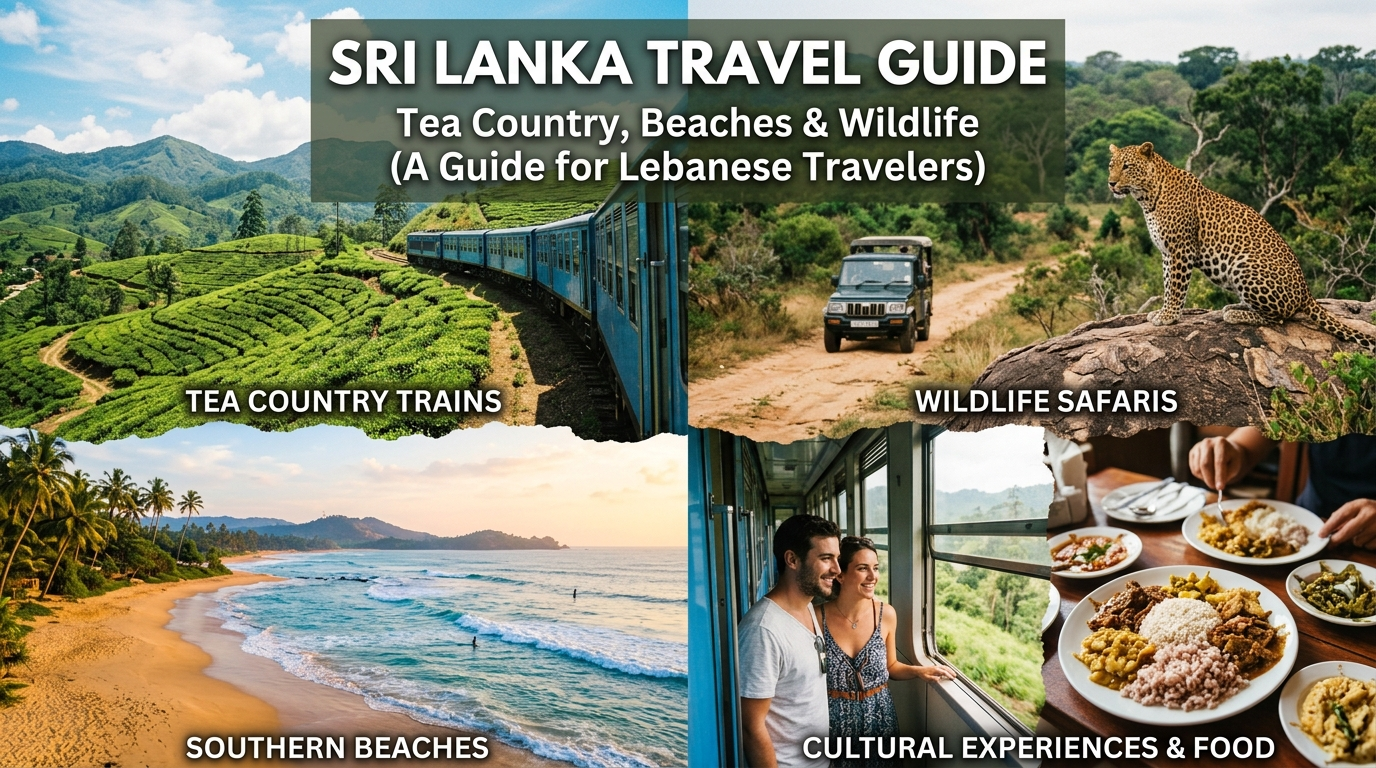
Few destinations pack ancient ruins, misty tea plantations, leopard safaris, and genuinely excellent beaches into a country roughly the size of Ireland the way Sri Lanka does. A single well-paced trip can move from the ancient Cultural Triangle to the cool hill country’s train journeys to the palm-lined south coast, all without the long internal flights other multi-region trips often require. This Sri Lanka travel guide covers how to structure that trip and what Lebanese travelers need to know before booking — from realistic pacing across regions to the current entry requirements worth confirming ahead of time.
Getting There and Entry Requirements
Flight Routing from Beirut
There’s no direct flight from Beirut to Colombo, so most itineraries route through a Gulf hub — Doha, Dubai, Abu Dhabi, or Muscat are the most common connections — with total journey time typically running nine to eleven hours depending on the specific routing and layover.
The Electronic Travel Authorization (ETA)
All foreign nationals, including Lebanese travelers, need an Electronic Travel Authorization (ETA) applied for online before arrival in Sri Lanka. Following a 2026 cabinet decision, nationals of 40 specific countries became eligible for a free 30-day tourist ETA as of May 25, 2026, while other nationalities continue to pay the standard ETA fee — it’s worth confirming current fee status directly with the Sri Lanka Embassy in Beirut before applying, since this list and the underlying policy have both been actively revised this year.
Budgeting for a Sri Lanka Trip
Value is one of the genuine strengths this Sri Lanka travel guide can highlight, since the country delivers a lot of ground covered relative to overall cost.
Typical Costs Across the Country
Sri Lanka ranks among the better-value destinations covered on this site — comfortable mid-range hotels typically run $50 to $150 per night, boutique and higher-end properties run $150 to $400+, and a private driver (a genuinely popular and practical way to get around the country) typically runs $40 to $70 per day including fuel.
A Realistic Total for a 10-Day Trip
Combining flights, a mix of accommodation across the Cultural Triangle, hill country, and south coast, a private driver, and activities like the Yala safari and tea estate tours, a comfortable 10-day Sri Lanka trip for a couple typically totals $2,500 to $4,500.
Best Time to Visit Sri Lanka
Two Monsoon Systems, Two Different Coasts
Sri Lanka’s weather is shaped by two separate monsoon seasons affecting different parts of the island — the southwest monsoon (roughly May to September) affects the west and south coasts and hill country, while the northeast monsoon (roughly October to January) affects the east coast, meaning there’s often a reasonably dry region somewhere on the island regardless of when a trip is booked.
The Most Popular Overall Window
December through March generally offers the most reliable weather across the Cultural Triangle, hill country, and south coast simultaneously, making it the most popular window for a trip covering all three regions, though it’s also the busiest and most expensive stretch of the year.
Sri Lanka for Family Travel
Why Sri Lanka Works Well for Families?
The combination of manageable driving distances between regions, engaging wildlife experiences, and beach time at the end of the trip gives Sri Lanka a natural structure that suits families well, without the long-haul flights or extreme climate demands some other multi-region destinations require.
Pacing Considerations with Children
Building in downtime between the more active Cultural Triangle and hill country legs and the more relaxed south coast stretch helps keep the pace manageable for families traveling with younger children, particularly given Sigiriya’s climb and the hill country’s cooler but more strenuous hiking options.
Practical Travel Tips
Getting Around the Country
A private driver is by far the most popular and practical way for visitors to move between Sri Lanka’s regions, offering flexibility that public transport (outside the scenic hill country train) doesn’t easily match, particularly for a multi-region itinerary on a tighter timeline.
Currency and Payments
Sri Lanka’s currency is the Sri Lankan rupee, with cash still preferred at smaller vendors and rural areas, though hotels and larger restaurants in more visited areas generally accept card payments.
The Cultural Triangle: Ancient Cities and Sigiriya
Sigiriya Rock Fortress
Sigiriya, an ancient rock fortress rising dramatically out of the surrounding jungle, is Sri Lanka’s single most recognizable landmark and typically the anchor of a Cultural Triangle visit — the climb to the summit takes roughly an hour and rewards with panoramic views and the remains of an elaborate palace complex.
Dambulla’s Cave Temples
A short distance from Sigiriya, the Dambulla cave temple complex houses an extensive collection of Buddhist murals and statues carved into and around a series of natural caves, offering a different, equally impressive layer of the region’s ancient history.
Kandy and the Temple of the Tooth
Kandy, Sri Lanka’s cultural capital, centers around the Temple of the Sacred Tooth Relic, one of Buddhism’s most important pilgrimage sites, along with a scenic lake and botanical gardens that round out a comfortable one-to-two-day stay.
Tea Country: Trains, Plantations, and Cool Mountain Air
The hill country stretch is often the most memorable part of any Sri Lanka travel guide’s itinerary, and for good reason.
The Ella to Kandy Train Journey
The train journey through Sri Lanka’s hill country, particularly the stretch through Ella and Nuwara Eliya, is widely considered one of the world’s most scenic rail journeys, winding through tea plantations, misty valleys, and small mountain villages at a genuinely unhurried pace.
Nuwara Eliya’s Colonial Character
Nuwara Eliya, nicknamed “Little England” for its colonial-era architecture and noticeably cooler climate, sits at the heart of Sri Lanka’s tea-growing region, with working tea estates offering tours and tastings that give visitors a direct look at how the country’s famous Ceylon tea is actually produced.
Ella’s Hiking and Viewpoints
Ella offers some of the hill country’s best short hikes, including Little Adam’s Peak and the Nine Arch Bridge, both manageable half-day outings that pair well with the train journey and tea plantation visits.
Wildlife: Yala National Park and Beyond
No Sri Lanka travel guide would be complete without covering the wildlife side of the country, which rivals its cultural and scenic highlights.
Yala National Park’s Leopard Density
Yala National Park, on the southeastern coast, holds one of the highest leopard densities of any park in the world, alongside elephants, sloth bears, and a wide range of birdlife, making it Sri Lanka’s premier safari destination and a genuinely different kind of wildlife experience than an African safari.
Whale Watching from Mirissa
Mirissa, on the south coast, offers seasonal whale watching excursions, with blue whales and sperm whales among the species regularly sighted depending on timing — a strong add-on for travelers whose itinerary already includes the nearby beach stretch.
The South Coast: Beaches and Galle Fort
The south coast is where this Sri Lanka travel guide’s itinerary typically winds down, trading ancient sites and cool mountain air for palm-lined beaches.
Galle Fort’s Colonial Charm
Galle Fort, a UNESCO World Heritage Site built by Portuguese and later Dutch colonists, offers a walkable, atmospheric old town with boutique shops, cafés, and ocean views from its historic ramparts — a strong half-to-full-day addition to a south coast beach stay.
Beach Towns Along the South Coast
Mirissa, Weligama, and Bentota each offer a slightly different south coast beach experience — Mirissa and Weligama leaning toward a more laid-back, surf-friendly atmosphere, and Bentota offering a more polished resort scene, giving travelers a genuine range of options within a relatively compact stretch of coastline.
Building a Sri Lanka Itinerary
Pulling the whole Sri Lanka travel guide together into a bookable structure comes down to answering one core question first.
How Many Days Do You Need in Sri Lanka?
A comfortable trip covering the Cultural Triangle, tea country, and the south coast typically needs ten to twelve days given the country’s compact size but genuinely varied terrain; a shorter one-week trip can still work well by focusing on two of the three regions rather than all three.
A Sample 10-Day Route
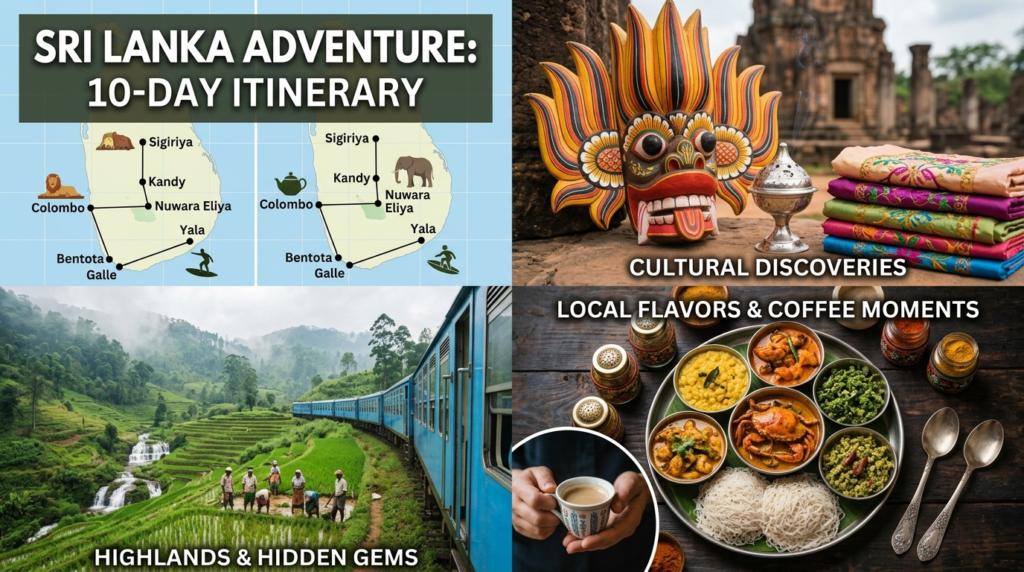
A well-paced itinerary might open with three nights in the Cultural Triangle (Sigiriya, Dambulla, Kandy), continue with two to three nights in the hill country (Nuwara Eliya and Ella, connected by the scenic train), and close with four nights on the south coast, combining Galle Fort, beach time, and a Yala safari or Mirissa whale watching excursion depending on which fits the route better.
Sri Lankan Cuisine
Rice and Curry, and Hoppers
Sri Lankan cuisine centers on rice and curry — a spread of multiple curries and side dishes served together — along with hoppers, bowl-shaped fermented rice-and-coconut-milk pancakes often served with an egg cooked into the center, both worth prioritizing over more internationally generic hotel menus.
Ceylon Tea Beyond the Plantation Tour
Beyond the formal tea estate visits in Nuwara Eliya, Ceylon tea shows up everywhere in Sri Lanka’s everyday food culture, and trying it prepared the traditional way — strong, often with condensed milk — offers a small but genuine cultural touchpoint throughout the trip.
Frequently Asked Questions
As this Sri Lanka travel guide recommends, ten to twelve days works well for a trip covering the Cultural Triangle, tea country, and the south coast; a one-week trip can still work by focusing on two of the three regions.
Yes, all travelers need an Electronic Travel Authorization (ETA) applied for online before arrival; whether Lebanese nationals qualify for the fee-free category introduced in 2026 is worth confirming directly with the Sri Lanka Embassy in Beirut.
The scenic train journey through Ella and Nuwara Eliya, combined with a working tea estate tour and tasting, offers the most complete introduction to the region.
Yes — Yala holds one of the highest leopard densities of any park in the world, alongside elephants and diverse birdlife, making it Sri Lanka’s premier safari destination.
There’s no direct flight from Beirut, so most itineraries connect through a Gulf hub like Doha, Dubai, or Abu Dhabi, with total travel time typically nine to eleven hours.
Ready to plan a Sri Lanka trip covering tea country, beaches, and wildlife? Speak with a Fayad Travel destination expert to build the right route and confirm current entry requirements.