
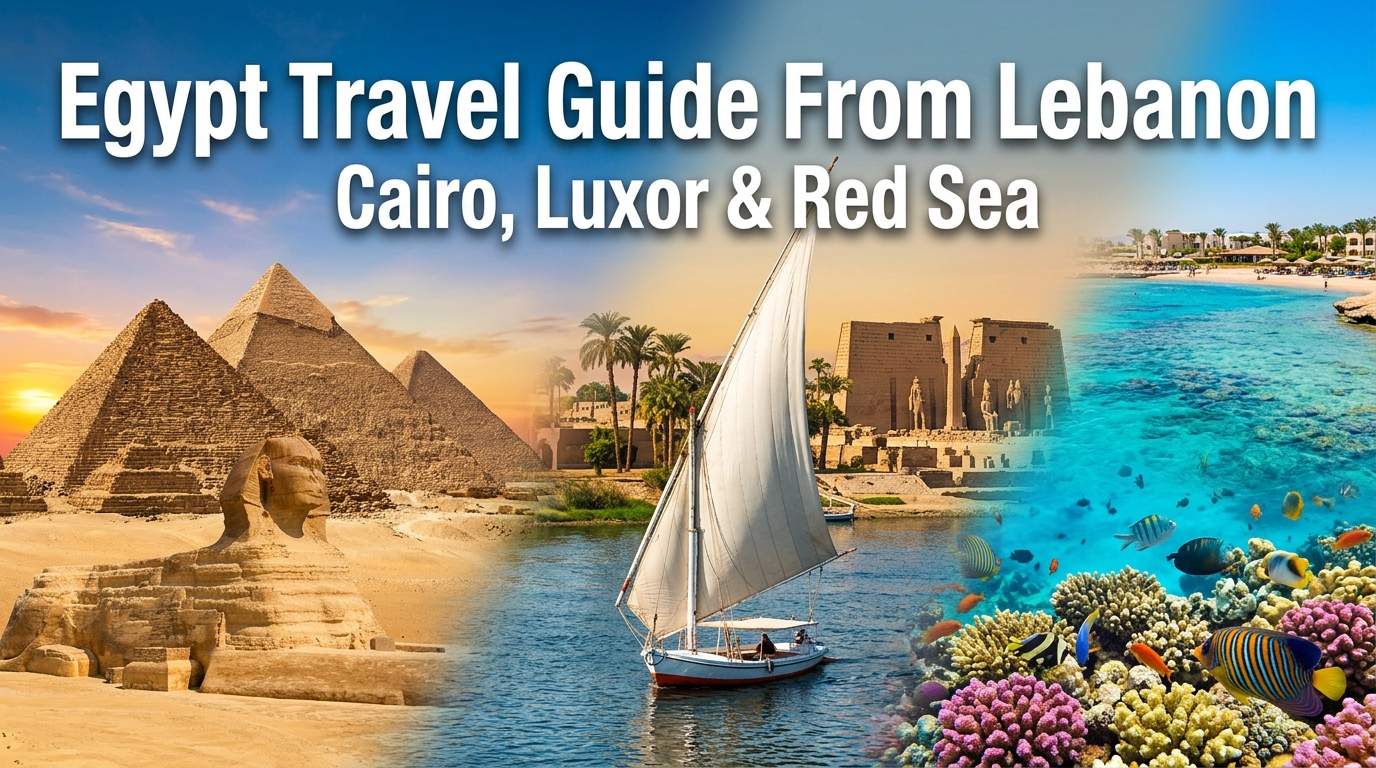
Few destinations pack in as much sheer historical density as Egypt, and few are as genuinely convenient for Lebanese travelers to reach — a short direct flight connects Beirut to Cairo, and once there, the country offers a rare combination of ancient monuments, a slow Nile cruise through Luxor and Aswan, and Red Sea resort time that can turn a history-focused trip into a proper beach holiday too. This Egypt travel guide covers how to structure a trip across all three, along with what Lebanese travelers specifically need to know before booking — from the direct flight to a genuinely nuanced visa process worth understanding ahead of time.
Getting There and Entry Requirements
A Direct, Short Flight from Beirut
Middle East Airlines and EgyptAir both operate direct flights between Beirut and Cairo, with a flight time of roughly ninety minutes to two hours — making Egypt one of the most convenient international destinations available to Lebanese travelers.
Visa Requirements: More Nuanced Than Many Destinations
Egypt’s entry process for Lebanese citizens carries a genuine age-based distinction worth understanding before booking — one of the more unusual details this Egypt travel guide covers. Lebanese travelers under 16 or over 50 years old can generally obtain a visa on arrival in Egypt without needing to apply in advance. Lebanese travelers between these ages are generally expected to apply for a visa in advance through the Egyptian Embassy in Beirut, with the embassy recommending submission at least 15 days ahead of travel. Because this rule is more specific than the straightforward visa-on-arrival or e-visa systems common elsewhere, confirming current requirements directly with the embassy before finalizing travel dates is worth the extra step.
Budgeting for an Egypt Trip
Value is one of the more pleasant surprises this Egypt travel guide can offer, since the country delivers an unusual amount of experience per dollar spent.
Typical Costs Across the Itinerary
Egypt remains one of the better-value destinations in this guide relative to the sheer scale of what’s included — a comfortable four- or five-star hotel in Cairo typically runs $80 to $200 per night, a well-rated Nile cruise cabin runs $150 to $400 per night all-inclusive depending on ship tier, and Red Sea resort accommodation spans a wide range from $60 budget-friendly options to $250+ for high-end all-inclusive properties.
A Realistic Total for a 10-Day Trip
Combining flights, the Cairo stay, a Nile cruise, and a Red Sea resort stretch, a comfortable 10-day Egypt trip for a couple typically totals $2,500 to $5,000, making it one of the more accessible multi-region trips covered across this site.
Best Time to Visit Egypt
Timing is a genuinely practical piece of any Egypt travel guide, since Cairo and the Nile Valley’s desert climate makes the calendar matter more than travelers sometimes expect.
The Cooler Months (October to April)
October through April offers the most comfortable temperatures for sightseeing in Cairo and along the Nile, avoiding the intense summer heat that can make a full day of pyramid and temple visits genuinely difficult, particularly in Luxor and Aswan’s desert climate.
Red Sea Timing Considerations
The Red Sea resorts stay comfortably warm nearly year-round, meaning the beach portion of a trip is less season-dependent than the Cairo and Nile legs, giving some flexibility to time the overall trip around the cooler months for sightseeing while still enjoying good beach weather.
Cairo: Pyramids, Museums, and the City Itself
No Egypt travel guide can skip Cairo, since it’s almost always the starting point for any first-time visit to the country.
The Giza Pyramids and the Sphinx
The Giza Pyramid complex, on Cairo’s outskirts, remains one of the few places on earth where a genuinely ancient wonder sits within a short drive of a modern capital city, and a half-day visit — ideally starting early to avoid both crowds and midday heat — is essential on any first Egypt trip.
The Grand Egyptian Museum
The Grand Egyptian Museum, Cairo’s newer flagship museum near the Giza plateau, houses an extensive collection including Tutankhamun’s treasures, and its scale and modern presentation make it worth a dedicated half-day alongside the pyramids visit rather than a rushed add-on.
Islamic Cairo and Old Cairo
Beyond the ancient sites, Islamic Cairo’s mosques and historic markets, along with Old Cairo’s Coptic quarter, offer a different, equally rich layer of the city’s history, giving travelers with more than a couple of days in Cairo genuine additional depth beyond the headline sites.
Egypt for Family Travel
Families researching this Egypt travel guide will find the country strikes an unusually good balance between education and pure relaxation.
What Works Well for Families
Egypt’s combination of genuinely awe-inspiring sights (children tend to find the pyramids and temples captivating in a way many museums don’t manage) and Red Sea beach time gives families a strong mix of education and relaxation within one trip.
Pacing an Egypt Trip with Kids
Families traveling with children generally benefit from pacing sightseeing days with the heat and crowds in mind — earlier starts, shorter midday breaks, and building in beach or pool time at the Red Sea resort stretch as a natural decompression period after the more intensive Cairo and Nile cruise legs.
Shopping and Souvenirs
Khan el-Khalili and Local Crafts
Beyond the bargaining culture itself, Cairo’s markets offer genuine local crafts worth bringing home — papyrus art, alabaster carvings, and traditional textiles among the more distinctive options compared to mass-produced tourist items.
Buying Along the Nile Cruise Route
Luxor and Aswan also offer their own local craft markets, often with slightly different specialties and generally calmer bargaining dynamics than Cairo’s busier Khan el-Khalili.
A Nile Cruise Through Luxor and Aswan
Any complete Egypt travel guide has to spend real time on the Nile cruise portion, since it’s arguably the most distinctive part of the entire trip.
Why a Nile Cruise Anchors an Egypt Itinerary?
A multi-day Nile cruise between Luxor and Aswan, typically three to four nights, is widely considered the best way to experience Egypt’s ancient temple sites, combining transportation with accommodation while stopping at major sites along the river.
Luxor’s Temple Complexes
Luxor alone justifies significant time — the Valley of the Kings, Karnak Temple, and Luxor Temple together form one of the densest concentrations of ancient Egyptian monuments anywhere in the country, best explored with a knowledgeable guide given the sheer historical context involved.
Aswan’s More Relaxed Pace
Aswan offers a noticeably calmer pace than Luxor, along with its own highlights — the Philae Temple, the Aswan High Dam, and, for travelers with extra time, a side trip to Abu Simbel, one of Egypt’s most dramatic and remote temple sites.
Felucca Sailing on the Nile
A traditional felucca sail, typically a shorter excursion rather than the main mode of cruise transport, offers a quieter, more traditional way to experience the Nile beyond the larger cruise ships, often timed around sunset for the best light.
Red Sea Resorts: Turning History into a Beach Holiday
Rounding out this Egypt travel guide, the Red Sea leg is what gives the trip real balance against the more history-heavy Cairo and Nile portions.
Hurghada: The Established Resort Hub
Hurghada offers Egypt’s most developed Red Sea resort infrastructure, with a wide range of all-inclusive properties, extensive diving and snorkeling options, and generally the most direct flight access from Cairo among the Red Sea destinations.
El Gouna: A More Polished, Planned Resort Town
El Gouna, a short distance north of Hurghada, offers a more deliberately planned, upscale resort environment built around lagoons and marinas, appealing to travelers wanting a more boutique alternative to Hurghada’s larger scale.
Sharm El Sheikh and the Sinai Coast
Sharm El Sheikh, on the Sinai Peninsula, offers some of the Red Sea’s best diving given its proximity to the Ras Mohammed National Park’s coral reefs, along with a well-established resort scene of its own.
Building an Egypt Itinerary That Combines All Three
Bringing the whole Egypt travel guide together into a bookable structure, a well-paced trip looks something like this:
A Sample 10-Day Route
A well-paced Egypt trip typically opens with three nights in Cairo covering the pyramids, the Grand Egyptian Museum, and Islamic Cairo, continues with a four-night Nile cruise between Luxor and Aswan, and closes with three nights at a Red Sea resort — Hurghada or El Gouna — before flying home from Cairo or a regional Red Sea airport.
Adjusting for Shorter Trips
Travelers with less time can compress this into a Cairo-and-Red-Sea combination without the Nile cruise, or a Cairo-and-Luxor combination without the beach extension, depending on which experience matters more for the specific trip.
Combining Egypt with Other Regional Destinations
A Natural Two-Country Extension
Because Egypt sits within a short flight of several other destinations covered elsewhere on this site, travelers with more time sometimes pair an Egypt trip with a Jordan extension (Petra especially) or a Gulf stopover, given the relatively convenient flight connections between these regions.
Why Egypt Often Works Best as a Standalone Trip?
For most travelers, though, Egypt’s sheer density of sights — Cairo, the Nile cruise, and the Red Sea — fills a comfortable 10-day trip on its own without needing an additional country to justify the journey, making a standalone Egypt trip a genuinely complete experience rather than a partial one.
Egyptian Cuisine and Practical Travel Tips
What to Order?
Egyptian cuisine centers on dishes like koshari (a hearty mix of rice, lentils, and pasta), ful medames, and fresh Nile-caught fish along the river stretch of the trip, offering genuinely distinct flavors from Lebanese cuisine despite the regional proximity.
Bargaining and Local Markets
Cairo’s Khan el-Khalili market and similar bazaars operate on an expected-bargaining basis, which can feel unfamiliar to travelers used to fixed pricing — a private guide familiar with local customs can make this part of the trip considerably smoother.
Frequently Asked Questions
As this Egypt travel guide lays out, a ten-day trip combining Cairo (pyramids and museums), a Nile cruise between Luxor and Aswan, and a Red Sea resort stay in Hurghada or El Gouna covers Egypt’s three signature experiences well.
It depends on age — travelers under 16 or over 50 can generally obtain a visa on arrival, while travelers between these ages are generally expected to apply in advance through the Egyptian Embassy in Beirut, ideally at least 15 days ahead of travel.
Roughly ninety minutes to two hours on a direct flight operated by Middle East Airlines or EgyptAir, making Egypt one of the more convenient international destinations for Lebanese travelers.
Yes — a three-to-four-night Nile cruise between Luxor and Aswan is widely considered the best way to experience Egypt’s major ancient temple sites, combining transport and accommodation in one experience.
Hurghada offers the most developed resort infrastructure and easiest access from Cairo, El Gouna offers a more upscale, planned alternative, and Sharm El Sheikh offers some of the region’s best diving given its proximity to Ras Mohammed National Park.
Ready to plan an Egypt trip covering Cairo, the Nile, and the Red Sea? Speak with a Fayad Travel destination expert to build the right itinerary and confirm current visa requirements for your travel dates.