

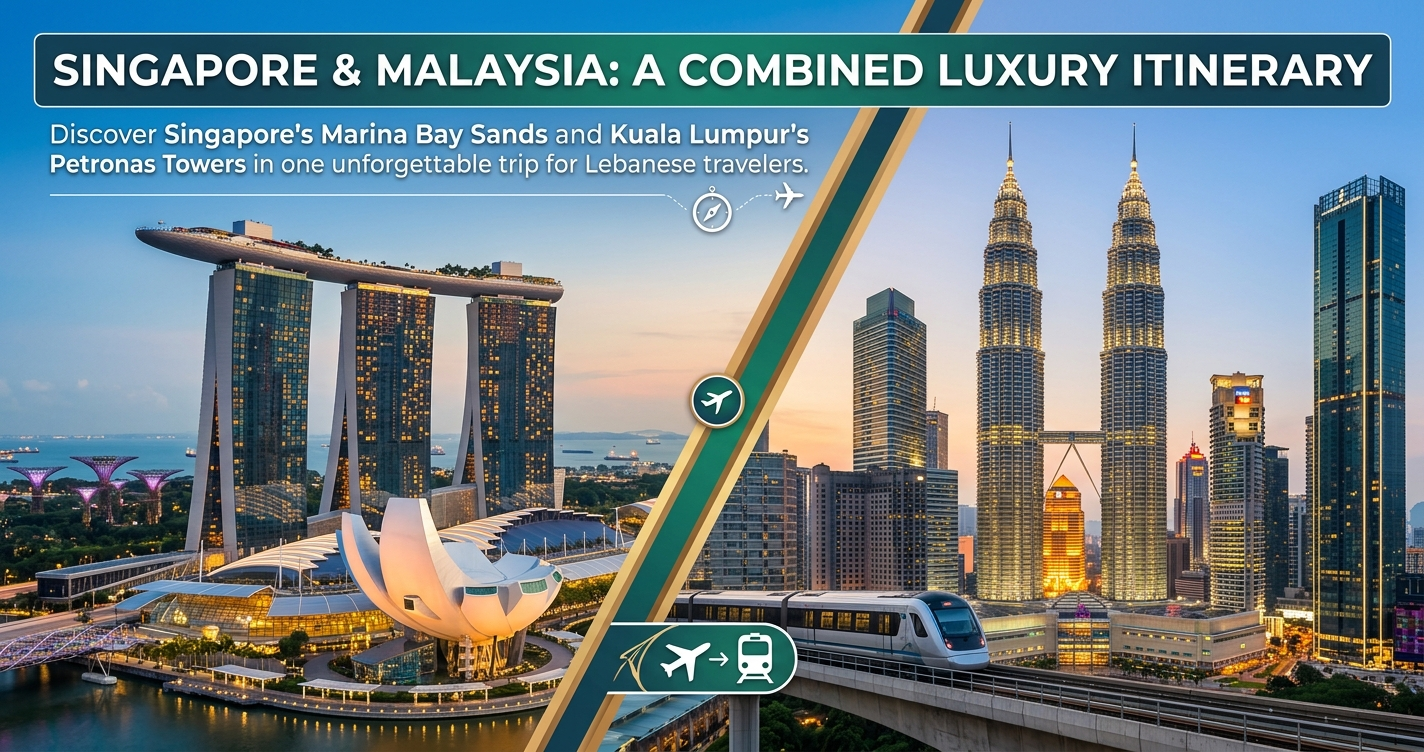
Singapore and Kuala Lumpur sit close enough together — connected by a high-speed rail link and under an hour apart by air — that pairing them in one trip is less an ambitious multi-country itinerary than a genuinely natural combination. Singapore delivers polish, precision, and a skyline built around some of the world’s most photographed hotel architecture, while Malaysia offers more relaxed pacing, dramatic mosque and temple architecture, and, for travelers extending further, some of Southeast Asia’s best beach islands. This Singapore Malaysia itinerary covers how to combine the two well — the flights, the entry requirements, and a realistic route that actually makes sense given how the two countries connect.
Getting There and Entry Requirements
The logistics section of this Singapore Malaysia itinerary is worth reading carefully, since the two countries handle Lebanese travelers’ entry very differently from each other.
Flights from Beirut
There’s no direct flight from Beirut to either Singapore or Kuala Lumpur, so most itineraries route through a Gulf hub — Doha, Dubai, or Abu Dhabi — with total journey time typically running 12 to 16 hours depending on the specific connection and final destination.
Singapore’s E-Visa and Arrival Card
Lebanese citizens need an e-Visa to enter Singapore, applied for online before travel and typically permitting a stay of up to 30 days. Separately, all travelers also need to submit an SG Arrival Card — a digital arrival registration rather than a visa — within three days before entering Singapore, via the MyICA app or official website.
Malaysia’s Visa-Free Entry
Malaysia, by contrast, allows Lebanese citizens to enter visa-free for stays of up to 30 days, requiring only a passport valid for at least six months and, ideally, a return ticket — a meaningfully simpler process than Singapore’s e-Visa requirement for the same broad region.
Budgeting for a Singapore-Malaysia Trip
Cost is one of the more useful things to plan around in any Singapore Malaysia itinerary, since the two countries sit at genuinely different price points.
Typical Costs in Each Country
Singapore’s costs run considerably higher than Malaysia’s across the board — comfortable four- and five-star hotels typically run $200 to $500 per night in Singapore versus $100 to $300 in Kuala Lumpur, with dining and daily expenses following a similar gap.
A Realistic Total for an 8-Day Trip
Combining flights, hotels across Singapore, Kuala Lumpur, and an island extension, and daily spending, a comfortable 8-day trip for a couple typically totals $4,500 to $8,000, with Singapore’s higher cost base pulling the overall average up compared to a Malaysia-only trip.
Best Time to Visit Singapore and Malaysia
Singapore’s Near Year-Round Climate
Singapore sits close to the equator and stays warm and humid year-round with limited seasonal variation, meaning there’s no dramatically wrong time to visit, though the November-to-January period brings the heaviest monsoon rainfall.
Malaysia’s East Coast vs. West Coast Seasons
Malaysia’s weather varies more by region than Singapore’s — the west coast (including Kuala Lumpur and Langkawi) sees its wettest period from September through November, while the east coast experiences a more pronounced monsoon from November through February, worth factoring in if the itinerary extends beyond the standard west-coast route covered here.

Singapore: Marina Bay, Gardens, and a City Built for Precision
Singapore anchors most versions of a Singapore Malaysia itinerary, both because of its recognizable skyline and because it’s usually the more convenient arrival point from a Gulf connection.
Marina Bay Sands and the Rooftop Infinity Pool
Marina Bay Sands, with its three connected towers topped by a rooftop infinity pool overlooking the city skyline, remains Singapore’s single most recognizable image, and a stay here — or at minimum a visit to the observation deck for non-guests — is close to essential on a first trip.
Gardens by the Bay
Gardens by the Bay’s Supertrees and climate-controlled domes offer a genuinely striking blend of architecture and botanical garden, particularly impressive after dark when the Supertrees’ light show runs each evening.
Beyond the Icons: Hawker Centers and Neighborhoods
Beyond Marina Bay’s headline attractions, Singapore’s hawker centers offer some of the best value fine dining in the region, while neighborhoods like Chinatown, Little India, and Kampong Glam each offer a genuinely distinct cultural texture within a compact, easily walkable city.
Singapore and Malaysia for Family Travel
Why This Combination Works for Families?
Singapore’s cleanliness, safety, and family-oriented attractions (Universal Studios Singapore among them) pair naturally with Malaysia’s more relaxed pace and beach options, giving families genuine variety across a single trip without extreme climate or logistical demands.
Pacing Considerations with Children
Families traveling with young children often benefit from front-loading the more structured, air-conditioned Singapore leg before the more outdoor-heavy Malaysia stretch, particularly if Langkawi’s beach time is included as the trip’s natural wind-down.
Food Across Both Countries
Singapore’s Hawker Culture
Singapore’s hawker centers, some holding Michelin recognition despite their casual setting, offer an unmatched combination of quality and value, making them worth prioritizing over purely upscale restaurant dining for at least a few meals during the Singapore leg.
Malaysia’s Multicultural Food Scene
Malaysia’s food culture draws on Malay, Chinese, and Indian traditions in equal measure, and Kuala Lumpur and Penang in particular offer some of the region’s most celebrated street food, worth building real time into the itinerary specifically for eating rather than treating meals as an afterthought between sights.
Kuala Lumpur: Twin Towers and a More Relaxed Pace
The second half of any Singapore Malaysia itinerary shifts gears noticeably once the rail link arrives in Kuala Lumpur.
The Petronas Towers
The Petronas Towers, Kuala Lumpur’s iconic twin skyscrapers, anchor the city’s skyline and offer an observation deck experience of their own, along with the surrounding KLCC Park providing one of the best ground-level viewpoints for photographing the towers.
Batu Caves and Cultural Diversity
Batu Caves, a Hindu temple complex built into limestone caves just outside the city, offers a striking half-day excursion, reflecting Malaysia’s genuinely diverse multicultural character — Malay, Chinese, and Indian influences all visible throughout Kuala Lumpur’s food, architecture, and daily life.
Kuala Lumpur’s More Accessible Luxury
Kuala Lumpur’s luxury hotel and dining scene generally runs at a more accessible price point than Singapore’s, giving travelers combining both cities a natural way to balance overall trip cost across the two legs.
The High-Speed Rail Connection
The rail link is really what makes a genuine Singapore Malaysia itinerary practical rather than a stretch, turning two separate country visits into one cohesive trip.
Getting Between the Two Cities
A high-speed rail link connects Singapore and Kuala Lumpur, offering a scenic, comfortable alternative to a short domestic-style flight between the two, and turning the transfer itself into a reasonably pleasant part of the trip rather than pure logistics.
Extending to Malaysia’s Islands: Langkawi and Penang
Adding an island stop rounds out a Singapore Malaysia itinerary nicely, giving the trip a proper wind-down after two city-focused legs.
Langkawi’s Beach Resort Scene
Langkawi, an archipelago off Malaysia’s northwest coast, offers a well-developed luxury beach resort scene along with duty-free shopping, making it a natural extension for travelers wanting to close a Singapore-Malaysia trip with beach time.
Penang’s Food and Heritage
Penang, and specifically Georgetown’s UNESCO-listed old town, is widely regarded as one of Southeast Asia’s best food destinations, combining street food culture with well-preserved colonial-era architecture, appealing to travelers wanting a cultural stop distinct from Kuala Lumpur’s more modern character.
Building a Singapore-Malaysia Itinerary
Pulling everything together into a genuine bookable Singapore Malaysia itinerary comes down to deciding how much time each leg deserves.
A Sample 8-Day Route
A well-paced trip might open with three nights in Singapore covering Marina Bay, Gardens by the Bay, and the city’s neighborhoods, continue via the high-speed rail to three nights in Kuala Lumpur for the Petronas Towers and Batu Caves, and close with two nights on Langkawi or in Penang depending on whether beach time or food culture matters more to the trip.
Adjusting for Shorter Trips
Travelers with less time can compress this into a Singapore-and-Kuala-Lumpur combination without the island extension, still capturing both cities’ signature experiences within a comfortable six-day trip.
Shopping Across Both Countries
Singapore’s Orchard Road
Orchard Road remains Singapore’s premier shopping destination, offering a dense concentration of international luxury brands and department stores within an easily walkable stretch.
Duty-Free Shopping in Langkawi
Langkawi’s duty-free status makes it a popular final stop for travelers wanting to combine beach time with lower-priced shopping on alcohol, chocolate, and other duty-free goods before flying home.
Practical Tips for a Combined Trip
Currency Considerations
Singapore uses the Singapore dollar and Malaysia the Malaysian ringgit, meaning travelers crossing between the two need to manage two separate currencies, worth factoring into ATM withdrawal planning rather than assuming one currency covers the whole trip.
Border Crossing Logistics
Even via the high-speed rail, travelers still clear immigration when crossing between Singapore and Malaysia, so it’s worth allowing reasonable buffer time around the rail journey rather than treating it as an instantaneous domestic-style transfer.
Frequently Asked Questions
Building a genuine Singapore Malaysia itinerary is straightforward given the high-speed rail link connecting the two capitals — most travelers split time between Singapore and Kuala Lumpur and optionally extend to Langkawi or Penang for a beach or food-focused finish.
Yes, an e-Visa applied for online before travel, typically permitting a stay of up to 30 days, along with a separate SG Arrival Card submitted within three days of entry.
No — Malaysia allows Lebanese citizens to enter visa-free for stays of up to 30 days, a simpler process than Singapore’s e-Visa requirement.
Generally yes — Kuala Lumpur’s luxury hotel and dining scene typically runs at a more accessible price point than Singapore’s, helping balance the overall cost of a combined trip.
It depends on priorities: Langkawi suits travelers wanting beach resort time, while Penang suits travelers prioritizing food culture and heritage architecture.
Ready to plan a Singapore and Malaysia trip that flows smoothly between both countries? Speak with a Fayad Travel destination expert to build the right route for your priorities.