

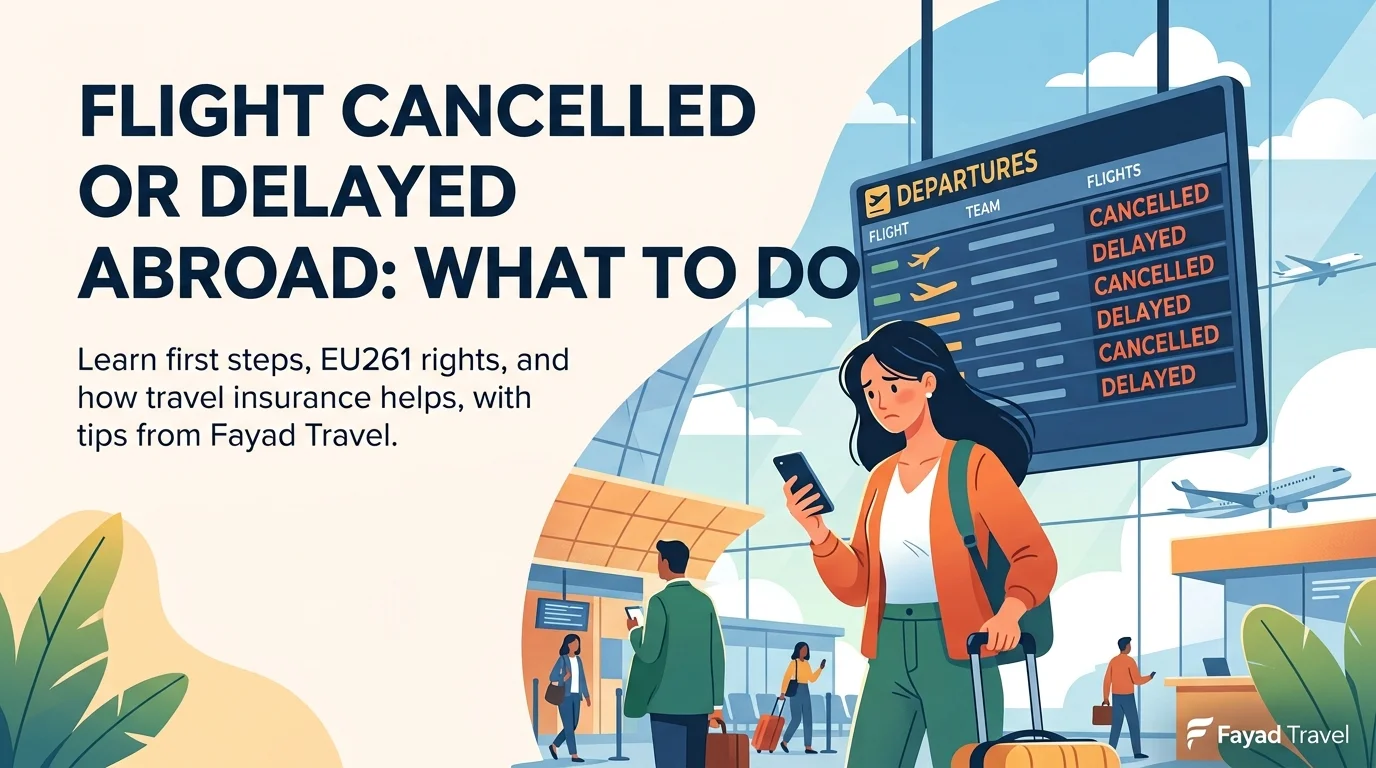
The departures board flips from “On Time” to “Cancelled,” and within minutes a queue forms at the airline desk that will take an hour to clear. If you’re standing in it with a hotel waiting on the other end, a meeting in the morning, or children asleep on the luggage, the next thirty minutes matter far more than most travelers realize. Knowing what to do when a flight is cancelled or delayed abroad can be the difference between a rebooked seat that evening and two nights waiting for the airline to get around to you.
This guide walks through the steps in the order you’ll actually need them, explains what your rights depend on (it’s less straightforward than most articles admit), and covers the preparation that makes a disruption far easier to handle. It’s written for Lebanese travelers, whose routings and airlines don’t always fall neatly under the rules people quote online.
The First Thirty Minutes After a Cancellation or Long Delay
Speed matters because seats on the next available flights are finite, and rebooking is generally handled in the order requests reach the airline. The queue at the desk is rarely the fastest route.
Contact the Airline While You Wait in Line
Call the airline’s helpline, message it on the app, or use its social channels while you wait at the desk. Any one of them may reach a rebooking agent before you reach the front of the line. If you booked through a travel agency, contact your agent at the same moment — an agent with access to airline systems can often see availability you can’t and act on it directly.
Ask for Rebooking, Not Just Information
Ask the airline to put you on the earliest available flight, including flights on partner airlines if your own has none soon. Note the name of the agent, the time, and what was promised. If the delay or cancellation has already made your trip pointless, you can generally ask for a refund instead of a rebooking, though what applies depends on your ticket and the rules governing the flight.
Photograph Everything and Keep Every Receipt
Screenshot the departures board and any airline notification showing the cancellation or revised time. If the airline doesn’t provide meals or accommodation and you have to pay yourself, keep every receipt. These records are what any later claim — with the airline or with your insurer — will rest on.
What Your Rights Actually Depend On?
Here is where most online advice goes wrong: it treats passenger rights as universal. They aren’t. What you can claim depends on where the flight departed from, which airline operated it, and why it was disrupted.
3 hrsarrival delay threshold that can trigger compensation under EU261
€250–€600EU261 compensation range, set by flight distance
Not alldisruptions qualify — weather and air traffic control are typically excluded
Understanding EU261 and When It Applies
The European Union’s passenger rights regulation, known as EU261, covers flights departing from an EU airport on any airline, and flights arriving in the EU when operated by an EU carrier. That distinction matters for travelers from Beirut. A flight from Paris to Beirut is covered even on a non-EU airline; a flight from Beirut to Paris on a non-EU airline generally is not. Compensation is typically owed only when the cause is within the airline’s control — a technical fault or crew shortage, for example — and not for extraordinary circumstances such as severe weather or air traffic control restrictions.
Separately, where EU261 applies, the airline owes you care during a long wait — meals, refreshments, communication, and hotel accommodation if you’re stranded overnight — even when compensation isn’t due. Other regions have their own rules, and some have none, so it’s worth checking the regulations for the country where the flight departed.
“The rule that surprises people most: the airline can owe you a hotel and meals even when it owes you no compensation at all.”
How Travel Insurance Fits In?
Where airline obligations end or don’t apply, travel insurance often picks up the slack. A good policy can cover unexpected accommodation and meals during a delay, rebooking costs, and non-refundable expenses at your destination that a missed arrival makes worthless. Most policies require a minimum delay before they pay out, and they generally expect you to have kept your receipts and obtained written confirmation of the delay from the airline.
The practical lesson is that insurance should be arranged before departure. Once the departures board changes, it is too late to buy protection for the disruption already in front of you.
Situations That Need Different Handling
| Situation | Priority Action | Keep in Mind |
|---|---|---|
| Cancelled, same-day rebooking available | Accept the earliest option, confirm in writing | Check baggage is transferred to the new flight |
| Delayed overnight | Ask for hotel and meal vouchers | Keep receipts if you pay yourself |
| Missed connection due to a delayed first leg | Go to the transfer desk, not the exit | A single booking usually gives stronger protection than separate tickets |
| Visa-limited stay or hotel prepaid | Notify the hotel and adjust bookings | Also check whether an entry deadline is affected |
Prepare Before You Fly
Most of the stress of a disruption comes from having no plan. A few habits make a large difference, and none of them cost much.
- Save your airline’s helpline and your travel agent’s number offline before departure
- Book connecting flights on a single ticket wherever possible
- Keep a change of clothes and essential medication in your carry-on
- Arrange travel insurance before you leave, not after the disruption starts
- Leave a buffer between a long-haul arrival and any important commitment
Why the Way You Booked Matters?
When something goes wrong, the booking route becomes very real. Travelers who booked through a marketplace often find themselves passed between the airline and the seller, each pointing to the other. Those who booked through a travel agency have one accountable point of contact who can rebook, re-time connecting hotel and transfer arrangements, and speak to the airline in a language and at a level of familiarity that shortens the process. It’s a quiet advantage that only becomes visible on the one trip in a hundred that doesn’t go to plan.
Frequently Asked Questions
Contact the airline by phone or app while queuing at the desk, ask to be rebooked on the earliest available flight, and record everything: names, times, screenshots, and receipts.
It depends on where the flight departed, which airline operated it, and the cause. EU261 can provide compensation for long delays within the airline’s control, but not for extraordinary circumstances like severe weather.
Generally only if the flight is operated by an EU airline. Flights departing from an EU airport are covered regardless of the carrier, including the return flight to Beirut.
Where EU261 applies, airlines owe meals and accommodation for long waits. Elsewhere it depends on the airline’s policy, so ask, and keep receipts if you have to pay yourself.
Yes — clients who book flights through us have a direct contact to manage rebooking and adjust connecting arrangements, rather than facing the airline alone. Passenger rights vary by country and change over time; confirm current rules with the airline or the relevant authority before filing a claim.
Want a flight booking with real support behind it?
Fayad Travel manages your tickets and connections, and steps in when plans change — request a tailored quote today.Request a Tailored Quote