


Many Lebanese companies send employees abroad regularly without ever formalizing a written travel policy, relying instead on ad hoc approvals and inconsistent expense practices that work fine until they don’t — a disputed expense claim, an employee stranded without support, or simply wildly inconsistent costs across similar trips. A clear corporate travel policy solves these problems before they happen, and doesn’t need to be complicated to be genuinely useful — even a simple, well-thought-out document goes a long way toward removing ambiguity for everyone involved.
Why a Written Policy Matters More Than Companies Expect?
Many Lebanese companies operate for years without a formal corporate travel policy, and it’s worth understanding exactly what that gap actually costs in practice.
Consistency Across Employees and Trips
Without a written policy, travel spending and booking choices tend to vary considerably between employees and even between trips by the same employee, making budgeting and expense review far harder than they need to be.
Protecting the Company and the Traveler
A clear policy also protects both sides — employees know exactly what’s covered and what isn’t before they book anything, and the company has a documented standard to point to when a disputed expense or an unusual booking choice comes up.
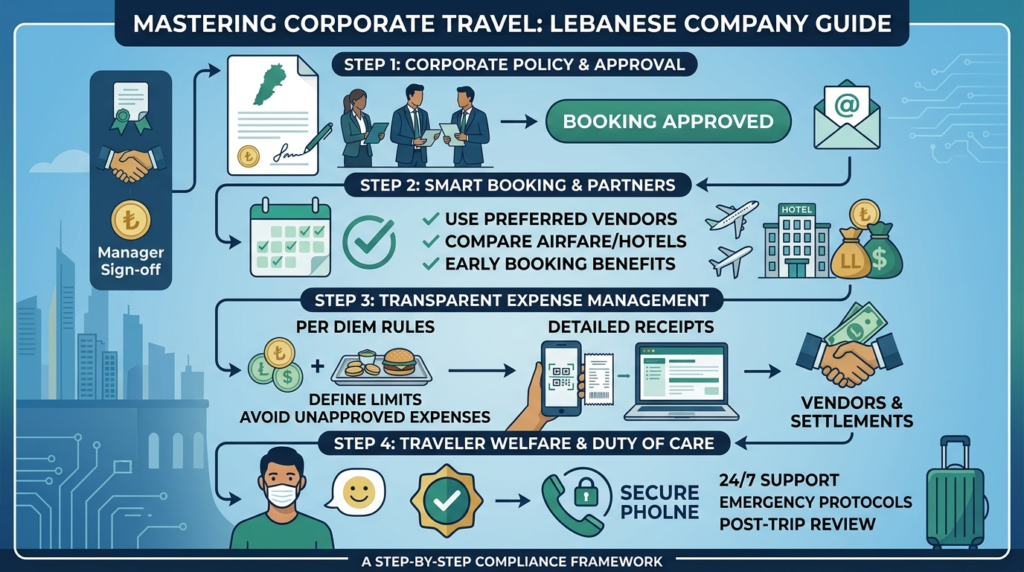
Building a Booking Approval Workflow
The approval workflow is usually the most visible, day-to-day part of any corporate travel policy, since employees interact with it every time they need to book a trip.
Setting Clear Approval Thresholds
A simple approval workflow — who needs to sign off on a booking, and at what cost threshold escalation to a more senior approver kicks in — removes the ambiguity that otherwise leads to either overly cautious employees delaying bookings unnecessarily or bookings proceeding without appropriate oversight.
Balancing Speed with Oversight
The workflow should be fast enough that employees aren’t stuck waiting days for approval on a routine trip, while still requiring genuine sign-off for larger or unusual expenses — a policy that’s too slow gets worked around, while one with no real oversight defeats its own purpose.
Setting Per Diem Rules
Choosing a Per Diem Structure
Companies generally choose between a fixed daily per diem (simpler to administer, less precise) or itemized receipt-based reimbursement (more precise, more administrative overhead), and the right choice often depends on company size and how much administrative capacity exists to review itemized claims.
Adjusting Per Diem by Destination
A single flat per diem rarely makes sense across genuinely different-cost destinations — a per diem calibrated for Dubai doesn’t stretch the same way in a lower-cost destination, so building in destination-based tiers, even just two or three broad categories, produces fairer and more realistic budgeting.
Scaling a Travel Policy to Company Size
Not every corporate travel policy needs the same level of detail, and matching the policy’s complexity to the company’s actual travel volume avoids over-engineering a document nobody will read.
Small Companies and Startups
Smaller companies with only occasional international travel don’t need an elaborate policy — a one-page document covering approval, per diem, and basic duty of care provisions is usually sufficient, with the emphasis on clarity over comprehensiveness.
Larger Organizations with Frequent Travel
Larger companies sending multiple employees abroad regularly benefit from a more detailed policy, including destination-specific per diem tiers, formal preferred vendor agreements, and a dedicated point of contact (internal or through an agency) managing bookings across the organization.
Common Mistakes in Corporate Travel Policies
Policies That Are Too Vague to Enforce
A policy that simply says “reasonable expenses will be reimbursed” without defining what reasonable means in practice leaves too much room for inconsistent interpretation and disputed claims after the fact.
Policies That Don’t Account for Real-World Delays
A policy built around ideal-case timelines — assuming every visa processes quickly, every flight departs on schedule — tends to break down under real-world conditions, making it worth building reasonable buffers into approval and booking timelines from the start.
No Clear Process for Policy Exceptions
Even a well-designed policy occasionally needs an exception — an unusual trip that doesn’t fit standard categories — and having a defined process for requesting and approving exceptions prevents these situations from becoming ad hoc negotiations each time.
Establishing Preferred Vendor Relationships
Why Preferred Vendors Save Money and Time?
Establishing a relationship with a single travel agency or a small set of preferred hotel and airline partners typically unlocks negotiated rates unavailable to one-off bookings, while also simplifying the booking process for employees who no longer need to independently research and compare options for every trip.
What to Look for in a Travel Partner?
A strong travel partner should offer transparent pricing, responsive support when something goes wrong mid-trip, and enough flexibility to handle both routine bookings and more complex multi-city or group travel needs without requiring a different provider for each type of trip.
Duty of Care: What Companies Owe Traveling Employees?
Duty of care is one aspect of a corporate travel policy that carries genuine legal and ethical weight beyond simple budgeting concerns.
Basic Duty of Care Obligations
At minimum, a company sending employees abroad should ensure they have adequate travel insurance, know how to reach emergency support if something goes wrong, and have a clear escalation path if a trip is disrupted by illness, a natural event, or a security concern at the destination.
Building Duty of Care Into the Policy Itself
Rather than treating duty of care as a vague aspiration, writing specific provisions into the policy — mandatory travel insurance, a 24/7 emergency contact number, and clear guidance on what to do if a trip is disrupted — makes the company’s obligations concrete and actionable rather than assumed.
Handling Visa Costs and Timelines in Policy
Who Pays for Visa Costs?
The policy should explicitly state whether the company covers visa application fees and any expedited processing costs, removing ambiguity that otherwise surfaces awkwardly when an employee is left covering a cost they assumed was included.
Building Visa Lead Time Into Trip Approval
A policy that requires trip requests to be submitted with enough lead time for visa processing — rather than approving trips on a timeline that doesn’t account for how long a Schengen or UK visa realistically takes — prevents the kind of last-minute scramble that damages both the trip and employee morale.
Measuring Whether the Policy Is Working
Tracking Compliance and Exceptions
Monitoring how often employees request exceptions to the standard policy, and why, gives a useful signal about whether the policy itself needs adjustment or whether specific employees need clearer guidance on existing rules.
Reviewing Cost Trends Over Time
Comparing travel costs before and after implementing or revising a policy — average cost per trip, per diem utilization, and vendor rate savings — provides concrete evidence of whether the policy is delivering the consistency and cost control it was designed for.
Reviewing and Updating the Policy Over Time
Why Policies Need Periodic Review?
A travel policy written once and never revisited tends to drift out of step with actual costs, destination requirements, and company growth — periodic review, at least annually, keeps the policy realistic rather than a document nobody actually follows.
Gathering Employee Feedback
Employees who travel regularly often notice gaps or friction points in a policy that leadership doesn’t see from the outside, making their feedback a genuinely useful input when revising the policy rather than an afterthought.
Frequently Asked Questions
Building a genuinely useful corporate travel policy starts with a clear booking approval workflow, then sets per diem rules calibrated to destination cost differences, establishes preferred vendor relationships, defines duty of care obligations, and specifies who covers visa costs and how much lead time trip requests require.
Meals, local transport, and incidentals are the most common per diem categories, with rates ideally tiered by destination cost rather than applying one flat rate across genuinely different-cost cities.
Preferred vendor relationships typically unlock negotiated rates unavailable to one-off bookings and simplify the booking process for employees, who no longer need to independently research options for every trip.
At minimum, ensuring employees have adequate travel insurance, know how to reach emergency support, and have a clear escalation path if a trip is disrupted by illness, a natural event, or a security concern.
At least annually, ideally incorporating feedback from employees who travel regularly and noticing gaps or friction points that aren’t visible from a leadership perspective.
Building or refining your company’s travel policy? Read the full guide and speak to a Fayad Travel destination expert about structuring a policy that actually works for your team.