


For most corporate travel, the business class vs private jet question isn’t really close — a scheduled commercial flight in a comfortable cabin covers the vast majority of trips perfectly well. But there’s a genuine threshold, driven by group size, schedule flexibility, and how much time actually matters, where chartering a jet stops being an extravagance and starts being the more sensible business decision. This guide breaks down the real business class vs private jet trade-offs so that threshold is easier to identify for your own trip.
The Cost Reality of Private Jet Charter
Cost is naturally where any business class vs private jet comparison has to start, since the price gap between the two options is substantial before any other factor comes into play.
Hourly Rates by Aircraft Category
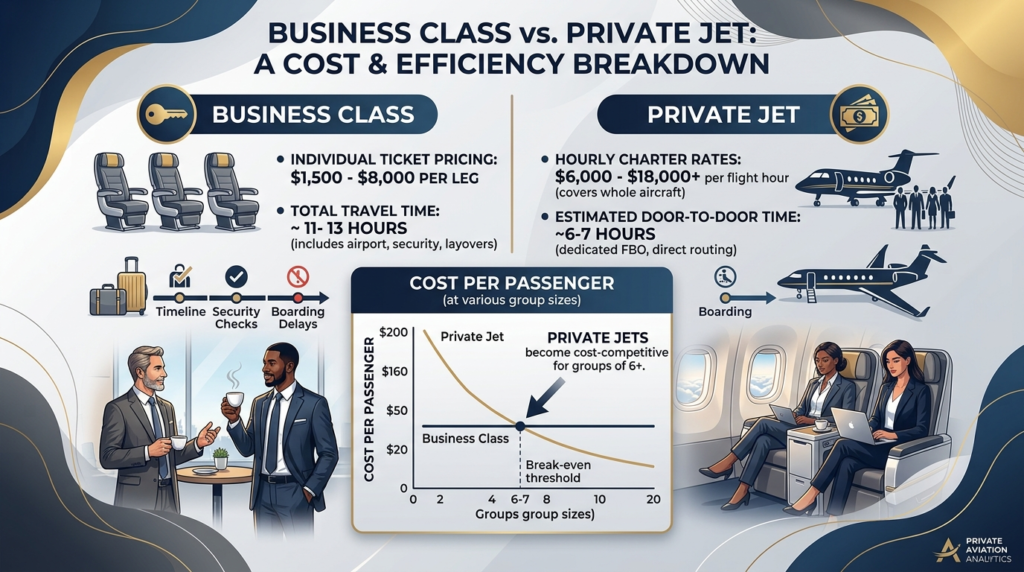
Private jet charter is priced per flight hour rather than per seat, and rates vary considerably by aircraft size: light jets (seating four to seven) typically run $2,500 to $4,500 per hour, midsize jets $4,000 to $8,000 per hour, and heavy or ultra-long-range jets $8,500 to $20,000 or more per hour for intercontinental capability.
What the Hourly Rate Doesn’t Include?
Beyond the base hourly rate, a charter quote typically adds positioning fees (getting the aircraft to your departure airport), landing and airport fees, fuel surcharges, and crew costs, which together commonly add 20 to 40 percent above the quoted hourly rate — worth confirming in any quote rather than assuming the hourly figure is the full cost.
The Group Size Threshold
Group size is arguably the single most important variable in the business class vs private jet math, since it changes the per-person economics more than any other factor.
Where Per-Person Cost Starts to Make Sense?
For a solo traveler, a private jet charter remains dramatically more expensive than even the most premium airline business or first class seat. The economics shift meaningfully once a group of six to ten travelers is flying together, where a light or midsize jet’s per-person cost can land surprisingly close to premium airline fares, particularly for last-minute bookings during peak periods when business class fares also spike.
Calculating Your Own Breakeven Point
A rough way to think about it: divide the total charter cost (hourly rate plus estimated fees) by the number of travelers, then compare that per-person figure against what business class tickets would cost the same group on the same route and dates — the comparison often looks very different for a group of two than for a group of eight.
Time Savings: The Case Private Jets Make Best
Avoiding Commercial Airport Friction
A private jet charter removes check-in queues, standard security lines, and the buffer time commercial travel requires, often reducing total door-to-door travel time by one to two hours or more compared to a scheduled flight, even before accounting for flight time itself.
Reaching Destinations Commercial Routes Don’t Serve Well
Private aviation can access smaller regional airports closer to a final destination, sometimes eliminating a connecting flight or long ground transfer that a commercial itinerary would otherwise require — a genuine advantage for destinations poorly served by direct commercial routes from Beirut.
When Time Savings Justify the Cost?
For a trip where a delayed or missed connection would mean missing a critical meeting, signing, or event, the time reliability of a private charter can justify its premium regardless of group size, since the cost of a missed business opportunity often exceeds the price difference between business class and charter.
Beyond Cost: Privacy, Discretion, and Comfort
When Privacy Matters More Than Price?
For sensitive negotiations, high-profile executives, or situations where discretion genuinely matters — avoiding public exposure at a commercial airport, or conducting confidential conversations en route — a private charter’s privacy can justify its cost independent of the group-size or time-savings calculations covered above.
Comfort for Long-Haul Routes
On longer intercontinental routes, a private cabin’s ability to work, rest, or hold meetings without the constraints of a shared commercial cabin offers a genuine productivity advantage for executives whose time in the air is otherwise lost to a standard business class seat.
Charter Safety and Operator Vetting
Choosing a Properly Certified Operator
Not all charter operators carry the same safety certifications, and working through a broker who only sources from vetted, audited operators (certifications like ARGUS or Wyvern ratings are common industry benchmarks) removes the burden of vetting operators independently for a company without in-house aviation expertise.
Why This Matters for Corporate Liability?
Beyond personal safety, companies chartering jets for executives carry a genuine duty-of-care responsibility, making operator vetting a real business consideration rather than a minor detail to skip when comparing quotes.
When Business Class Remains the Better Choice?
Solo and Small-Group Travel
For a single executive or a pair of travelers on a standard route with reliable commercial service, business class delivers comparable comfort at a fraction of the cost, making it the clearly better choice outside the specific scenarios where charter’s advantages apply.
Routes with Strong Direct Commercial Service
On routes already served by a direct, reliable commercial flight — Beirut to Dubai or Geneva, for instance — the time savings a charter offers shrink considerably, since there’s little airport friction or connection risk to eliminate in the first place.
Middle-Ground Options Worth Knowing About
Jet Cards and Membership Programs
Beyond a one-off charter, jet card programs let companies pre-purchase a set number of flight hours at a locked rate, offering more predictable pricing and faster booking for companies that charter regularly enough to justify the upfront commitment, without the larger capital outlay of fractional ownership.
Empty-Leg Flights
Empty-leg flights — repositioning flights an operator needs to fly anyway — can offer charter-quality travel at a meaningful discount for companies with flexible dates, though the trade-off is considerably less schedule control than a standard on-demand charter.
Working with a Charter Broker
Why Companies Use a Broker Rather Than Booking Directly?
A charter broker with access to a global network of vetted operators can source the right aircraft for a specific mission — balancing cabin size, range, and cost — rather than a company navigating the fragmented charter market independently for an occasional trip.
Coordinating Charter Alongside the Rest of a Trip
For companies that charter only occasionally, coordinating the jet booking through the same travel agency managing hotels, ground transport, and any accompanying commercial travelers keeps the entire trip’s logistics under one point of contact.
Frequently Asked Questions
Working through the business class vs private jet decision, it generally makes sense once a group of six or more is traveling together, when the destination is poorly served by direct commercial flights, or when a missed connection would carry a genuinely high business cost.
Light jets typically run $2,500 to $4,500 per hour, midsize jets $4,000 to $8,000 per hour, and heavy or ultra-long-range jets $8,500 to $20,000 or more per hour, before positioning fees, landing fees, and fuel surcharges that can add 20 to 40 percent to the total.
For larger groups of six to ten travelers, especially on last-minute or peak-period bookings, a light or midsize jet’s per-person cost can land close to premium airline fares, though it rarely beats business class for solo or small-group travel.
Avoiding standard check-in and security queues, plus the ability to fly into smaller airports closer to the final destination, together can reduce total door-to-door travel time by an hour or more compared to commercial travel.
Working through a broker or travel agency with existing charter relationships generally produces better aircraft matching and pricing than booking directly, particularly for companies that charter only occasionally rather than as a routine practice.
Weighing whether a private jet charter makes sense for an upcoming trip? Request a Custom Quote or WhatsApp a Fayad Travel Advisor and we’ll give you an honest cost comparison.