
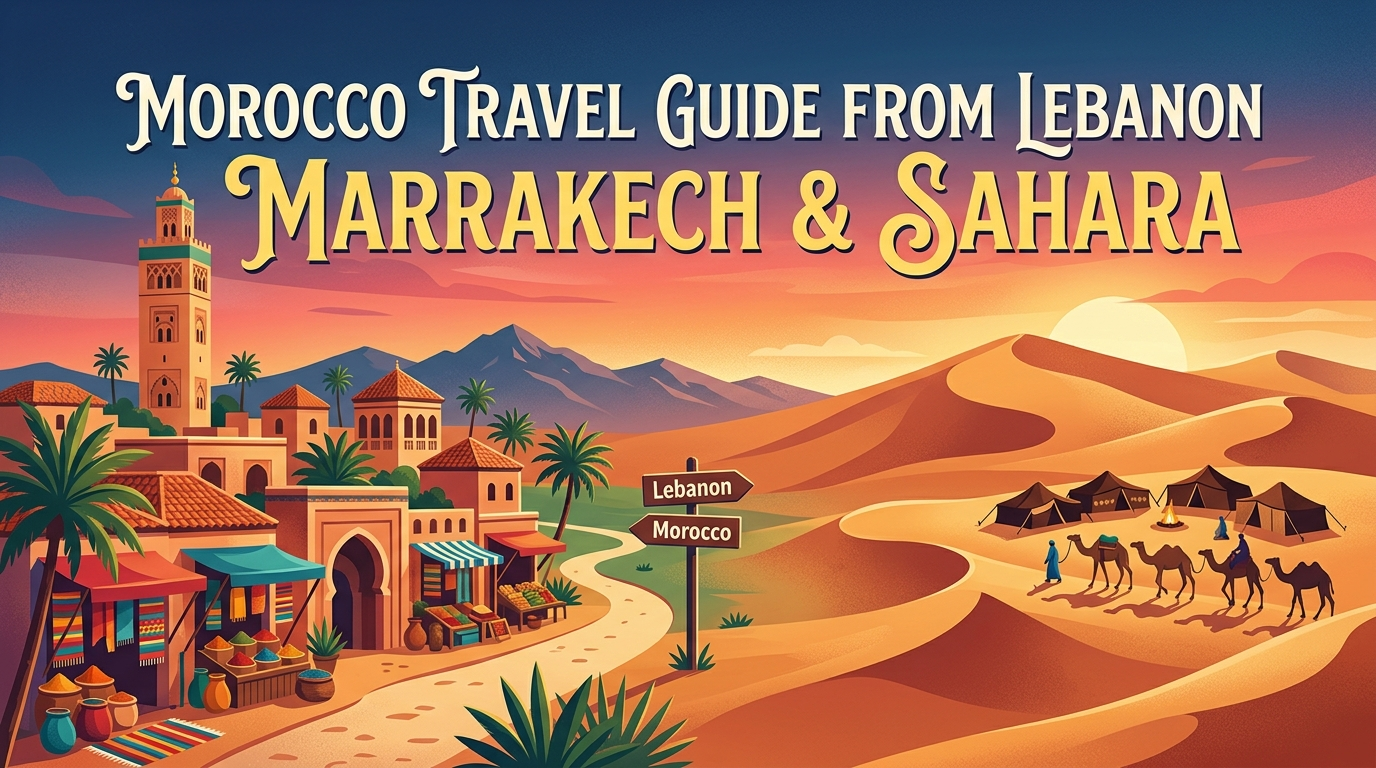
Morocco delivers a genuinely rare combination within a single, relatively compact country — a labyrinthine medina in Marrakech, snow-capped Atlas Mountain passes, a night under the stars in a Sahara desert camp, and Fes’s even older, more intact medieval old town, all reachable within a well-paced week to ten days. This Morocco travel guide covers how to structure a trip across all of it, along with the flight and visa details Lebanese travelers need before booking — enough to move from imagining the trip to actually planning it.
Getting There and Entry Requirements
The logistics section of any Morocco travel guide is worth reading closely, since both the flight and visa situation for Lebanese travelers have genuinely changed recently.
A New Direct Flight from Beirut
Royal Air Maroc launched a direct route between Casablanca and Beirut in April 2026, currently operating twice weekly on Fridays and Sundays, with a flight time of roughly six hours — a genuinely new and convenient option for Lebanese travelers that didn’t exist on this route until recently. Travelers heading specifically to Marrakech can also find direct or near-direct connections depending on the current schedule, worth checking given how new this route is.
Visa Requirements for Lebanese Travelers
Lebanese passport holders need an advance visa to enter Morocco — a sticker visa applied for through the Moroccan Embassy in Beirut rather than an e-visa or visa on arrival. The visa typically allows a single-entry stay of up to 90 days, and given the embassy-based application process, it’s worth starting well ahead of the planned travel dates rather than assuming a quick turnaround.
Budgeting for a Morocco Trip
Value is one of the more pleasant surprises this Morocco travel guide can offer, given how much ground and how many distinct experiences the country delivers relative to cost.
Typical Costs Across the Country
Morocco remains one of the better-value destinations in this guide relative to the sheer variety of experiences included — a comfortable riad in Marrakech typically runs $60 to $200 per night, a luxury Sahara desert camp runs $150 to $400 per night per person, and a private driver for the Atlas Mountains and desert loop typically runs $80 to $150 per day.
A Realistic Total for an 8-Day Trip
Combining flights, riad stays in Marrakech and Fes, the Sahara desert camp, and a private driver for the mountain and desert legs, a comfortable 8-day Morocco trip for a couple typically totals $2,500 to $5,000, making it one of the more accessible multi-region trips covered across this site.
Best Time to Visit Morocco
Spring and Autumn Advantages
Late March through May and September through November offer the most comfortable temperatures for exploring Marrakech, the Atlas Mountains, and Fes, avoiding both summer’s intense heat and winter’s colder mountain-pass conditions.
Desert Timing Considerations
The Sahara can be genuinely uncomfortable during summer’s peak heat, while winter nights in the desert turn surprisingly cold, making the shoulder seasons the strongest overall window for combining comfortable city sightseeing with a pleasant desert camp experience.
Marrakech: The Medina, Souks, and Riad Culture
Any Morocco travel guide has to start in Marrakech, since it’s almost always the entry point and anchor of a first visit.
Staying in a Traditional Riad
A traditional Marrakech riad — a historic house built around an interior courtyard, often with a small pool or garden — is one of the most distinctive accommodation experiences in the country, and staying inside the medina itself rather than a modern hotel outside it genuinely changes the character of a Marrakech visit.
Navigating the Souks
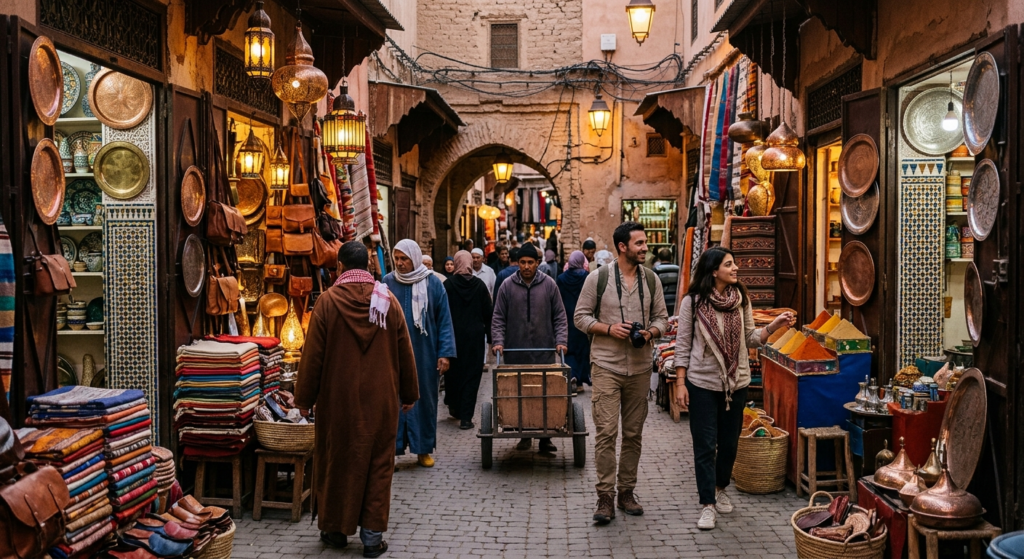
Marrakech’s souks form a dense, maze-like market spread across the medina, selling everything from spices and leather goods to lanterns and textiles. Getting comfortably lost here is part of the experience, though a local guide for the first exploration helps orient newcomers before they set off independently.
Jemaa el-Fnaa Square
Jemaa el-Fnaa, Marrakech’s central square, transforms through the day — market stalls and snake charmers by afternoon, an enormous outdoor food market by evening — making it worth visiting at multiple points during a stay rather than just once.
Morocco for Family Travel
Families researching this Morocco travel guide will find the country offers a genuinely strong mix of history, adventure, and comfortable accommodation.
What Works Well for Families?
Morocco’s mix of engaging historical sites, the genuine adventure of a desert camp, and generally family-friendly riad accommodation gives families a trip with real variety, though the Sahara leg’s driving distances are worth weighing against younger children’s tolerance for long car days.
Pacing Considerations
Families traveling with young children often benefit from trimming the Sahara leg to the more accessible camps closer to Marrakech, or building in extra rest days between the more intensive medina exploration in Marrakech and Fes.
Shopping in Morocco’s Souks
What to Look For
Morocco’s souks offer genuinely distinctive local crafts — hand-woven rugs, leather goods, ceramics, and traditional lanterns — with Marrakech and Fes each carrying their own regional specialties worth comparing rather than assuming both markets offer the same selection.
Bargaining Expectations
Bargaining is standard practice in Morocco’s souks, and prices quoted initially are rarely the expected final price, which can feel unfamiliar to travelers used to fixed pricing — a local guide can help set realistic expectations for specific items early in the trip.
The Atlas Mountains and Sahara Desert
The mountain-and-desert leg is where this Morocco travel guide’s itinerary earns its “adventure” credentials, offering scenery genuinely different from the medina-focused cities on either end.
Crossing the Atlas Mountains
The drive from Marrakech toward the Sahara crosses the Atlas Mountains via the dramatic Tizi n’Tichka pass, offering some of Morocco’s most striking mountain scenery and a natural stopping point at Ait Benhaddou, a UNESCO-listed fortified village that’s served as a filming location for numerous major productions.
A Night in a Sahara Desert Camp
Reaching the Merzouga dunes typically involves a multi-day journey from Marrakech, culminating in a camel trek to a desert camp for an overnight stay under genuinely spectacular stars, with luxury camp options now offering considerably more comfort than a basic tent experience.
Planning the Desert Excursion’s Timing
Because the full Marrakech-to-Sahara round trip realistically takes three to four days given the driving distances involved, it’s worth building this into the itinerary as its own dedicated stretch rather than treating it as a quick side trip.
Fes: Morocco’s Best-Preserved Medieval City
No Morocco travel guide is complete without Fes, since it offers a genuinely different, older layer of the country’s history than Marrakech.
The Fes Medina
Fes’s medina, a UNESCO World Heritage Site, is considered the best-preserved medieval city in the Arab world, with a medina so extensive and labyrinthine that hiring a local guide for at least the first day is less a luxury than a practical necessity for most first-time visitors.
The Chouara Tannery
The Chouara Tannery, one of Fes’s most photographed sights, offers a genuinely striking view of the traditional leather-dyeing process from surrounding terraces, though the smell is notably strong and worth preparing for.
Comparing Fes to Marrakech
Where Marrakech feels more geared toward tourism and comfort, Fes retains a rawer, more historically intact character, making the two cities a genuinely complementary pairing rather than a redundant one within the same trip.
Building a Morocco Itinerary
Pulling everything from this Morocco travel guide together into a bookable structure, a well-paced trip looks something like this:
A Sample 8-Day Route
A well-paced Morocco itinerary might open with two nights in Marrakech, continue with a three-night loop through the Atlas Mountains and a Sahara desert camp, and close with two to three nights in Fes before flying home, either from Fes directly or via a return to Casablanca.
Adjusting for Shorter or Longer Trips
Travelers with less time can compress this into a Marrakech-and-Sahara combination without Fes, or extend it with a coastal stop in Essaouira for travelers wanting a beach and fishing-town component alongside the more inland-focused route.
Combining Morocco with Other Destinations
A Natural Coastal Extension
Travelers with more time sometimes extend a Morocco trip with a stop in Essaouira, a laid-back coastal fishing town roughly two and a half hours from Marrakech, offering a different pace and a beach-and-seafood component alongside the more inland-focused Marrakech-Sahara-Fes route.
Why Morocco Often Works as a Standalone Trip?
For most travelers, though, the sheer variety already packed into Morocco — medinas, mountains, desert, and history — fills a comfortable week to ten days on its own, making a standalone Morocco trip a genuinely complete experience without needing an additional country to round it out.
Moroccan Cuisine and Hammam Culture
Tagine and Mint Tea
Moroccan cuisine centers on the tagine — slow-cooked stews named for the conical clay pot they’re prepared in — along with mint tea, poured with a distinctive high pour that’s as much ceremony as beverage, both worth experiencing at a proper local restaurant rather than only at the hotel.
The Hammam Experience
A traditional hammam, a public or private bathhouse offering a scrub-and-massage treatment, is a genuine cultural touchpoint worth building into a Marrakech or Fes stay, with many riads offering their own private hammam experience for guests.
Frequently Asked Questions
As this Morocco travel guide lays out, an eight-day trip combining Marrakech, an Atlas Mountains and Sahara desert loop, and Fes covers Morocco’s signature experiences well, with shorter or longer variations possible depending on available time.
Yes, Lebanese passport holders need an advance sticker visa from the Moroccan Embassy in Beirut, typically allowing a single-entry stay of up to 90 days, rather than an e-visa or visa on arrival.
Royal Air Maroc launched a direct route between Casablanca and Beirut in April 2026, currently operating twice weekly, offering a genuinely new and convenient option worth checking for current schedule details.
Yes for most travelers — an overnight in a desert camp near Merzouga is widely considered one of Morocco’s most memorable experiences, though it does require building three to four days into the itinerary given the driving distances involved.
Many travelers find the two cities genuinely complementary — Marrakech offers more polish and tourism infrastructure, while Fes offers a rawer, more historically intact medieval old town.
Ready to plan a Morocco trip covering Marrakech, the Sahara, and Fes? Speak with a Fayad Travel destination expert to build the right route and confirm current visa and flight details.