

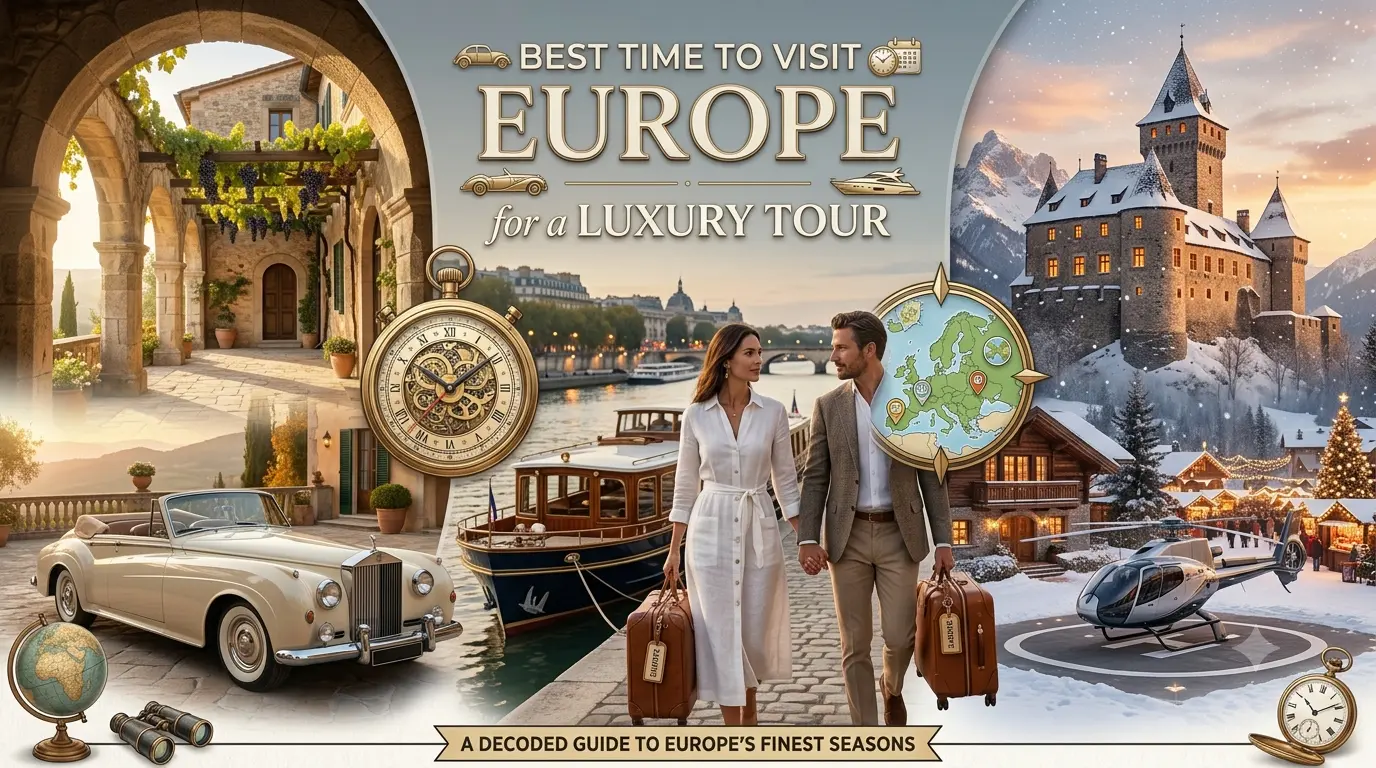
There’s a version of Europe that most travelers never see: the Amalfi Coast without the coach-tour queues, Venice with room to actually stand still on a bridge, Salzburg lit up for Christmas markets instead of packed for a July heatwave. Finding the best time to visit Europe for a luxury trip isn’t really about picking a “good month” — it’s about understanding how the continent’s rhythm of crowds, light, and pricing shifts, and choosing the window that matches the trip you actually want.
For Lebanese travelers building a custom luxury itinerary, this decision carries extra weight. A Europe trip from Beirut is usually a once- or twice-a-year investment, often combining several countries, and the difference between arriving in peak August and arriving in a well-chosen shoulder week can mean the difference between an itinerary that feels rushed and one that feels genuinely indulgent. Put simply, the best time to visit Europe is rarely a single calendar date — it’s a decision shaped by which countries, experiences, and comfort level matter most to your trip.
Why Timing Is the First Decision in Luxury Travel?
Luxury travel isn’t defined by five-star hotels alone. It’s defined by ease — private guides who aren’t rationing your time slot, restaurants that seat you without a two-hour wait, viewpoints you can actually enjoy rather than fight for. Europe’s most photographed destinations have become considerably more crowded in recent years, and several — Venice among them — now manage day-tripper volume through caps and entrance fees during peak weeks. None of that changes the beauty of the destination; it changes how comfortably you experience it, which is precisely why timing sits at the center of any well-planned luxury itinerary.
Where you’re headed within Europe matters just as much as when. A Nordic aurora trip and a Tuscan wine-country escape are, in seasonal terms, almost opposite journeys — which is worth remembering before locking in dates for a multi-country tour.
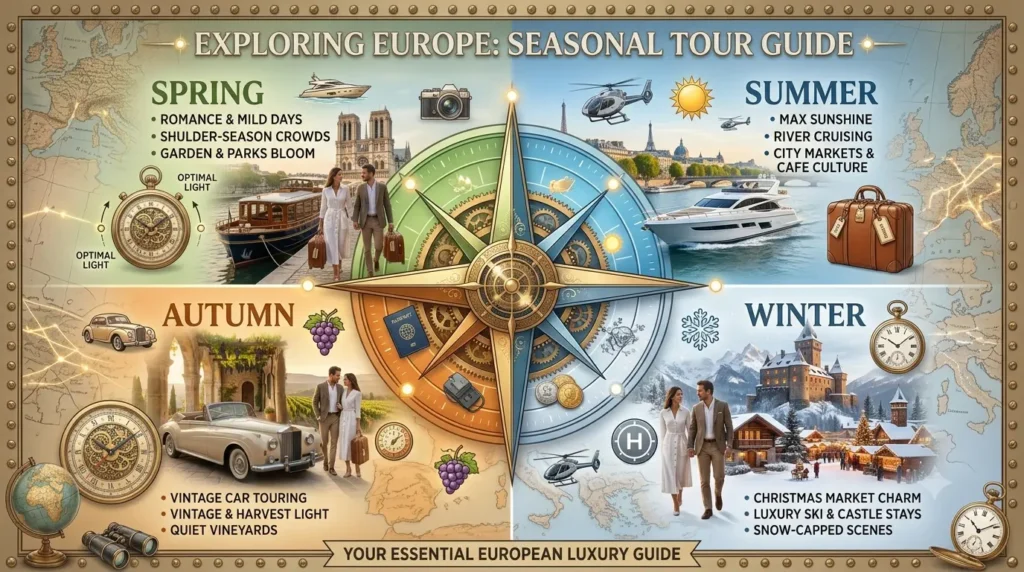
Spring in Europe (April to Early June): Blooms, Light, and Breathing Room
Spring is where Europe’s luxury travel calendar quietly peaks in appeal, even if it doesn’t peak in volume. Gardens across France and the Netherlands are in full bloom, Mediterranean coastal towns are warm enough for long lunches outdoors without yet being crowded, and cities like Paris, Rome, and Vienna offer the rare combination of mild weather and manageable footfall.
By late May, southern coastal Europe — the Amalfi Coast, the Cinque Terre, the smaller Greek islands — starts to warm into swimming-friendly territory while still sitting comfortably below the price and crowd levels of July and August. This stretch of the calendar rewards travelers chasing outdoor experiences: hiking in the Dolomites, wine touring through the Loire Valley, or simply wandering a city with room to actually look up at the architecture instead of the person in front of you.
Easter week is the one exception worth flagging — it draws a genuine surge to religious and cultural sites across the continent, so a luxury itinerary timed around Holy Week benefits from earlier planning and, where possible, private access arrangements.
Summer in Europe (Late June to August): Peak Season, Peak Everything
Summer remains, for good reason, Europe’s most in-demand season — long days, reliably warm weather almost everywhere, and a packed calendar of festivals from Cannes to Munich’s beer gardens. For travelers whose itinerary centers on Nordic or Baltic Europe, summer is genuinely the best window, since the far north’s short season and near-endless daylight make June through August the only realistic time to visit comfortably.
Elsewhere, though, summer is where the trade-offs sharpen. The Colosseum and the Vatican Museums routinely require timed-entry bookings weeks in advance during July and August. Santorini’s caldera-view restaurants fill their sunset seating well before the actual sunset. Hotel rates across the Amalfi Coast, the French Riviera, and central Rome climb to their yearly peak, and availability for the kind of boutique five-star properties luxury travelers prefer can disappear months ahead. None of this makes summer the wrong choice — for beach-and-yacht itineraries along the Riviera or the Greek islands, it’s still genuinely excellent — but it does mean summer trips reward considerably more advance planning than any other season.
Autumn in Europe (September to Late October): The Insider’s Season
Ask a seasoned luxury travel advisor when they’d personally choose to visit Europe, and autumn comes up more often than any other answer. The crowds that build through summer thin out noticeably once European schools return in early September, hotel rates soften, and the Mediterranean coastline stays warm enough for swimming well into the month.
Autumn also delivers something summer can’t: the light. Tuscany’s vineyards turn gold during harvest season, the Loire Valley’s château gardens shift into rich autumn color, and the quality of afternoon light across southern Europe becomes noticeably softer and more atmospheric for photography. Northern Europe’s aurora season begins around the autumn equinox, opening a window for travelers pairing a Nordic extension onto a broader itinerary. By October, weather becomes slightly less predictable in northern regions, but southern and central Europe remain highly workable well into the month — arguably the single best value-to-experience ratio anywhere on the calendar.
Winter in Europe (November to March): Markets, Mountains, and a Different Kind of Luxury
Winter divides sharply by region, and that divide is exactly what makes it interesting for a well-planned luxury tour. Central European cities transform for the Christmas markets in Vienna, Salzburg, and across German towns — an atmosphere entirely built around this season, and one that simply doesn’t exist at any other time of year. Alpine Switzerland and Austria shift into ski season, offering a completely different luxury experience: private chalets, mountain gastronomy, and slopes rather than piazzas.
Meanwhile, major cities like Paris, Rome, and Florence become noticeably quieter and more affordable outside the Christmas and New Year peak, rewarding travelers who want to experience iconic sights without the crowd management that summer requires. It’s a trade: outdoor Mediterranean travel largely pauses, but city-and-culture itineraries, ski trips, and market-season city breaks all perform beautifully.
Matching the Season to Your Itinerary
Because “Europe” spans such different climates and cultural calendars, the honest answer to when depends on what — and travelers planning a multi-country luxury trip need to weigh those priorities against one another rather than picking a single ideal month. A few patterns tend to hold consistently:
- Coastal and Mediterranean-focused trips perform best in late spring or early autumn, avoiding both summer’s crowd peak and winter’s closures.
- City-and-culture itineraries (Paris, Rome, Vienna, Florence) work well nearly year-round but reward autumn and winter timing for comfort and value.
- Alpine and Nordic-focused trips are genuinely season-locked — winter for skiing, summer for Nordic daylight and hiking.
Europe by Region: Climate at a Glance
Because “Europe” isn’t one climate but several stitched together, it helps to think regionally before settling on the best time to visit Europe for your specific itinerary:
- Southern Europe (Italy, Spain, Greece, Portugal): Hot, dry summers and mild, wet winters — meaning spring and autumn deliver the most comfortable sightseeing conditions, while summer suits beach-and-coast itineraries best.
- Central Europe (France, Austria, Switzerland, Germany): Four genuine seasons, with spring and autumn favoring cities and countryside, summer favoring alpine hiking, and winter built around Christmas markets and skiing.
- Northern Europe (Scandinavia, the Baltics, Iceland): A short, intense summer window of long daylight hours for outdoor travel, and a distinct winter season built around aurora chasing rather than city sightseeing.
Recognizing which of these zones your itinerary leans on most heavily is often the single clearest way to identify the best time to visit Europe for the specific countries on your list, rather than defaulting to a generic “spring or fall” answer that may not suit every leg of the trip.
Common Timing Mistakes Worth Avoiding
A few patterns show up repeatedly among travelers planning their first major Europe trip, and they’re worth naming directly. The first is treating “Europe” as a single climate zone and booking a Nordic and Mediterranean leg into the same narrow week — a scheduling choice that almost guarantees one half of the trip lands in the wrong season. The second is underestimating how far in advance popular restaurants, private guides, and boutique hotels book out during July, August, and the two weeks around Christmas, which can force last-minute compromises on properties or availability that don’t match the rest of a luxury itinerary.
The third, more subtle mistake is chasing a single “best month” without accounting for how event calendars reshape a destination overnight — Cannes during its festival, Munich during Oktoberfest, or Rome during a major religious holiday all shift pricing and crowd levels dramatically compared to the weeks immediately before or after. None of these are reasons to avoid those destinations; they’re simply variables worth building into the plan rather than discovering after arrival.
Planning a Luxury Europe Trip from Lebanon
Beirut’s flight connections into major European hubs run reliably year-round, which gives Lebanese travelers real flexibility in choosing dates around experience rather than around limited seasonal routes. That flexibility is worth using deliberately: a family combining Italy and France in early June, for instance, gets noticeably better restaurant availability and hotel rates than the same itinerary run six weeks later in peak July.
Because a multi-country European tour usually means navigating several climate zones and event calendars at once — Cannes’ festival crowds, Easter surges, Oktoberfest bookings, ski-season chalet availability — this is where a travel agency that plans specifically for the Lebanese departure market earns its value: sequencing the itinerary so each leg lands in its own best window, rather than compromising the whole trip around a single fixed travel date.
Frequently Asked Questions
Late spring (April to early June) and early autumn (September to mid-October) consistently offer the best balance of pleasant weather, thinner crowds, and stronger availability at boutique luxury properties.
For heavily visited sites in Italy and Greece, summer does mean timed-entry queues and peak pricing — but for Nordic and Alpine summer destinations, or Riviera-style yacht-and-beach itineraries, it remains an excellent choice.
Late November through late December is the Christmas market window across Austria, Germany, and much of central Europe, with Vienna and Salzburg among the most atmospheric settings.
Yes — autumn is often considered the strongest all-around season, combining thinner crowds, softer light for photography, and warm-enough weather across southern and central Europe well into October.
It can. Honeymoon travelers often prioritize quieter, more intimate shoulder-season windows, while families are frequently anchored to summer school holidays, which is worth factoring into how far in advance a summer luxury itinerary needs to be booked.
Planning a luxury Europe itinerary from Lebanon? Speak with a Fayad Travel destination expert to build a custom trip timed around the season that suits it best.