
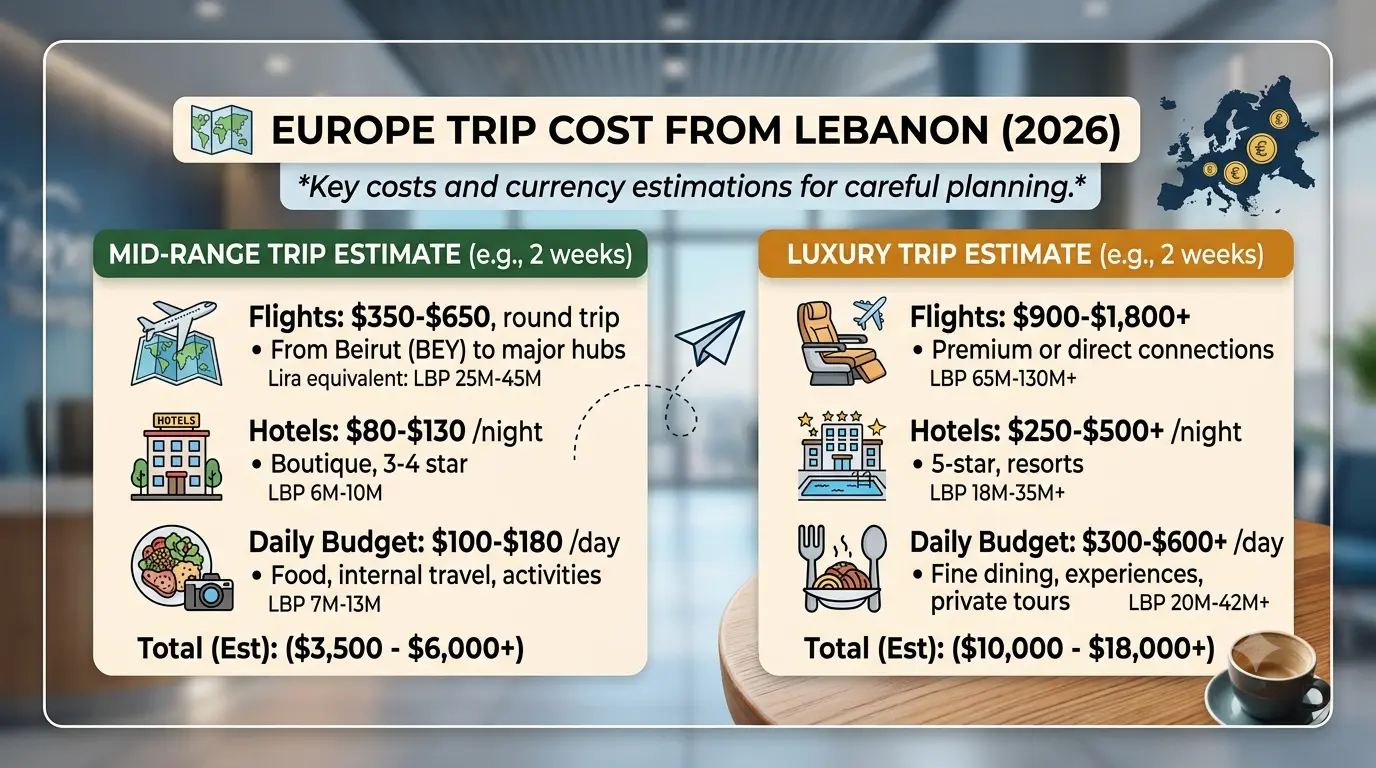
“How much should I budget for Europe?” is one of those questions that doesn’t have a single honest answer — a week in Rome on a mid-range budget and a week in Rome staying at a five-star property with a private guide are barely the same trip, cost-wise, even though the flight and the destination are identical. What follows is a realistic breakdown of where the money actually goes on a Europe trip from Lebanon in 2026, at both a comfortable mid-range level and a genuine luxury level, so you can budget against your actual trip rather than a generic number.
What Actually Drives the Cost?
Five categories make up the overwhelming majority of any Europe trip’s cost: flights, accommodation, food, local transport and activities, and the visa and insurance costs that come with them. Flights and accommodation are usually the two biggest line items, and they’re also the two with the widest swing between a budget-conscious approach and a luxury one — which is why “how much does Europe cost” really has two honest answers rather than one.
Flights from Beirut to Europe
Current fare data shows meaningful variation by destination and season. Round-trip economy fares from Beirut to Paris currently run roughly $250-$350 in lower-demand periods, climbing well above that during summer and holiday peaks. Beirut to Rome runs slightly lower, typically $200-$300 round trip in economy during off-peak windows. Istanbul and other closer hub cities tend to run cheaper still, often under $250 round trip, which is one reason many multi-city European itineraries route through Istanbul.
These figures are for economy class on standard carriers. Premium economy typically runs 1.5-2x the economy fare, and business class on these routes commonly runs $1,500-$3,000+ round trip depending on the airline and how far in advance it’s booked. For a family or couple prioritizing comfort on a 4-5 hour flight, business class is one of the more meaningful “luxury tier” cost jumps in the entire trip, and one worth budgeting for deliberately rather than assuming it’s a small upgrade.
November through February is consistently the cheapest window to fly from Beirut to major European hubs, while July, August, and the December holiday period carry the steepest premiums — sometimes 40-60% above off-peak fares for the same route.
Accommodation: Mid-Range vs Luxury
This is where the two versions of a Europe trip diverge most sharply. A comfortable, well-located 3-4 star hotel in a major Western European city typically runs $120-$220 per night, varying by city — Paris and London sit at the higher end of that range, while cities like Lisbon, Athens, or Budapest run noticeably lower for a comparable standard. A genuine luxury property — five-star, well-located, the kind of hotel built around service rather than just amenities — typically runs $400-$900+ per night in the same cities, with flagship properties in Paris, London, or the Amalfi Coast easily exceeding that during peak season.
The gap isn’t purely about thread counts. At the luxury tier, you’re also paying for location (walking distance to major sights rather than a transit ride away), service level (concierge access, room service, personalized arrangements), and often a more flexible booking policy — all of which matter more on a special-occasion trip than the room itself.
Daily Budget: Food, Local Transport, and Activities
For food, a mid-range traveler eating a mix of casual lunches and one nicer dinner per day should budget roughly $60-$100 per person per day in most major European cities. A luxury-tier traveler dining at well-regarded restaurants regularly, with wine included, should budget closer to $150-$300+ per person per day — a single tasting menu dinner at a well-known restaurant in Paris or Rome can easily run $150-$250 per person before wine.
Local transport is one of the few categories where the mid-range and luxury versions of a trip aren’t wildly different in cost — a multi-day public transit pass typically runs $10-$25 per day, while private transfers and a driver-guide arrangement (more common at the luxury tier) run $150-$350 per half-day depending on the city and vehicle type.
Activities and entrance fees vary enormously by destination and interest — museum entry typically runs $15-$30 per person, while a private guided tour of a major site can run $200-$500 for a small group, well worth it for skip-the-line access and genuine expertise at major sites like the Vatican Museums or the Louvre.
Sample 7-Day Trip Budgets
Mid-range, per person (based on double occupancy, one major Western European city):
- Flights (economy): $280
- Accommodation (7 nights, split): $770
- Food: $560
- Local transport: $105
- Activities: $150
- Estimated total: roughly $1,865 per person
Luxury, per person (based on double occupancy, one major Western European city):
- Flights (business class): $2,200
- Accommodation (7 nights, split): $2,800
- Food: $1,400
- Private transfers and driver-guide: $900
- Activities and private guiding: $600
- Estimated total: roughly $7,900 per person
These figures are illustrative planning ranges rather than fixed quotes — the actual number for any specific itinerary depends heavily on destination, season, and exactly how the days are structured, which is exactly the kind of detail a tailored quote accounts for that a generic budget estimate can’t.
How Costs Compare Across Popular Destinations?
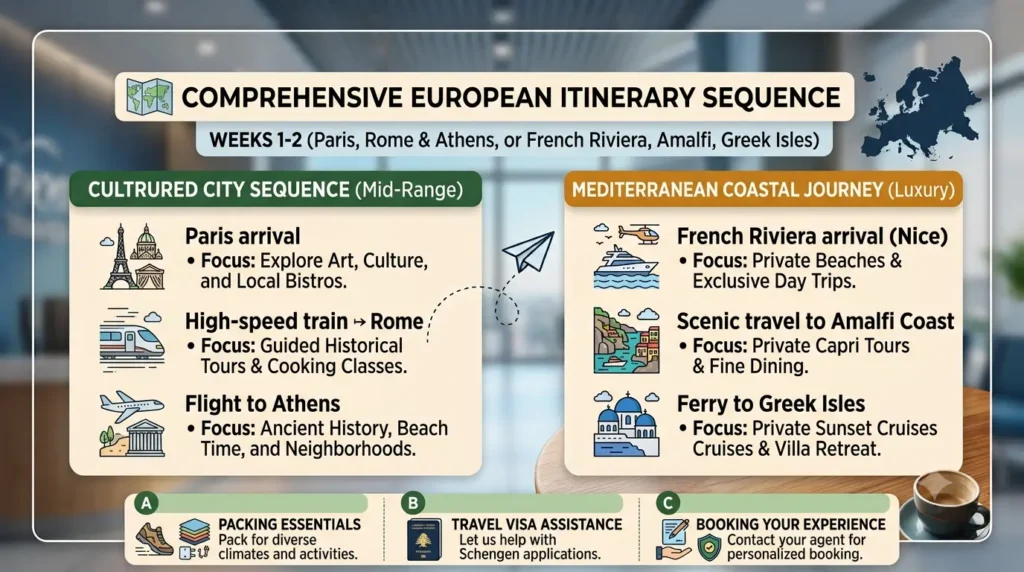
Not all of Europe prices the same, even at a comparable standard of hotel and dining. For Lebanese travelers, a few destinations come up consistently enough to be worth comparing directly:
France (Paris and the Riviera). Consistently at the higher end of the range across every category — flights, hotels, and dining all sit above the Western European average, and a luxury week here tends to land at or above the upper end of the sample budget outlined earlier. The trade-off is that Paris and the Riviera also carry the deepest concentration of five-star properties and Michelin-level dining for travelers specifically seeking that tier.
Italy (Rome, the Amalfi Coast, Venice). Slightly more moderate than France on flights and comparable on luxury accommodation, though mid-range hotels in Rome and Venice can actually run higher than expected during peak season due to limited inventory in historic centers. The Amalfi Coast in particular carries a significant summer premium, with accommodation pricing that can double between shoulder season and August.
Greece (Athens and the islands). Generally more accessible on accommodation than France or Italy at a comparable standard, though island-hopping adds ferry or short-flight costs that a single-city Western European trip doesn’t have. Santorini and Mykonos luxury properties during peak summer are an exception — pricing there can rival or exceed Riviera rates for the most sought-after clifftop suites.
Switzerland and Austria. Among the most expensive destinations in Western Europe for food and local transport specifically, even when flights and hotel rates are comparable to France or Italy — a function of the overall cost of living rather than tourism pricing specifically. Worth budgeting food costs here noticeably above the ranges given earlier.
Spain and Portugal. Consistently the best value among major Western European destinations at both budget tiers, with mid-range and luxury accommodation alike running below equivalent properties in France or Italy, making these strong choices for travelers wanting a luxury standard without the Riviera-level price tag.
Costs That Are Easy to Forget
Schengen visa costs. Beyond the visa fee itself, factor in mandatory travel insurance meeting the Schengen area’s €30,000 minimum coverage requirement, and the visa center’s service fee — covered in detail in our Schengen visa guide.
Travel insurance beyond the visa minimum. The Schengen-mandated minimum is a floor, not a comprehensive policy — trip cancellation, baggage, and higher medical coverage limits typically cost more and are worth considering separately, especially for a higher-value luxury trip.
Currency conversion and card fees. Foreign transaction fees on Lebanese-issued cards can add up over a week of daily spending; a travel-friendly card or pre-loaded currency card meaningfully reduces this hidden cost.
Tipping norms. Tipping expectations vary significantly by country — service is often included in France and Italy, while other destinations expect a more explicit tip, and getting this wrong in either direction is an easy oversight.
Airport transfers on arrival. A private transfer from a major European airport into the city center can run $60-$150 depending on the city and distance, a cost that’s simple to underbudget when planning around flight and hotel prices alone.
Why Timing Changes the Math So Much?
The same 7-day Western Europe trip can cost meaningfully more or less depending purely on when it’s booked. Flying and staying during peak summer months or the December holidays can push both flight and hotel costs 30-50% above the ranges above, while shoulder-season travel — April-May or September-October in most of Western Europe — often delivers comparable weather with noticeably better pricing on both fronts. For travelers with flexibility on dates, this single decision often has more impact on the total trip cost than any other single choice.
Getting More Value Without Cutting Quality
The biggest lever for a mid-range traveler looking to stretch a Europe budget further is usually timing — shoulder-season travel and mid-week flights routinely deliver 20-30% savings without changing the actual experience. For a luxury traveler, value tends to come less from cutting corners and more from sequencing: booking accommodation and private guiding as a package rather than piecemeal, choosing destinations with strong exchange-rate value relative to Western Europe’s priciest cities, and building a realistic day-by-day plan that avoids the wasted cost of an itinerary that’s trying to do too much in too little time.
This is, in practice, where a tailored quote earns its value over a generic online estimate — a well-sequenced itinerary at either budget level usually costs less than the sum of its parts booked separately, purely because timing, routing, and bundling are handled together rather than each booked in isolation.
Frequently Asked Questions
How much does a 7-day trip to Europe cost from Lebanon? A mid-range 7-day trip typically runs around $1,800-$2,000 per person including flights, hotels, food, and activities. A genuine luxury version of the same trip, with business-class flights and five-star accommodation, typically runs $7,000-$9,000+ per person.
What’s the cheapest time to fly from Beirut to Europe? November through February is consistently the lowest-fare window for most major European routes from Beirut, while July, August, and the December holiday period carry the steepest premiums.
Is accommodation or flights the bigger cost on a Europe trip from Lebanon? For a multi-night stay, accommodation usually edges out flights as the larger total cost at both budget levels, though the gap narrows considerably if booking business-class flights.
Do visa costs add significantly to a Europe trip budget? The Schengen visa fee itself is a modest line item, but mandatory travel insurance and the visa center’s service fee add up, and are easy to underbudget if planning around flights and hotels alone.
Is it cheaper to book a Europe trip as a package rather than separately? Often yes, particularly at the luxury tier — bundling accommodation, transfers, and guided experiences together typically costs less than booking each piece independently, since it avoids the premium pricing that comes with last-minute, piecemeal bookings.
Ready to see real numbers for your trip? Request a tailored quote from Fayad Travel and get an itinerary priced to your actual budget.