

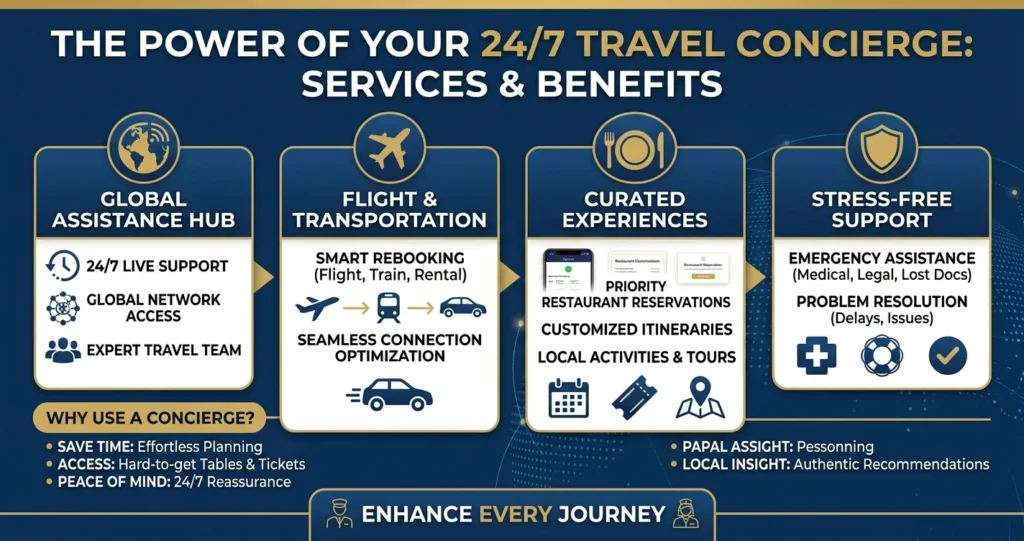
“Travel concierge” is one of those phrases that shows up constantly in luxury travel marketing without much explanation of what it actually means day to day. It isn’t a single service so much as a standing relationship — someone reachable at any hour who can solve a problem, make a reservation, or rework a plan while a trip is actually happening, rather than only before it starts. This guide covers what a 24/7 travel concierge service genuinely does, with concrete examples of the situations where it matters most.
Real-Time Rebooking When Plans Change
This is often the single most valuable function a 24/7 travel concierge service provides, precisely because disruptions rarely happen during convenient business hours.
Handling a Cancelled or Delayed Flight
When a flight gets cancelled or delayed mid-trip, a concierge can work the rebooking directly — searching alternate routes, holding a new reservation, and coordinating any knock-on changes to hotels or transfers — while the traveler continues with their day rather than standing in an airline rebooking line.
Adjusting an Itinerary on Short Notice
If a traveler decides to extend a stay, skip a planned stop, or add an unplanned destination mid-trip, a concierge can rework hotel bookings, transfers, and any pre-arranged activities to match the new plan, handling the coordination that would otherwise fall entirely on the traveler.
Restaurant Reservations and Local Access
Securing a Table at a Fully Booked Restaurant
A concierge’s local relationships and standing arrangements with restaurants, particularly in destinations where the best tables book out weeks in advance, can sometimes secure a reservation that wouldn’t be available through a standard booking platform.
Arranging Experiences Beyond Standard Booking Platforms
Beyond restaurants, a concierge can arrange private guides, last-minute event tickets, or access to experiences not listed on public booking sites, drawing on relationships built specifically for this kind of on-the-ground problem-solving.
Emergency Support When Something Goes Wrong
Medical or Safety Situations Abroad
If a traveler faces a medical issue, a safety concern, or any situation requiring immediate local knowledge, a 24/7 concierge provides a single point of contact who can coordinate emergency support, communicate with local authorities or medical providers, and keep family back home informed if needed.
Lost Documents or Personal Items
A concierge can also help navigate the process of replacing a lost passport, arranging emergency funds, or dealing with lost luggage — situations that are considerably more stressful to handle alone in an unfamiliar destination without local language skills or knowledge of the right offices to contact.
Proactive Support, Not Just Reactive Problem-Solving
Monitoring a Trip Before Issues Arise
A genuinely good concierge service doesn’t wait for a traveler to call with a problem — proactively monitoring flight status, weather disruptions, and local conditions at the destination means issues can sometimes be resolved or flagged before the traveler even notices something’s wrong.
Anticipating Needs Based on Traveler Preferences
For repeat clients specifically, a concierge familiar with a traveler’s preferences can anticipate needs — a preferred seat type, a dietary restriction communicated to a restaurant in advance, a specific room configuration — without needing to be reminded each time.
What a Concierge Doesn’t Replace?
It’s worth being clear-eyed about the limits of a 24/7 travel concierge service, since overestimating what it covers can leave a real gap in protection.
Not a Substitute for Travel Insurance
A concierge can coordinate and advocate during a medical or safety emergency, but it doesn’t replace the financial coverage travel insurance provides — the two work together, with the concierge handling logistics and communication while insurance covers the actual costs involved.
Not a Guarantee of Availability
Even the best-connected concierge can’t guarantee a fully booked restaurant will always have room, or that a cancelled flight will always have an immediate alternative — the value lies in maximizing the odds and handling the process efficiently, not in eliminating every possible disruption.
How Travelers Typically Access the Service?
Bundled Into a Trip vs. Standalone Add-On
Some travel agencies bundle 24/7 concierge access into a broader package for a specific trip, while others offer it as a standalone add-on that can be attached to any booking regardless of how the rest of the trip was arranged.
Communication Channels
Most concierge services offer multiple ways to reach support — phone, messaging apps, or email — recognizing that a traveler dealing with a middle-of-the-night flight cancellation needs a fast, low-friction way to make contact rather than navigating a formal support ticket system.
A Realistic Scenario Walkthrough
The Situation
Consider a traveler mid-trip whose connecting flight gets cancelled late in the evening, with the next available commercial option not until the following afternoon, threatening to derail the rest of a tightly scheduled itinerary.
How a Concierge Handles It?
Rather than the traveler navigating the airline’s own rebooking queue, a concierge can simultaneously search alternate routings across other carriers, hold a backup option, arrange an extra hotel night if needed, and notify any downstream bookings (a tour guide, a restaurant reservation) that the schedule has shifted — compressing what could be hours of stressful, solo problem-solving into a single phone call.
Who Actually Uses This Service?
Frequent Luxury Travelers
Travelers who take multiple significant trips per year often find the standing relationship with a concierge pays for itself over time, given how often small disruptions or last-minute needs come up across several trips annually.
Travelers on High-Stakes or Complex Trips
For a honeymoon, a milestone celebration, or a complex multi-country itinerary, having a concierge available throughout the trip provides meaningful reassurance, even for travelers who wouldn’t otherwise use the service regularly.
Concierge Support for Families and Groups
Coordinating Changes Across a Larger Party
For a family or group trip, a mid-trip disruption affects everyone traveling together, and a concierge coordinating the fix for the whole group — rather than each traveler independently contacting airlines or hotels — keeps the group’s plans aligned rather than fragmenting into individual scrambles.
A Single Point of Contact During a Complex Trip
Particularly for a multi-generational trip or a large group with varying needs, having one concierge contact who already understands the full itinerary’s context produces faster, more coordinated solutions than each traveler managing their own piece of a shared disruption.
Frequently Asked Questions
A travel concierge handles real-time itinerary changes, secures restaurant reservations and local experiences, provides emergency support if something goes wrong, and proactively monitors a trip for potential disruptions before they become problems.
While often marketed toward luxury travelers, the service is generally offered as an add-on rather than requiring a specific income level, making it accessible to any traveler willing to pay for the added support and peace of mind.
No — a concierge coordinates logistics and provides support during a disruption or emergency, while travel insurance covers the actual financial costs involved; the two serve complementary rather than overlapping roles.
Often, yes, through established local relationships, though this isn’t guaranteed for every restaurant or every date, particularly during a destination’s busiest periods.
Frequent luxury travelers and anyone on a high-stakes or complex trip — a honeymoon, a milestone celebration, or a multi-country itinerary — tend to get the most value from having a concierge available throughout the trip.
Want the reassurance of round-the-clock support on your next trip? Speak with a Fayad Travel destination expert about adding a 24/7 concierge to your itinerary.